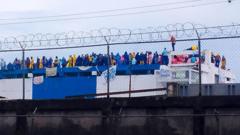
The smoke rising from the Barinas penitentiary in western Venezuela is not an isolated incident of unrest. It is the visible symptom of a profound systemic collapse.
When more than a thousand inmates occupied the roof of the facility, burning mattresses and hanging desperate "SOS" banners, international media quickly labeled the event as a standard localized riot over poor conditions. That interpretation misses the entire point. The current wave of violence across the Venezuelan penitentiary complex is the direct, volatile byproduct of an unprecedented geopolitical shift: the recent fracturing of the state's central authority under acting president Delcy Rodríguez and the chaotic, selective rollout of a massive political prisoner amnesty.
Venezuelan prisons are no longer just warehouses for the condemned. They have transformed into highly politicized pressure cookers where common criminals, leftover gang networks, and hundreds of forgotten political detainees are competing for survival against an increasingly desperate, militarized guard apparatus.
The Illusion of Reform
To understand why Barinas exploded, one must look at what happened in Caracas earlier this year. Following the dramatic political upheaval of January 2026, the interim administration announced a sweeping amnesty law, promising the rapid release of hundreds of high-profile political prisoners. Figures like activist Rocío San Miguel walked out of confinement, captured by international television crews.
The state used these releases to project a image of humanitarian transition and to ease foreign pressure. Behind the headlines, however, the administration implemented a strict "revolving door" policy. While some political detainees left through the front gate, security forces continued to arrest local dissidents to maintain leverage.
More importantly, this selective freedom completely ignored the general prison population. The vast majority of Venezuela’s estimated 30,000 to 50,000 inmates remain trapped in facilities that resemble medieval dungeons more than correctional institutions. When the state proved it could empty cellblocks overnight for political expedience, the remaining inmates realized that legal channels were entirely useless. Violence became their only viable mechanism for negotiation.
The Fall of the Gang Kings and the Vacuum of Power
For over a decade, the Venezuelan state maintained a cynical, stable status quo inside its penal system by outsourcing control to pranes—powerful prison gang bosses. Under this arrangement, infamous complexes like the Tocorón prison became autonomous fiefdoms. The Tren de Aragua mega-gang ran a transnational criminal empire from inside a facility equipped with its own swimming pools, nightclubs, and concrete bunkers.
The government’s heavily publicized military takeovers of these fortresses stripped away that criminal infrastructure but offered no viable substitute. The state dismantled the pran system without addressing the underlying rot.
Without the brutal internal discipline imposed by gang bosses, and with the Ministry of Penitentiary Services failing to provide basic necessities, a dangerous power vacuum emerged. The state attempted to fill this void with sheer tactical force, deploying National Guard units armed with riot shields and live ammunition to manage starved, desperate populations.
The results have been consistently fatal. Just weeks before the Barinas uprising, a major clash at the maximum-security Yare III prison outside Caracas left five inmates dead. The ministry claimed the facility was designed to hold gang leaders, but human rights advocates confirmed that several political prisoners awaiting amnesty were caught in the crossfire. The official narrative blamed the violence on a routine transfer of detainees. The reality is that the state is shuffling bodies across an overcrowded network to hide its complete loss of logistical control.
| Prison Facility | Recent Incident | Reported Causes and Conditions |
|---|---|---|
| Barinas Prison | Roof occupation, mattress fires | Alleged guard shootings, zero visitation, systemic torture |
| Yare III | Lethal armed clash (5 dead) | Power vacuum following inmate transfers, mixing of populations |
| El Rodeo I & II | Hunger strikes, fatal medical neglect | Severe respiratory illness, lack of potable water, zero medical care |
The Mechanics of Attrition
The immediate catalyst for the Barinas rebellion was a localized demand for the removal of the prison’s director, whom inmates accused of ordering guards to fire on unarmed groups. A video smuggled out by the Venezuelan Observatory of Prisons showed an inmate with an open bullet wound to the chest, surrounded by terrified cellmates.
The deeper provocation is a deliberate strategy of isolation. Inmates reported that guards confiscated their clothing, cut off communication, and banned all family visits. In a system where the state does not provide adequate food or clean water, cutting off family visits is not a disciplinary measure. It is a death sentence by starvation.
Outside the gates of these facilities, the crisis takes a devastating toll on families. Mothers, wives, and sisters gather daily in the dust, facing down National Guard riot shields. They are not there to protest judicial rulings; they are begging for proof of life. Because the ministry routinely refuses to publish casualty lists or medical logs, families must wait for sporadic, smuggled phone calls to learn if their relatives survived the night.
At the El Rodeo complex, the situation has degraded from overt violence into quiet, systematic neglect. The Venezuelan Prison Observatory recently documented two deaths within a 24-hour window in Module 4 of El Rodeo. Both inmates died of respiratory failure brought on by untreated tuberculosis and malnutrition.
The state's response to these crises is entirely predictable. Following a brief protest by foreign inmates at El Rodeo, the Public Prosecutor’s Office conducted a staged walk-through and declared that all protocols complied with international human rights standards. This bureaucratic theater ignores the observable reality on the ground: extreme overcrowding, non-existent medical personnel, and an absolute lack of potable water.
A Broken System Beyond Repair
The interim government under Delcy Rodríguez lacks the capital, the infrastructure, and the political will to reform this network. The Ministry of Penitentiary Services operates on a philosophy of containment through containment failure—allowing diseases and internal violence to naturally reduce the prison population while using tactical units to crush any resistance that spills over the walls.
The international community remains focused on high-level political negotiations and macroeconomic indicators in Caracas. If this focus does not expand to include the systemic collapse of the penal architecture, the fires seen in Barinas will spread to every major facility across the country. The state cannot build a stable transition on top of a subterranean network of torture chambers and starvation camps. The immediate dismissal of corrupt penal directors and the entry of independent international medical observers are no longer idealistic humanitarian goals. They are structural necessities required to prevent a total, bloody collapse of domestic security.