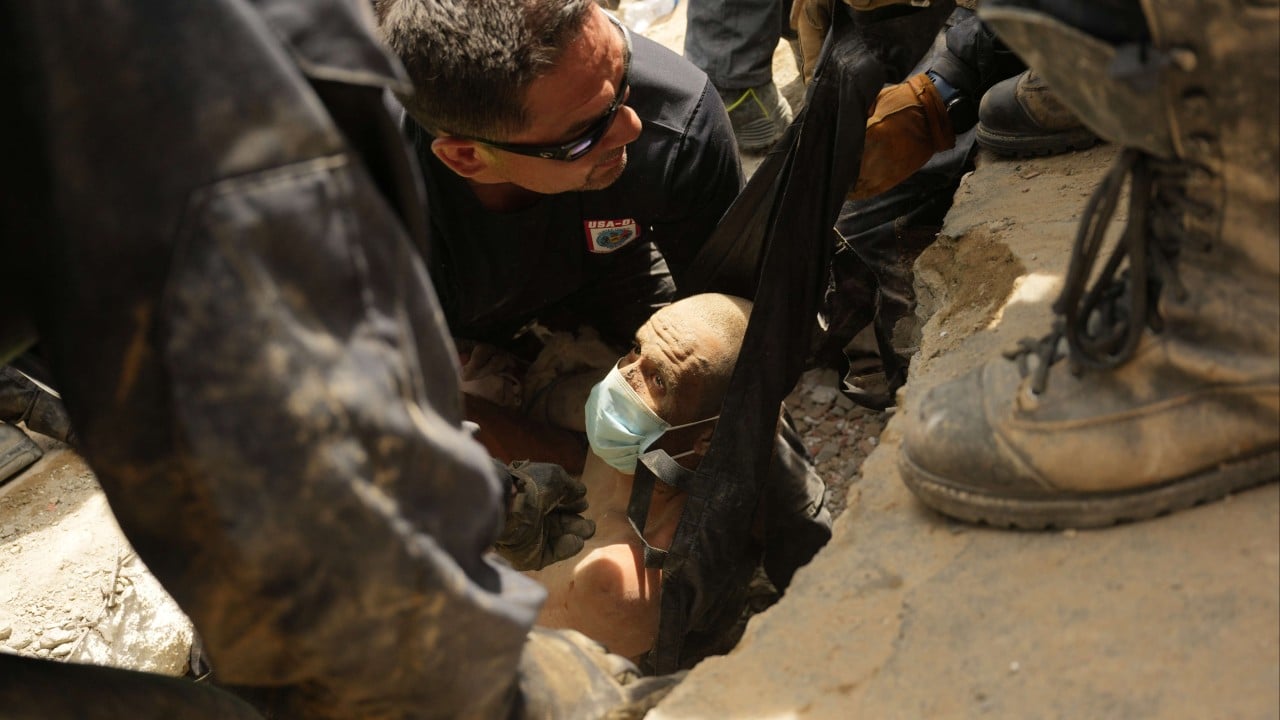
The pull of a father and son from the pancaked layers of a concrete high-rise in Caraballeda offered a brief, televised burst of hope. Days after twin 7.2 and 7.5 magnitude earthquakes shattered north-central Venezuela, the extraction of survivors past the critical 72-hour mark feels miraculous. But individual miracles cannot mask a systematic catastrophe. The harsh reality on the ground is that the search-and-rescue operation is failing to reach thousands of trapped victims due to broken local infrastructure, a decade of economic decay, and bureaucratic bottlenecks that stalled foreign aid during the most critical hours of the disaster.
While state broadcasts focus on dramatic pull-outs, the numbers paint a far darker picture. Over 1,700 people are confirmed dead, thousands are injured, and tens of thousands remain missing under the debris of communities like Catia La Mar and La Guaira. The golden hour for rescue has closed. What remains is a desperate, uneven race against time, hampered by a reality that goes ignored in political speeches.
Structural Decay Meets Seismic Shock
The twin quakes that hit Yaracuy state and tore through the coastal spine of Venezuela were the strongest the country has seen in more than a century. Yet the sheer scale of the destruction is not merely a natural phenomenon. It is an engineering failure.
During the construction booms of the past few decades, building codes in coastal areas like La Guaira were routinely ignored. High-density residential blocks, including many within the state-built Urbanismo Hugo Chavez complex, were constructed with substandard materials and poor structural reinforcement. When the earth shook for nearly three minutes, these buildings did not sway. They pancaked, trapping thousands in compressed spaces with zero air pockets.
EARTHQUAKE SEQUENCE IMPACT (JUNE 24, 2026)
--------------------------------------------------
Foreshock:        Magnitude 7.2
Mainshock:        Magnitude 7.5 (39 seconds later)
Depth:            10–22 km (Shallow)
Confirmed Dead:   1,719+
Missing/Trapped:  Tens of thousands
The physical nature of these collapses makes heavy machinery vital. Yet, specialized hydraulic shears, listening devices, and search cameras were almost non-existent in the initial 48 hours. Local civil defense teams, hollowed out by years of underfunding and brain drain, lacked basic fuel for vehicles and functional gear.
The Logistics Bottleneck
International rescue teams from the United States, France, and Mexico have since arrived, but their deployment highlights a deep logistical failure. By the time foreign crews established operational bases in La Guaira, the 72-hour survival window was already shutting down.
The state of emergency found Venezuela with a paralyzed domestic transport network. Major roadways connecting Caracas to the coast were blocked by landslides or severed by fissures. International airports closed immediately after the quakes, forcing initial rescue flights to reroute or delay landing.
"We have the personnel and the dogs, but we spent twelve hours waiting for a secure transport corridor to move equipment forty kilometers," notes a foreign responder who spoke on condition of anonymity. "In a collapse scenario, twelve hours is the difference between a rescue and a recovery."
While acting President Delcy Rodriguez praised the arrival of hundreds of tons of supplies, distribution remains highly centralized and deeply political. In neighborhoods like San Bernardino, civilian volunteers are left to clear heavy slabs of concrete using basic hammers and bare hands. The lack of coordination means specialized international teams are sent to high-profile sites while poorer, secondary collapse zones receive no official attention at all.
A Broken Health System Under Siege
Finding a survivor under the rubble is only half the battle. Surviving the rescue is the next hurdle, and Venezuela’s healthcare system is structurally unequipped for the influx of trauma patients.
Long before the June 24 disaster, over 90% of Venezuelan households faced acute shortages in basic services, and the public medical system operated on a shoestring budget. Now, the Pan American Health Organization reports that dozens of emergency hospitals are located in the high-intensity shaking zones. Many of these facilities suffered structural damage themselves or lost municipal power and water supply instantly.
The medical crisis is defined by specific, immediate deficiencies:
- Surgical Backlogs: A complete lack of orthopedic hardware and neurosurgical equipment to treat crush syndrome.
- Resource Depletion: Hospitals in Caracas are operating without basic intravenous rehydration fluids, antibiotics, and anesthetic agents.
- Staff Exhaustion: Local doctors and nurses, many affected by the disaster themselves, are working 36-hour shifts without relief.
When a patient is pulled from the debris after 100 hours, they require immediate, complex metabolic management to prevent kidney failure caused by crush syndrome. Without the necessary medication and continuous dialysis equipment, individuals who survive the physical collapse are dying hours later on makeshift hospital floors.
The Mirage of Coordinated Aid
Diplomatic breakthroughs, including discussions between U.S. officials and the Venezuelan administration, look clean on paper. On the ground, they are messy. Over 2,700 rescue personnel are in the country, but there is no unified command structure.
The lack of a centralized digital registry for missing persons has forced families to resort to desperate measures. In Chacao, commercial electronic billboards flash the faces of the missing. Outside hospitals, crowds gather to scan handwritten lists taped to walls, hoping to find a relative who might have been admitted anonymously. This administrative void breeds chaos, as multiple rescue teams are sometimes dispatched to the same site while nearby collapses remain completely ignored.
The focus will inevitably shift from rescue to recovery as the days press on. The economic cost of rebuilding almost 200 destroyed high-rise structures and restoring a shattered power grid will run into billions for a country already locked out of international financial markets. The survival of a few individuals shows human resilience, but the thousands still buried beneath the concrete of La Guaira are the true indicator of a state completely unprepared for the inevitable.


