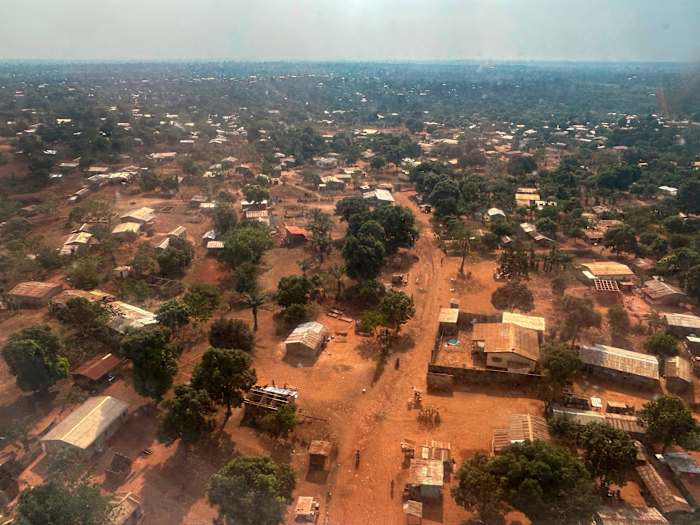
A chartered ICE Air flight departed from Alexandria, Louisiana, carrying an assortment of human collateral that the United States government could not legally return to their home countries. Among them was a female Iranian pro-democracy activist who had fled Tehran, sought safe haven in America, and successfully convinced a U.S. immigration judge that she faced a clear probability of torture or death if sent back to Iran.
Instead of finding safety, she was dropped on a tarmac in Bangui, the capital of the Central African Republic. She has no family there. She does not speak Sango or French. She has never set foot on the continent of Africa.
This transfer is part of an aggressive, quietly expanding mechanism devised by the Trump administration to execute a sweeping immigration crackdown. By leveraging secretive bilateral agreements, the U.S. government is bypassing domestic legal protections by outsourcing its deportation pipeline to impoverished, conflict-torn nations. The arrival of an Iranian dissident in Bangui exposes a gaping loophole in the American asylum system. It is a legal maneuver that satisfies domestic deportation statistics while abandoning vulnerable individuals in regions the State Department explicitly warns Americans not to visit under any circumstances.
The Loophole of Withholding of Removal
To understand how a pro-democracy activist from Tehran ends up in a central African war zone, one must examine the fine print of American immigration law. The deportees sent to Bangui held a specific legal status known as withholding of removal.
Unlike standard asylum, which offers a direct path to permanent residency and citizenship, withholding of removal is a defensive, hyper-technical form of protection. To win it, an applicant must meet a significantly higher burden of proof than standard asylum. They must demonstrate a "clear probability"—greater than a 50 percent chance—that their life or freedom would be threatened in their native country due to race, religion, nationality, political opinion, or membership in a particular social group.
When a judge grants withholding, the ruling is explicit. The United States is legally barred from deporting that individual to their country of origin.
However, immigration enforcement officials have seized upon a critical, long-dormant distinction. The order protects the individual from being sent to their specific country, but it does not protect them from being sent to a third country. Historically, this option was rarely used because foreign nations seldom volunteer to accept random, non-citizen deportees who possess no local ties or legal status.
That historical norm has been dismantled. By establishing agreements with foreign governments willing to accept these third-country nationals, immigration authorities can clear out backlogged detention facilities and boost removal numbers without technically violating the judicial orders forbidding repatriation to Iran, Afghanistan, or Syria.
Cash Tariffs and Sovereign Coercion
The Central African Republic is not an isolated case. It is one of at least nine African nations—including South Sudan, the Democratic Republic of the Congo, Uganda, and Ghana—and over a dozen Latin American countries that have quietly capitulated to Washington’s demands.
The agreements are rarely publicized. They are hammered out through a mixture of aggressive diplomatic leverage, threats of punitive tariffs, visa restrictions on foreign elites, and direct financial incentives disguised as international development aid. For an impoverished nation like the Central African Republic, where one in three citizens lives on less than two dollars a day despite vast gold and diamond reserves, accepting a few dozen foreign nationals in exchange for U.S. diplomatic concessions or financial backing is viewed by local authorities as a transaction worth making.
Yet, the operational reality on the ground presents severe security concerns. The State Department maintains a Level 4 "Do Not Travel" advisory for the Central African Republic, citing rampant violent crime, kidnapping, civil unrest, and active insurgencies. The advisory instructs American citizens currently in the country to draft a will, formulate a "proof of life" protocol, and leave DNA samples with medical providers.
The irony is stark. The American government deems the environment too dangerous for its own citizens to step foot in, yet views it as an acceptable dumping ground for foreign political dissidents who turned to the U.S. for protection.
The Geopolitical Pipeline Back to Tehran
The immediate physical danger of a conflict zone is only the first layer of risk for these deportees. For an Iranian pro-democracy activist, being left in Bangui introduces a distinct, lethal geopolitical threat.
The Central African Republic has spent years operating under heavy Russian security influence. The Kremlin-backed Wagner Group (now rebranded and operating under direct Russian state control) serves as the primary security apparatus for President Faustin-Archange Touadéra, protecting the regime from rebel factions in exchange for lucrative mining concessions.
Moscow maintains an exceptionally close military, intelligence, and diplomatic alliance with Tehran. The proximity of Russian intelligence networks to a defenseless Iranian dissident in a country with weak institutional guardrails creates a direct pipeline for identification, tracking, and potential extra-legal repatriation.
Immigration attorneys and human rights monitors are sounding alarms that these third-country placements are merely a pitstop on a longer, forced journey back to the torture chambers the deportees originally fled. Once an individual is abandoned in Bangui without legal status, passports, or a support network, local authorities face little international scrutiny if they choose to deport them onward to their home countries to satisfy foreign allies.
Defending the Enforcement Mandate
The administration defends these third-country agreements as a lawful, necessary tool to preserve the integrity of U.S. borders and deter unlawful immigration. From an enforcement perspective, the argument is straightforward: the United States cannot become a permanent sanctuary for every individual who claims a fear of their home country, particularly when their initial entry may have bypassed official channels.
Proponents of the policy argue that withholding of removal was never intended to grant a permanent right to reside in the United States. It was designed as a temporary shield against immediate refoulement—the forcible return of refugees to a country where they face persecution. By securing third-country destinations, the government argues it fulfills its treaty obligations under the 1951 Refugee Convention while exercising its sovereign right to remove non-citizens from American soil.
Furthermore, officials suggest that these arrangements incentivize regional cooperation and distribute the global migration burden across a broader network of states. From a purely administrative standpoint, the policy functions precisely as intended. It removes individuals from domestic detention spaces, lowers costs, and signals a zero-tolerance approach designed to discourage future migrants from making the journey to the southern border.
The Reality of Outsourced Asylum
The legal framework may hold up under strict administrative scrutiny, but the logistical execution borders on abandonment.
When a deportation flight lands in Bangui or Juba, there are no integration programs waiting. There are no housing vouchers, language classes, or legal pathways to local citizenship. The deportees are handed over to local immigration authorities who are frequently unbriefed on the specifics of the U.S. agreements, leaving individuals to navigate a fragile state on their own.
+---------------------------+-----------------------------------+-----------------------------------+
| Country of Origin         | US Legal Status Achieved          | Forced Third-Country Destination  |
+---------------------------+-----------------------------------+-----------------------------------+
| Iran                      | Withholding of Removal Granted    | Central African Republic          |
| Afghanistan               | Withholding of Removal Granted    | Central African Republic / Uganda |
| Turkey                    | Withholding of Removal Granted    | Ghana                             |
| Syria                     | Withholding of Removal Granted    | Democratic Republic of Congo      |
+---------------------------+-----------------------------------+-----------------------------------+
This shifting of administrative responsibility represents a structural overhaul of international human rights norms. By converting asylum into a commercialized commodity traded between wealthy nations and developing states, the U.S. is pioneering a blueprint that weakens the very definition of international protection.
The activist from Iran who landed in Bangui is not an anomaly. She is the proof of concept for a globalized, outsourced deportation apparatus designed to operate far beyond the reach of American courts.


