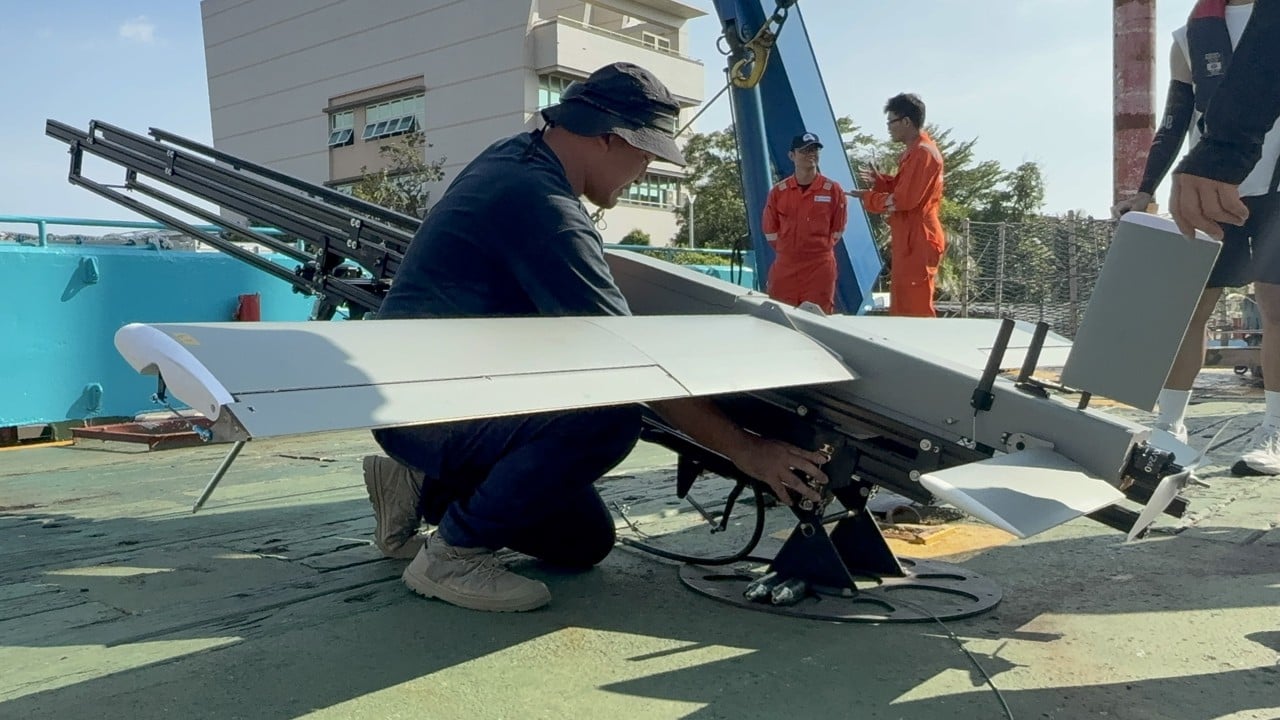
Taiwan is aggressively building thousands of autonomous unmanned systems—spanning aerial drones, uncrewed surface vessels, and underwater submersibles—to counter Beijing’s relentless grey-zone warfare without triggering a full-scale shooting war. For years, Taipei relied on billion-dollar fighter jets and massive naval destroyers to deter the People's Liberation Army (PLA). That math no longer works. Every time a Chinese military aircraft crosses the median line of the Taiwan Strait or a coast guard cutter harasses a Taiwanese vessel near Kinmen, Taipei burns through millions of dollars in fuel, maintenance, and pilot hours just to shadow them.
By shifting toward cheap, expendable, and networked autonomous swarms, Taiwan aims to flip the cost-exchange ratio back in its favor. Instead of scrambling an F-16V to monitor a low-cost Chinese reconnaissance drone, Taipei can deploy an automated, persistent surveillance net that watches, tracks, and documents Beijing’s encroachments around the clock at a fraction of the price.
The Exhaustion Trap of Grey-Zone Tactics
To understand why Taiwan is rewriting its defense procurement playbook, you first have to look at the mechanics of grey-zone coercion. Beijing does not need to launch an amphibious invasion to weaken Taiwan. It only needs to exhaust the island’s military readiness, fray the nerves of its population, and normalize a permanent Chinese military presence in waters and airspace Taipei considers its own.
Over the past several years, the PLA and the China Coast Guard have perfected a strategy of continuous, low-intensity pressure. This includes daily air defense identification zone (ADIZ) incursions, high-altitude spy balloons drifting over the island, sand dredging vessels eroding Taiwan’s outlying coastlines, and maritime militia boats swarming disputed reefs. Each individual incident falls just below the threshold that would justify a kinetic military response from Taipei or trigger direct intervention from Washington.
Yet the cumulative effect is brutal. Traditional military hardware is built for high-intensity conflict, not endless policing. Fighter engines have finite lifespans. Naval hulls require dry-dock maintenance. Pilots and sailors suffer fatigue. When a modern military uses exquisite, multi-million-dollar platforms to chase down cheap commercial-grade drones or civilian-flagged fishing trawlers, the defender loses a war of attrition before a single shot is fired.
The Asymmetric Math Problem
Defense planners in Taipei have spent the last decade debating the Porcupine Strategy—the concept of turning Taiwan into an indigestible target bristling with mobile missiles, sea mines, and portable air defenses. While those weapons are designed to stop an invasion fleet on D-Day, they do almost nothing to solve the Tuesday morning headache of three Chinese coast guard ships idling six nautical miles off Penghu.
You cannot fire a Harpoon anti-ship missile at a coast guard cutter conducting an "inspection" patrol. You cannot shoot down a weather balloon with a Patriot interceptor without looking disproportionate and depleting vital war stocks. Taiwan needed a middle tier of deterrence—something persistent, non-lethal, scalable, and cheap enough to lose without flinching.
How Autonomous Swarms Change the Equation
An autonomous swarm is not merely a collection of remote-controlled drones flying in formation. In a traditional setup, one human operator flies one drone via a direct radio link. That model fails instantly in a contested electromagnetic environment, where jamming severs the connection, and it fails economically because you still need thousands of trained pilots.
True autonomy relies on edge computing, onboard sensors, and mesh networking. Individual units—whether flying at 5,000 feet or skimming the waves of the Taiwan Strait—communicate with one another to share targeting data, divide up search sectors, and adapt to losses in real time. One human operator at a command console acts as a mission supervisor, setting boundaries and rules of engagement while the software handles navigation, collision avoidance, and target tracking.
Maritime and Aerial Applications
In the grey-zone context, Taiwan’s emerging unmanned architecture serves three distinct operational functions:
- Persistent Maritime Domain Awareness: Uncrewed surface vessels (USVs) equipped with electro-optical cameras, radar, and acoustic sensors can patrol the median line for days or weeks without fuel or crew constraints. When a Chinese maritime militia fleet assembles, a swarm of small USVs can shadow the vessels, broadcast high-definition video back to Taipei, and expose Beijing’s actions to international media in real time.
- Counter-Drone Screening: When PLA reconnaissance drones probe Taiwan’s outlying islands like Matsu or Kinmen, automated aerial interceptors can launch within seconds. Rather than firing missiles, these systems can track the intruder, deploy localized electronic warfare jamming, or physically herd the drone away from sensitive installations.
- Subsurface Chokepoint Monitoring: Autonomous underwater vehicles (AUVs) can patrol the deep waters off Taiwan’s eastern coast—traditionally a sanctuary for PLA submarines—and monitor the subsea fiber-optic cables that connect Taiwan to the global internet, which have repeatedly suffered suspicious "accidental" cuts by commercial vessels.
The Industrial Reality Behind the Headlines
Announcing a drone program is easy. Building a sovereign, China-free supply chain capable of churning out tens of thousands of autonomous platforms is an entirely different beast.
For years, the global commercial drone market has been dominated by Chinese manufacturers, most notably DJI. Even Western defense contractors have repeatedly been caught with Chinese-made microcontrollers, batteries, cameras, or magnets buried deep inside their tier-three supply chains. For Taiwan, relying on any component that passes through Shenzhen is a non-starter. In a crisis, Beijing could cut off exports overnight—or worse, exploit hidden hardware backdoors to blind Taiwan’s fleet at the exact moment it is needed most.
To bypass this vulnerability, Taipei established the Drone Taiwan initiative, centered around the Asia UAV AI Innovation Application R&D Center in Chiayi County. The goal is to fuse Taiwan’s world-leading semiconductor and electronics manufacturing base with defense aerospace engineering.
The Cost and Scale Bottleneck
Here is where the optimistic press releases collide with hard industrial math. Taiwan knows how to manufacture high-end chips and consumer laptops at staggering scale. It does not yet have a mature, high-volume assembly line for military-grade unmanned systems.
When a domestic defense contractor produces 50 prototype sea drones, the unit cost remains stubbornly high—often hundreds of thousands of dollars per hull. To achieve true swarm economics, Taiwan must drive unit costs down by an order of magnitude while pushing annual production into the tens of thousands. That requires standardizing airframes, off-the-shelf commercial sensors, and open-architecture software so dozens of small precision-machining shops across the island can manufacture interchangeable parts simultaneously.
What the Optimists Miss About Swarm Warfare
The narrative surrounding autonomous weapons often veers into science fiction, portraying swarms as an unstoppable silver bullet that renders conventional militaries obsolete. Veterans of modern electronic warfare know better. Autonomy introduces a completely new set of vulnerabilities that Beijing is already working to exploit.
First, there is the electromagnetic spectrum problem. The Taiwan Strait is one of the most heavily contested electronic battlefields on earth. When autonomous vehicles rely on mesh networks to coordinate their movements, high-powered jamming from PLA electronic warfare aircraft or naval vessels can fracture the swarm into isolated, blind units. While advanced onboard AI allows a drone to navigate via inertial systems and visual terrain matching without GPS, losing inter-drone communication severely degrades the collective intelligence that makes a swarm effective in the first place.
Second, weather in the Taiwan Strait is notoriously unforgiving. Small aerial drones struggle against the fierce monsoon winds that whip through the channel for months at a time. Compact uncrewed surface vessels—typically three to ten meters long—take a beating in high sea states, losing sensor stability and burning through battery or fuel reserves rapidly when fighting heavy swells. A swarm that performs flawlessly in a calm harbor demonstration can become half-blind and scattered during a winter gale.
The Escalation Paradox
There is also an uncomfortable strategic question that few officials in Taipei or Washington want to address publicly. Grey-zone warfare works because both sides carefully manage the risk of human casualties. When a Chinese coast guard ship bumps a Taiwanese patrol boat, nobody dies, and diplomats can argue over maritime law.
Remove the humans from the vessels, and the psychological calculus shifts dramatically. If a Taiwanese autonomous surface vessel blocks a Chinese maritime militia trawler, Beijing might calculate that ramming or sinking an unmanned robot carries zero political cost—no grieving families, no funeral processions, no immediate public outrage demanding retaliation.
Conversely, if Taiwan’s autonomous systems are programmed to defend themselves or hold their ground aggressively, a software miscalculation in crowded waters could trigger a collision that spirals out of control faster than human commanders in Taipei or Beijing can intervene. Automation compresses decision-making timelines, and in a crisis where both sides are looking for leverage, speed is not always a virtue.
Lessons From the Black Sea and Beyond
Taiwan’s military planners are not operating in a vacuum. They have spent the last several years studying how Ukraine—a nation with virtually no conventional navy—used small, explosive-laden uncrewed surface vessels to cripple Russia’s Black Sea Fleet and force its capital ships out of Sevastopol.
Yet the Taiwan Strait is not the Black Sea. Ukraine’s maritime drones succeeded largely because they utilized commercial satellite internet terminals—specifically Starlink—to maintain high-bandwidth command links across hundreds of miles of open water.
Taiwan cannot rely on a single private foreign satellite constellation that could be switched off, geofenced, or subjected to geopolitical pressure during a blockade. As a result, Taipei is pouring billions into redundant communications architectures, including low-Earth-orbit (LEO) satellite partnerships, high-altitude stratospheric balloons acting as cellular relays, and resilient line-of-sight tactical radios. Without an unbreakable nervous system, an autonomous swarm is just expensive driftwood.
The Real Measure of Success
Ultimately, Taiwan’s push into autonomous swarms is not about winning a Hollywood-style robot battle in the middle of the strait. It is about buying time and preserving human capital.
Every hour an unmanned surface vessel spends shadowing a Chinese coast guard cutter is an hour a Taiwanese naval crew spends resting, training, and keeping their guided-missile frigates ready for a high-end fight. Every cheap reconnaissance drone launched from an outlying island saves wear and tear on an air force that cannot afford to lose a single pilot or airframe to peacetime attrition.
Beijing’s grey-zone strategy relies on the assumption that a smaller democracy will eventually buckle under the financial and psychological weight of endless, low-level harassment. By automating the front lines of its daily defense, Taiwan is stripping away Beijing’s ability to bleed its military dry without firing a shot—forcing the PLA to either accept stalemate in the grey zone or openly cross a threshold it has spent decades trying to avoid.