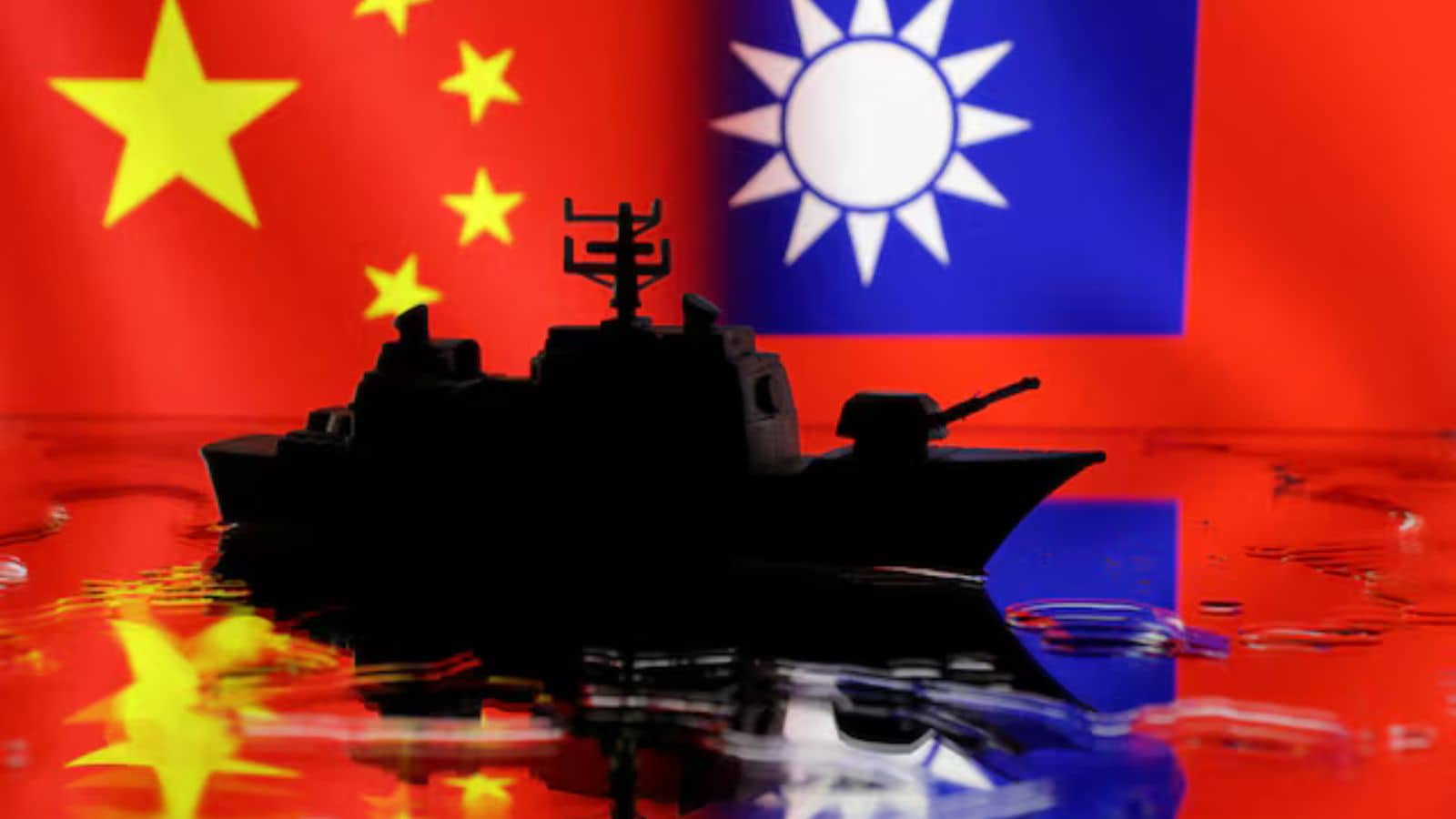
Beijing has escalated its maritime pressure campaign by deploying a continuous rotation of China Coast Guard formations to conduct law enforcement patrols in the waters east of Taiwan. This aggressive expansion of administrative presence directly defies international pushback and a coordinated monitoring effort by Taipei and Tokyo. By substituting the Daishan ship formation with the Xiushan ship formation, the Chinese government has formalized a permanent presence in a maritime sector previously considered a safe buffer zone for Taiwan. This development fundamentally alters the strategic geometry of the Western Pacific.
The international community routinely views these maritime friction points through the narrow lens of military posturing. That interpretation misses the actual mechanism at work. Beijing is not merely rattling sabers; it is executing a deliberate legal and administrative annexation of international waterways. By sending white-hulled coast guard ships instead of gray-hulled naval destroyers, China exploits a legal blind spot that leaves regional democracies scrambling for an effective counter-strategy.
Beijing rewrites the law of the sea
The deployment of the Xiushan task group represents a calculated transition from sporadic military intimidation to normalized administrative oversight. For decades, the waters stretching east of Taiwan into the Philippine Sea served as a critical operational sanctuary for the Taiwanese military. In the event of a conflict, Taipei planned to preserve its naval assets and receive foreign assistance through these deep-water ports and sea lanes. That sanctuary is disappearing.
The China Coast Guard now claims the right to conduct vessel verifications, cargo inspections, and fishery enforcement in these very waters. This is a subtle but devastating strategy known as legal warfare. By conducting routine law enforcement activities, Beijing aims to establish a historical track record of sovereign jurisdiction over the area. If the international community accepts these patrols as routine, China effectively wins the legal argument without firing a single shot.
The ships are heavily armed. Despite their designation as law enforcement vessels, many of these coast guard cutters are converted naval frigates equipped with rapid-fire cannons and advanced electronic warfare suites. They operate under a domestic law passed in Beijing that explicitly authorizes the use of lethal force against foreign vessels in waters claimed by China. This blurred line between civilian law enforcement and military aggression places Taiwanese and Japanese patrol vessels in an impossible position. Responding with military force risks triggering a full-scale war, while responding with standard law enforcement tools leaves them outgunned.
A manufactured crisis triggered by Tokyo and Manila
The timing of this latest escalation reveals the deep geopolitical anxieties driving Beijing's decision-making apparatus. Recently, Japan and the Philippines initiated bilateral negotiations to delimit their overlapping exclusive economic zones and continental shelves in the waters east of Taiwan. This diplomatic alignment between two major American allies sent shockwaves through the Chinese security establishment. Beijing viewed the talks not as a standard legal procedure, but as a containment strategy designed to lock China out of the Western Pacific.
The reaction from the Chinese Ministry of Foreign Affairs was swift and uncompromising. Officials asserted that any maritime demarcation in the waters east of Taiwan must involve Beijing, claiming that the entire maritime zone falls under Chinese jurisdiction. When Tokyo and Manila ignored these protests, the China Coast Guard was ordered to move from diplomatic rhetoric to physical enforcement.
The Chinese oceanographic survey ship Xiang Yang Hong 22 was deployed deep into Japan's exclusive economic zone, escorted closely by heavily armed coast guard vessels. For three days, these ships cut a deliberate path through the disputed waters, conducting unsanctioned marine scientific research. They mapped the seabed, measured water temperatures, and collected acoustic data. This data is vital for submarine operations. The message to Japan was clear. If Tokyo attempts to draw lines in the ocean with Manila, Beijing will erase them with hulls on the water.
The friction of tracking a ghost fleet
Taipei faces an existential challenge in responding to these continuous rotations. The Taiwan Coast Guard Administration has deployed its own vessels to shadow and monitor the Chinese formations, but the operational strain is becoming unsustainable. Taiwan’s fleet is significantly smaller and forced to respond to multiple flashpoints simultaneously, including the Taiwan Strait, the Kinmen islands, and now the vast expanses of the western Pacific.
The physical toll on hulls and crews is only part of the problem. Chinese vessels frequently manipulate their Automatic Identification System transmissions, vanishing from commercial tracking screens only to reappear miles away. This digital camouflage forces Taiwanese and Japanese reconnaissance aircraft to fly continuous sorties, burning through maintenance hours and exhausting personnel.
The structural mismatch in these encounters favors the aggressor. A standard coast guard vessel from Taiwan or Japan operates under strict rules of engagement tied to international law and democratic accountability. The China Coast Guard answers to the Central Military Commission in Beijing. This command structure ensures that their maneuvers are coordinated with the People's Liberation Army Navy, which often hovers just beyond the horizon, ready to intervene if an incident escalates.
How gray zone operations replace formal warfare
The ultimate objective of these eastern patrols is the complete isolation of Taiwan. By establishing a permanent law enforcement presence on the eastern side of the island, Beijing effectively creates a maritime noose. In a future crisis, China would not need to launch a risky amphibious invasion across the Taiwan Strait. Instead, it could simply declare a maritime quarantine, using the coast guard to inspect and turn back commercial shipping bound for Taiwanese ports.
This approach bypasses the traditional thresholds of international conflict. Because the actions are framed as domestic law enforcement, foreign powers find it difficult to justify a military intervention. Washington faces a diplomatic puzzle. Sending a naval strike group to counter a routine customs inspection by a coast guard vessel risks looking like an overreaction, yet doing nothing allows Beijing to slowly suffocate a vital democratic partner.
The strategy relies on incremental gains that are too small to trigger a war but too significant to ignore. Each patrol by the Xiushan or Daishan formations adds another layer of legitimacy to Beijing's claims. The international community’s reliance on standard diplomatic protests has proven entirely ineffective at stopping this maritime creep.
The reality on the water has shifted permanently. The waters east of Taiwan are no longer a distant buffer zone; they are the frontline of a quiet, relentless struggle for control of the Western Pacific. As Beijing continues to rotate its fleets and enforce its domestic laws in international spaces, the space for deterrence is shrinking. Western planners can no longer treat this as a series of isolated provocations. It is a coherent, operational siege.