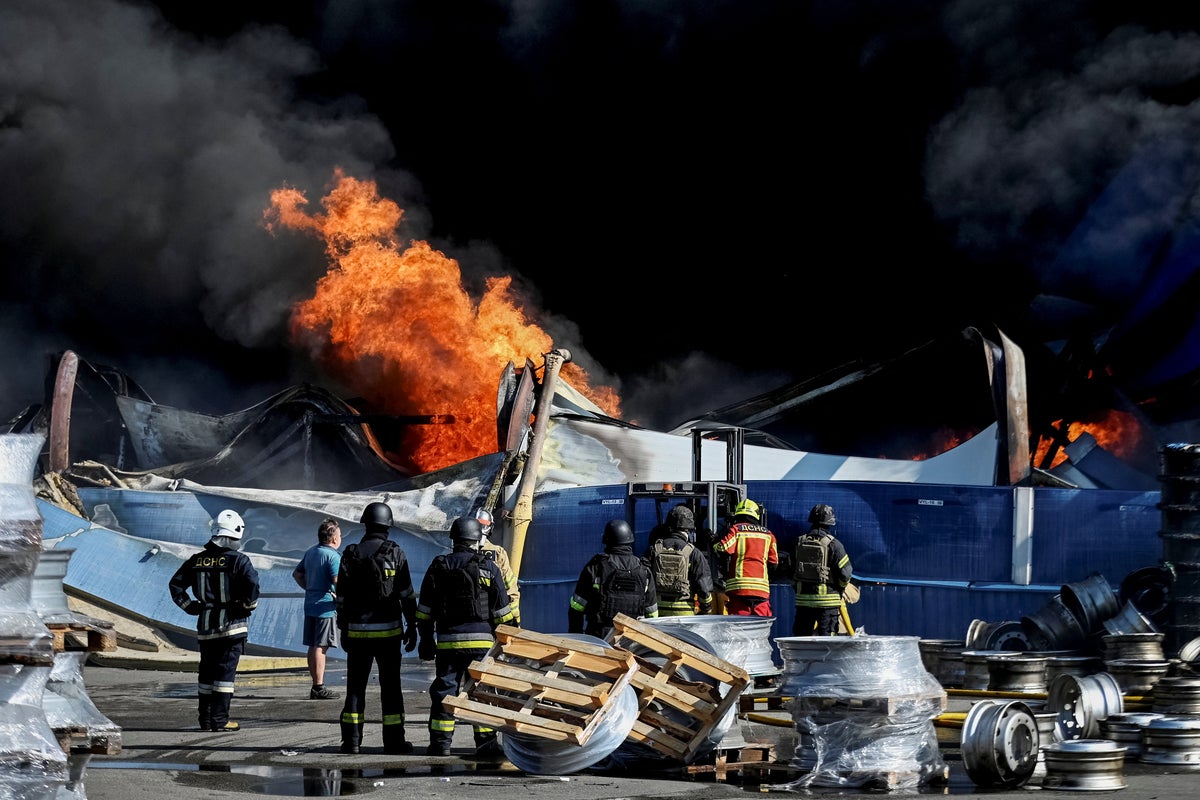
A warehouse blast in Ukraine kills dozens of personnel, laying bare a catastrophic structural failure in how military logistics nodes operate under persistent surveillance. When a single Russian drone detonates a facility packed with munitions and auxiliary personnel, the resulting detonation is not merely a tactical hit. It is the predictable outcome of static supply chains exposed to omnipresent aerial reconnaissance and precision loitering munitions.
For months, military analysts have watched the operational tempo of the war shift. The battlefield no longer affords the luxury of large, centralized depots. Yet, administrative inertia, poor dispersal discipline, and the sheer volume of material required to sustain frontline units continue to force armies into dangerous patterns. Understanding why these catastrophic facility strikes keep happening requires looking past the smoke of the immediate explosion and examining the engineering, logistics doctrines, and intelligence architectures driving modern attritional warfare.
The Anatomy of a Static Target
Logistics wins wars, but static logistics invites destruction. Every military force expanding its operations faces a fundamental tension between efficiency and survivability. Centralized warehouses allow for rapid inventory tracking, easy distribution of heavy crates, and streamlined administrative oversight. A single command post can manage thousands of metric tons of artillery shells, medical supplies, and vehicle parts when they sit under one roof.
That efficiency becomes a fatal liability when the skies belong to the enemy. Modern reconnaissance drones equipped with high-resolution multispectral cameras do not need to guess where supplies are stored. They track truck traffic patterns, monitor heat signatures, and observe the constant coming and going of administrative staff. Once a distribution node reaches a certain threshold of activity, it registers on targeting algorithms as a high-value zone.
When a loitering munition like the Lancet or an Iranian-designed Shahed variant enters the airspace above a saturated facility, the chain of events moves swiftly. Operators verify the target, calculate the wind vectors, and guide the warhead into the most vulnerable structural quadrant. Warehouses built from corrugated steel and concrete block offer zero protection against shaped charges or heavy high-explosive payloads. The secondary detonations do the rest.
The Human Cost of Centralization
The presence of dozens of casualties at a single logistics site highlights a secondary, often overlooked failure mode: personnel clustering. Modern military doctrine emphasizes decentralization, but administrative functions remain stubbornly tied to physical paperwork, command structures, and centralized communications hubs.
When supply personnel, drivers, mechanics, and security guards gather in mess halls, briefing rooms, or administrative offices adjacent to storage bays, they create dense human targets. A warehouse is rarely just a box for metal and powder. It is a workplace buzzing with hundreds of people handling the daily grind of war.
Armies struggle to decentralize human infrastructure as fast as they decentralize hardware. Moving a pallet of ammunition into a forest is simple. Relocating the clerks, quartermasters, and communication terminals required to log, distribute, and account for that ammunition requires secure local networks, redundant power supplies, and decentralized command protocols that many units simply lack.
The Surveillance Panopticon
No discussion of modern logistics vulnerability is complete without addressing the intelligence layer. The airspace above the front and rear zones of the conflict functions as a panopticon. Commercial synthetic aperture radar, electro-optical satellites, medium-altitude long-endurance drones, and partisan spotters on the ground create an unbroken feedback loop.
This transparency means that any large concentration of military vehicles or heavy loading equipment is logged within minutes. Armies attempting to run standard supply operations find themselves operating under a microscope. Camouflage nets and decoy vehicles help, but they cannot hide the thermal footprint of dozens of heavy diesel trucks idling outside a loading dock during a shift change.
Defending against this reality demands a radical pivot away from traditional supply chain management. The days of the regional distribution center are over. In their place, logisticians must adopt what can be described as cellular sustainment.
Toward Cellular Logistics
Adapting to the realities of drone-dominated warfare requires shrinking every operational footprint to the absolute minimum viable size. Instead of storing five thousand artillery shells in a single warehouse, effective doctrine demands scattering caches of fifty shells across dozens of heavily wooded, concealed locations separated by miles of rough terrain.
This approach introduces massive friction into the administrative process. Tracking inventory becomes a nightmare. Distribution times lengthen, and fuel consumption for transport vehicles skyrockets. Yet, this friction is the price of survival. An army that prioritizes administrative ease over dispersal will systematically lose its supplies and its people to precision strikes.
Furthermore, automation must replace human bodies wherever possible in rear-area logistics. Autonomous ground vehicles and heavy-lift drones can move pallets from hidden transit points to frontline trenches without exposing human drivers to aerial surveillance or risking dozens of lives in a single depot blast.
The explosion that killed dozens in that Ukrainian warehouse is a grim data point in a broader evolution of military science. As long as armies rely on large, visible nodes for storage and administration, those sites will remain primary targets for cheap, deadly precision weapons. The lesson written in the rubble is harsh, unforgiving, and absolute. Disperse or perish.