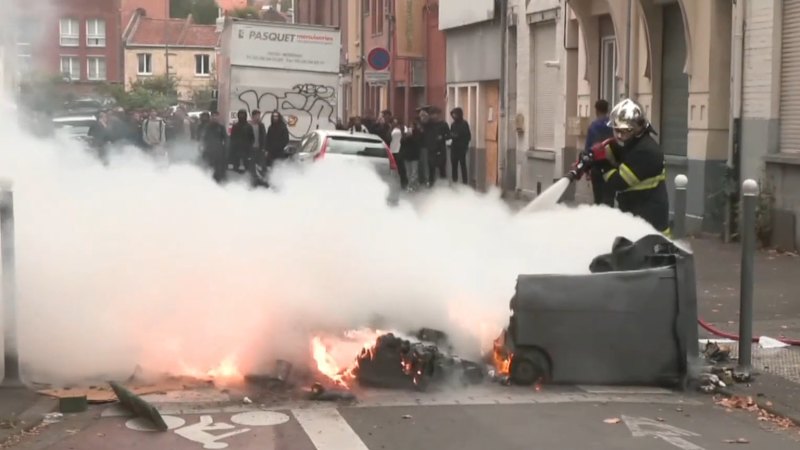
When a teenager or young protester in France loses a hand to a stun grenade, the headline reads like a sudden accident. It isn't. Over years of street protests, labor clashes, and urban unrest across France, explosive crowd-control munitions—most notoriously the GLI-F4 and defensive or de-encirclement grenades deployed by French riot police—have caused catastrophic hand amputations, severe burns, and permanent disabilities, sparking fierce legal battles, medical warnings, and periodic bans or restrictions on specific models.
To understand why these devices keep tearing hands apart, you have to look past the polite label "less-lethal." A stun grenade is not a harmless noise-maker. It relies on a rapid chemical deflagration or detonation to generate an intense acoustic wave and a blinding flash designed to disorient people in milliseconds. In open air at a safe distance, that shockwave is meant to scatter a crowd without piercing skin. In a hand—or enclosed by fingers—those same physics turn a crowd-control tool into a blast device. If you enjoyed this piece, you should check out: this related article.
Why Less-Lethal Munitions Keep Maiming
Police forces around the world face a constant operational dilemma during volatile street unrest. Officers need tools that create distance and break up hostile crowds without firing live bullets or wading into hand-to-hand combat where injuries mount on both sides.
Stun grenades and sting-ball or blast-dispersal munitions sit right in that middle ground. Yet middle ground in pyrotechnics is notoriously unforgiving. Explosive fillers such as flash-bang compositions or high-energy charges release gas and heat faster than human tissue can yield. When someone picks up an unexploded canister to throw it back, or when a grenade lands at someone's feet and they reach down instinctively, a two-second fuse leaves almost no margin for error. For another look on this event, see the latest update from Reuters.
Surgeons treating blast injuries to the hand describe a distinct pattern of destruction. The blast wave drives dirt, clothing fibers, and casing fragments deep along tendon sheaths and neurovascular bundles. Even when the outer skin does not split cleanly, internal pressure strips bone of its blood supply and shreds delicate motor nerves. Reattaching or reconstructing a hand after a close-range grenade blast is rarely a neat surgical fix; often, amputation is the only way to stop life-threatening tissue death and infection.
France and the Long Arc of Grenade Bans
French policing has relied heavily on specialized crowd-control munitions compared with many neighboring European democracies. Over the past two decades, recurring protests—from student demonstrations and labor strikes to the Yellow Vest movement and urban riots—put those weapons under intense scrutiny from human rights groups, parliamentary commissions, magistrates, and emergency physicians.
Pressure mounted as documented cases of hand amputations and facial or eye injuries piled up. Critics pointed out that munitions containing explosive charges or irritating chemical payloads behave unpredictably in dense, chaotic streets. If a canister bounces off a curb, hits a wall, or lands near bystanders and teenagers who do not recognize what it is, the intended tactical effect quickly gives way to severe collateral harm.
In response to mounting outrage and legal challenges, French authorities have moved at different times to withdraw or ban specific grenade types—most visibly phasing out the tear-gas-loaded GLI-F4 grenade after severe injuries—while adjusting rules of engagement for remaining models. Yet banning one model rarely ends the debate overnight. New designations, revised formulas, or alternative sting and acoustic devices often step into the gap, leaving activists arguing that the state changes labels while keeping explosive force in street policing, and leaving police unions insisting they are being stripped of tools needed to hold lines against projectiles and arson.
The Tactical Trade-Off Nobody Wants to Own
Here is the uncomfortable reality that simple outrage often misses. Removing explosive stun grenades from a riot officer's belt does not make a volatile street calm down by itself.
If commanders take away stun grenades without changing crowd-control doctrine, officers on the ground face a choice when a line is pushed. They can retreat and cede ground, hold position and absorb heavy thrown objects, or escalate to other kinetic options such as rubber-ball launchers or baton charges. Each option carries its own injury profile. A baton strike or kinetic impact projectile can fracture an orbital bone or rupture a globe; a tear-gas canister fired on a flat trajectory can strike someone in the head.
Consider a hypothetical scenario at a nighttime rail yard protest where fifty demonstrators block tracks and throw paving stones at a dozen officers. Without a loud, disorienting blast to force the front rank back ten meters, officers might either pull back—allowing infrastructure damage—or close distance for physical dispersal, where grappling and baton strikes become far more likely. That operational tension explains why interior ministries resist sweeping bans until court rulings, political pressure, or grotesque injuries force their hand.
| Crowd-Control Approach | Primary Mechanism | Typical Injury Risk | Operational Limitation |
|---|---|---|---|
| Explosive stun grenade | High-decibel blast and flash | Hand amputation, severe burns, hearing damage | Close-range handling or bounce creates extreme harm |
| Kinetic impact projectile | Blunt-force rubber or polymer round | Eye trauma, fractures, deep bruising | Aiming errors or ricochets can strike vital areas |
| Chemical irritant (CS/OC) | Respiratory and ocular irritation | Severe eye/airway irritation, asthma flare-ups | Wind shifts affect bystanders, children, and officers |
| De-escalation and containment | Perimeter control, dialogue, time | Lower acute blast trauma; higher standoff duration | Requires high manpower and time; struggles against arson |
Why Bans Alone Fail Without Doctrine Reform
A ban on paper is only as good as the rules, training, and accountability behind it. Even when a specific stun grenade is prohibited or restricted, injuries continue if deployment remains poorly tracked or poorly supervised.
Investigators and legal observers in France and elsewhere have repeatedly highlighted a basic accountability gap during chaotic street operations. When dozens of officers deploy munitions in smoke and noise, matching a specific spent casing or injury to a single thrower or launcher can be maddeningly difficult. Without strict chain-of-custody logs, clear minimum safe distances, and independent oversight, a formal ban can look like crisis management rather than lasting reform.
There is also a human factor that hardware rules cannot fully engineer away. In high-adrenaline street clashes, seconds feel stretched or compressed. A device meant to be thrown clear of people can be tossed blindly over a barricade. A young bystander or protester, acting on impulse or bravado, can scoop up a smoking cylinder thinking it is a harmless flare. Training officers to anticipate human behavior—including the certainty that people will sometimes pick up thrown devices—is just as critical as changing the chemical charge inside the casing.
What Comes After a Ban
When a government bans a stun grenade after a boy loses a hand, the decision marks a moral line in the sand. It says a society refuses to accept a child paying for street disorder with a limb.
Real progress requires following that moral line with practical discipline. Police leadership has to pair equipment bans with honest audits of injury data, transparent investigations when severe harm occurs, and realistic crowd-control tactics that do not depend on explosive shockwaves in crowded spaces. Until street policing treats every "less-lethal" munition with the respect due to a live explosive, every new protest season will carry the same grim risk.