For decades, the Brazilian music market stood as an impenetrable fortress. Protected by a colossal domestic industry, rich historical traditions, and a distinct linguistic barrier, Portuguese-language hits easily dominated the airwaves, streaming charts, and stadiums. Foreign pop crossed over occasionally, but Spanish-language music remained an outsider. That dynamic has fractured. Global Hispanic superstars like Rosalía, Bad Bunny, and Shakira have systematically dismantled the acoustic wall protecting South America's largest nation, turning Brazilian listeners into devoted consumers of Spanish-language lyrics.
This shift is not merely a byproduct of algorithmic playlist curation. It represents a calculated convergence of massive corporate muscle, digital migration, and changing youth identities across São Paulo and Rio de Janeiro.
The Linguistic Wall and How It Cracked
Brazil shares a continent with Spanish-speaking nations, yet historical isolation kept cultural exchange remarkably one-sided. Argentinian rock and Latin pop occasionally made minor ripples along southern borders, but they rarely penetrated the national consciousness. To the average Brazilian listener, Spanish sounded foreign enough to feel distant, yet close enough to trigger slight phonetic confusion. Major labels long viewed Brazil as a high-risk territory where marketing dollars spent on Spanish-language repertoires yielded poor returns.
Streaming platforms altered that equation permanently. When physical distribution costs vanished, the friction of testing foreign sounds disappeared with them. Spotify and YouTube algorithms do not care about historical market segmentation. They track behavioral patterns, skips, and repeat listens. When Brazilian Gen Z users began engaging with global reggaeton tracks, the tech infrastructure responded by pushing these sounds directly into daily rotation.
Superstars did not wait for an invitation. They built direct bridges.
The Blueprint of the Hispanic Wave
Shakira understood this landscape decades ago, but her modern resurgence relies on entirely different mechanics. Her massive collaborative footprint keeps her permanently embedded in the contemporary streaming diet of young Brazilians. Meanwhile, Bad Bunny arrives with the weight of global hegemony. When a streaming titan consistently commands top global charts, local preference bends toward international status symbols.
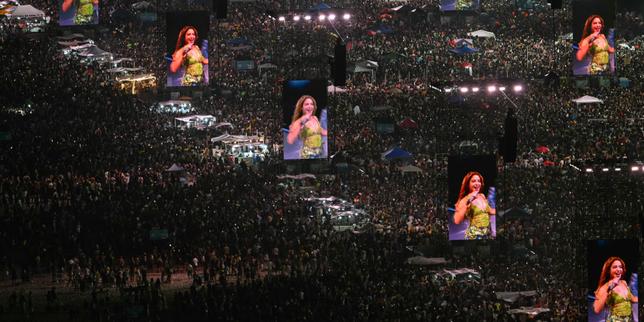
Rosalía approaches the market from a different analytical angle. Her artistic choices lean heavily into genre-bending shock value, merging traditional Iberian sounds with urban electronics and provocative visual aesthetics. When she performs in Brazilian festivals, the crowds do not just tolerate the Spanish lyrics; they scream them back phonetically.
Consider a hypothetical case study to understand the distribution mechanic. A major multinational beverage sponsor coordinates an arena tour in Rio de Janeiro, deliberately pairing corporate marketing budgets with Latin headliners. The brand alignment creates an air of exclusivity and high culture around Hispanic acts. Local youth culture absorbs this endorsement rapidly. Going to a Spanish-language pop spectacle stops being a niche foreign-music excursion. It becomes the definitive marker of being plugged into global trends.
The Pushback from Local Industry Insiders
Not everyone inside the Brazilian creative sector is celebrating the Spanish invasion. Domestic producers and MPB traditionalists have raised valid concerns about cultural displacement. When prime festival slots and heavy playlist curation favor imported Hispanic acts over domestic artists, local ecosystems suffer.
The economic disparity is stark. A major Puerto Rican or Colombian tour brings production scales that local Brazilian independent acts cannot match. Critics argue that this dynamic threatens to turn Brazil into a passive consumer market rather than an active cultural exporter within South America.
Yet, complaining about algorithmic globalization is like shouting at the tide. The language barrier has eroded because younger demographics value transnational cool over regional protectionism. If a track hits hard on TikTok, the language of the chorus becomes secondary to the physical energy of the drop.
The Mechanics of Modern Fandom
Fandom in the streaming era operates outside traditional radio gatekeeping. Brazilian fans organize massive digital campaigns on social platforms, translating lyrics, decoding visual metaphors, and creating localized meme ecosystems within hours of a single dropping.
This hyper-engagement creates a self-sustaining loop. Artists notice the digital mobilization from Brazilian accounts and respond with targeted localized content, Portuguese social media captions, and surprise festival appearances. The relationship stops being transactional and feels personal to millions of teenage users who spend hours online daily.
The linguistic friction that once defined Brazilian exceptionalism has effectively dissolved into a preference for global hitmaking. The old guard can bemoan the loss of market share, but the numbers tell an unvarnished story. Spanish-language music is no longer an imported novelty in Brazil. It occupies permanent real estate in the national ear.
Listen to how these sonic worlds collide in this Emotional Latin Night Drive Mix. This video captures the atmospheric crossover appeal driving modern Hispanic tracks across South American markets.
http://googleusercontent.com/youtube_content/1