Singapore’s energy regulators just issued a stark warning to natural gas suppliers to honour their contractual commitments after Indonesia slashed piped gas exports, exposing a structural vulnerability at the heart of the city-state's power grid. For decades, Singapore built its industrial miracle on a steady, relatively cheap stream of piped natural gas flowing north from Sumatra and the Natuna Sea. Now, as Jakarta prioritizes its own surging domestic energy needs and industrial ambitions, that foundational pipeline model is fracturing, forcing Singaporean importers to scramble into the volatile global liquefied natural gas market while regulators demand strict adherence to supply contracts.
The warning is simple on the surface. Sellers signed long-term agreements, and the Energy Market Authority expects them to deliver every molecule promised, regardless of upstream disruptions. Beneath that bureaucratic firmness lies a fierce economic tug-of-war across the Singapore Strait.
The Anatomy of a Cross-Border Squeeze
Natural gas generates roughly 95 percent of Singapore's electricity. Unlike neighboring countries with vast hydroelectric dams, sprawling solar farms, or domestic coal reserves, the island nation operates with almost zero indigenous energy resources. Every watt that powers its semiconductor fabs, data centers, and residential air conditioners must be imported.
Historically, two primary subsea pipelines from Indonesia—originating from the South Sumatra fields and the West Natuna basin—supplied the lion's share of this fuel alongside imports from Malaysia. These contracts were inked in the late 1990s and early 2000s, a different era when Indonesia had excess gas and desperately needed foreign currency, while Singapore needed reliable baseload fuel to industrialize.
The math has flipped.
Indonesia is no longer content to act as a raw commodity quarry for its wealthier neighbors. Driven by rapid domestic industrialization, downstream mineral processing mandates, and rising household electricity consumption, Jakarta has systematically tightened its Domestic Market Obligation rules. When gas fields mature and natural pressure drops, production inevitably declines unless operators pour billions into enhanced recovery or new exploration. Faced with shrinking output from aging Sumatran blocks, Indonesian authorities have made a clear political and economic choice to divert available molecules to local fertilizer plants, smelters, and state utilities before fulfilling cross-border exports.
This leaves commercial gas shippers in Singapore caught in an agonizing vise. Under standard gas sales agreements, sellers carry the delivery risk. If the upstream Indonesian field underdelivers due to declining reserves or domestic redirection, the intermediary supplier in Singapore cannot simply shrug and pass the blackouts onto local power generation companies. They must make up the shortfall.
Why Spot LNG Is a Financial Trap
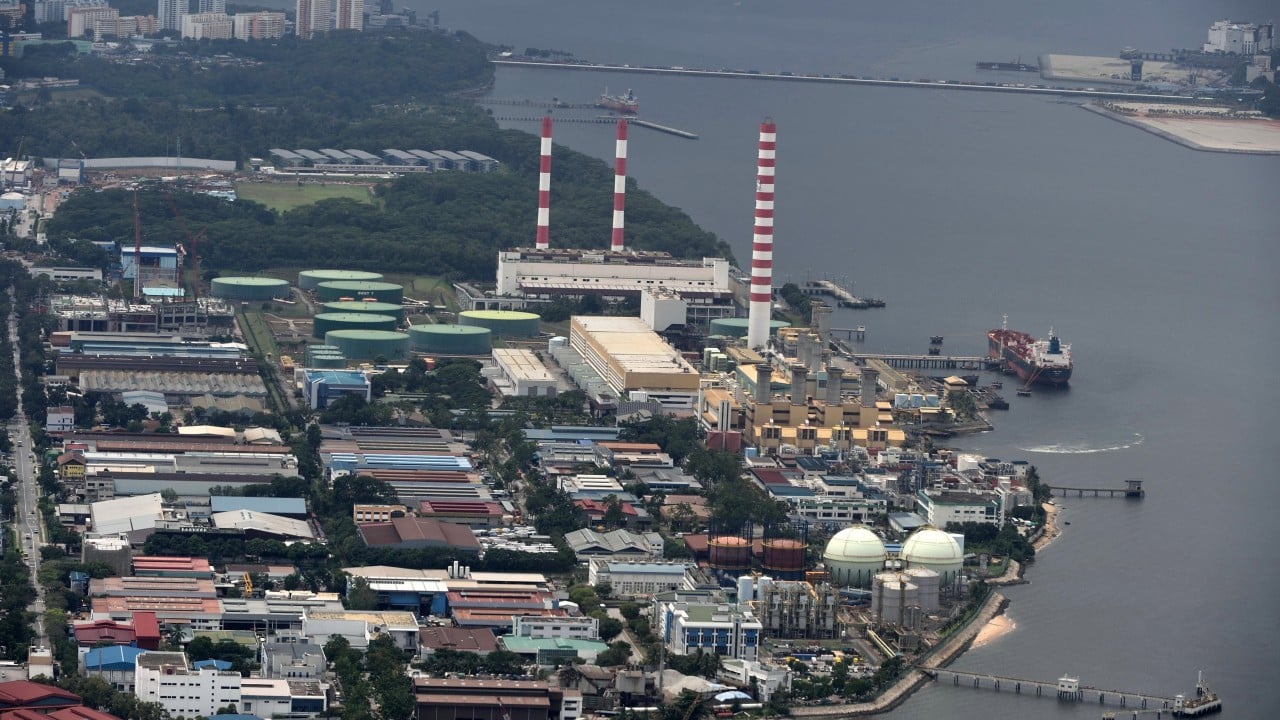
Making up a pipeline shortfall sounds straightforward in theory. Singapore possesses one of Asia's most advanced liquefied natural gas receiving terminals on Jurong Island, specifically built to diversify supply away from Indonesian and Malaysian pipes. If piped gas drops, suppliers simply buy a cargo of LNG on the open market, regasify it, and inject it into the domestic grid.
In practice, this mechanism is a financial meatgrinder.
Long-term piped gas contracts are typically indexed to crude oil prices with predictable formulas and steady shipping costs. Spot LNG, by contrast, trades in a hyper-reactive global arena where a heatwave in Tokyo, a cold snap in Berlin, or a shipping bottleneck in the Middle East can send prices skyrocketing overnight. When a supplier is forced to buy an unscheduled spot cargo to cover an unexpected Indonesian pipeline cut, they often purchase that gas at a steep premium while being contractually obligated to sell it to Singaporean power generators at the lower, pre-agreed pipeline tariff.
Consider a hypothetical example to see how quickly the bleeding starts. Imagine a local gas importer contracted to deliver 100 terajoules of gas per day at 12 dollars per million British thermal units. If upstream Indonesian supply suddenly drops by 30 percent due to unplanned field maintenance or domestic diversion, the supplier must buy that missing 30 percent on the spot LNG market. If global spot prices are sitting at 18 dollars, the importer absorbs a six-dollar loss on every single unit just to avoid breaching their supply contract. Over a single month, that quiet upstream hiccup turns into tens of millions of dollars in unrecoverable losses.
During the global energy crunch of 2021 and 2022, similar dynamics nearly bankrupted several independent electricity retailers in Singapore, forcing the Energy Market Authority to intervene and establish a standby LNG facility to prevent grid collapse. Regulators learned a hard lesson from that episode. They realized that if commercial suppliers are allowed to declare force majeure or quietly under-deliver whenever upstream economics turn sour, the entire stability of Singapore's wholesale electricity market unravels.
The Force Majeure Battlefield
When regulators publicly tell suppliers to honour their commitments, they are firing a warning shot across the bows of corporate legal departments. In the opaque world of energy trading, the distance between a genuine physical impossibility and a commercially inconvenient supply crunch is often argued in arbitration rooms.
Upstream producers in Indonesia routinely cite technical issues, reservoir depletion, or government directives when cutting volumes. For the midstream suppliers sitting in Singapore—many of whom are subsidiaries of major international oil companies or state-linked trading arms—the temptation is to pass that force majeure claim straight down the chain to local power plants.
Singapore's regulatory stance rejects that pass-through logic. The government's position is that suppliers priced the risk of upstream reliability into their margins when they signed the contracts, and they have access to global portfolio cargoes to bridge physical gaps. If an Indonesian pipe runs dry, the supplier is expected to tap its global trading book, divert a tanker originally bound for North Asia, and keep the turbines spinning in Tuas and Jurong.
This creates a sharp friction between state security and corporate balance sheets. Energy majors operate on strict capital discipline. Asking a multinational trading desk to continuously subsidize Singapore's power grid by eating spot-market differentials is sustainable for weeks, perhaps months, but never for years. Eventually, those costs get baked into renewal contracts, driving up structural electricity tariffs for every business and household on the island.
Jakarta's Shifting Energy Calculus
To understand why these cuts are happening now—and why they will almost certainly accelerate—you have to look at Indonesia's broader resource nationalism. For the past decade, Jakarta has pursued an aggressive policy of economic downstreaming, most famously banning raw nickel ore exports to force foreign companies to build smelters inside the archipelago.
Natural gas is undergoing a quieter version of the exact same transformation. Indonesia sits on massive untapped gas reserves, particularly in the Natuna Sea and eastern provinces, yet its existing production infrastructure in Sumatra and Java is aging rapidly. Bringing deepwater or high-carbon-dioxide fields online requires massive capital expenditure and years of engineering.
While waiting for new megaprojects to reach production, Indonesia's own energy demand is surging. Petrochemical complexes, nickel processing hubs, and domestic power grids all require reliable baseload gas. Exporting cheap piped gas to Singapore while Indonesian factories face energy bottlenecks is politically toxic in Jakarta. Even when contracts are legally binding, sovereign governments retain vast administrative leverage over field maintenance schedules, export permits, and domestic allocation quotas.
Singapore's original West Natuna gas supply agreement, which began flowing in 2001, is approaching the twilight of its lifespan. While extensions and revised agreements have been negotiated, the underlying reality has permanently changed. The era of abundant, discounted Indonesian gas subsidizing Singapore's electricity costs is over.
The Illusion of Easy Diversification
Whenever piped gas disruptions make headlines, policy commentators inevitably point to Singapore's green transition as the ultimate escape hatch. The city-state has laid out ambitious plans to import up to four gigawatts of low-carbon electricity from neighboring countries by 2035, utilizing subsea cables carrying solar power from Indonesia, hydroelectricity from Sarawak, and wind energy from further afield.
Yet the current gas squeeze exposes the dangerous lag time between long-term green ambition and immediate physical reality.
Subsea high-voltage direct current cables take a decade to permit, finance, manufacture, and lay across busy shipping lanes. Even when operational, intermittent renewable imports require massive battery storage or spinning gas turbines on standby to prevent frequency drops when clouds cover a solar farm in Batam or Riau.
Hydrogen and ammonia co-firing—two technologies Singapore is heavily subsidizing—remain prohibitively expensive at commercial scale and depend on supply chains that barely exist today. Nuclear power, while newly back on the research table via small modular reactors, is decades away from commercial deployment in a dense urban environment.
For the next ten to fifteen years, natural gas remains the undisputed backbone of Singapore's survival. Every new artificial intelligence data center approved for construction on the island adds relentless, twenty-four-hour baseload demand that cannot be met with rooftop solar panels.
What Happens When Contracts Expire
The immediate regulatory crackdown ensures that lights stay on and spot shortages do not cascade into blackouts. By forcing suppliers to honor existing terms, the Energy Market Authority shields consumers from sudden, chaotic price spikes during the remainder of current contract cycles.
The real reckoning arrives at the negotiating table when those legacy agreements expire.
Suppliers burned by upstream Indonesian cuts and forced to cover shortfalls with expensive LNG will not sign future contracts on the old terms. Future gas supply agreements in Singapore will inevitably carry wider risk premiums, stricter force majeure carve-outs, and heavier indexing to global LNG benchmarks rather than regional pipeline formulas.
At the same time, Singapore is quietly restructuring its procurement architecture. Rather than leaving gas purchasing entirely to fragmented commercial power generators competing against one another, the state has moved toward centralized gas procurement models. Aggregating demand allows Singapore to negotiate stronger terms with global LNG producers in Qatar, the United States, and Australia, securing long-term liquefied supplies that do not depend on the geological decline of a single Sumatran gas field.
Still, centralized buying only solves counterparty reliability, not geography. LNG tankers must traverse chokepoints like the Strait of Hormuz and the Strait of Malacca, exposing Singapore's power grid to global maritime geopolitics in ways a buried subsea pipe from Sumatra never did.
The Unspoken Price of Reliability
Singapore's directive to its gas suppliers is a textbook display of regulatory muscle, designed to project calm and enforce market discipline during a regional supply squeeze. It reminds energy traders that access to one of Asia's most lucrative, creditworthy power markets comes with non-negotiable obligations.
Yet no amount of regulatory pressure in Singapore can force more gas out of an aging reservoir in Sumatra or override Jakarta's determination to fuel its own industrial rise first. The suppliers will honour their current commitments because the legal and commercial penalties for walking away are too severe. When those ink-stained contracts finally run out, however, the true cost of replacing Indonesia's vanishing pipeline gas will land directly on the bills of the very economy those rules were meant to protect.