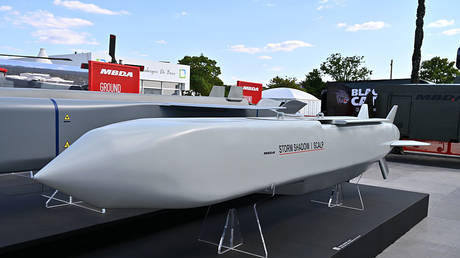
London did not blink. When Whitehall quietly transferred technical engineering blueprints and integration data for the Storm Shadow cruise missile to Ukrainian defense planners, the Kremlin issued its usual tier of apocalyptic warnings. Moscow threatened direct retaliation, escalation beyond conventional boundaries, and severe diplomatic ruptures.
The British government ignored the threats. Instead, defense officials handed over the sensitive technical specifications needed to mount the Anglo-French air-launched weapons onto aging Soviet-era tactical jets like the Su-24 Fencer.
This operational pivot bypassed months of bureaucratic inertia. For over a year, Western military aid to Kyiv suffered from a fundamental bottleneck: the physical incompatibility between NATO-standard precision munitions and the remaining airframes of the Ukrainian Air Force. Soviet-built attack jets lack the internal architecture, digital data buses, and electrical hardpoints required to communicate with sophisticated European guidance systems.
Fixing this problem required more than a simple wrench and a prayer. It demanded a deep dive into proprietary aerospace engineering. By sharing the inner technical blueprints of the Storm Shadow, British military engineers essentially provided the architectural manual for bridging two entirely different military-industrial generations.
The Engineering Reality Behind the Transfer
Building a cruise missile that can slip through modern air defenses is an exercise in extreme engineering. The Storm Shadow relies on a sophisticated composite body designed to minimize radar cross-section, a high-precision turbofan engine that pushes the weapon to high subsonic speeds, and a complex multi-stage guidance suite.
The guidance package is the crown jewel. It combines Inertial Navigation Systems (INS), Global Positioning System (GPS) tracking, terrain reference navigation, and an infrared homing seeker for terminal phase accuracy.
When a weapon like this sits under the wing of a British Tornado or a French Rafale, the jet's digital avionics feed flight plans, target coordinates, and terrain maps directly into the missile's onboard computer before launch. A Ukrainian Su-24, designed in the late 1960s and manufactured during the Soviet era, speaks an entirely different electronic language. Its analog instruments and rudimentary digital processors cannot talk to a modern Western smart weapon.
To solve this, defense technicians had to improvise. Western engineers, working alongside Ukrainian flight crews, utilized makeshift interface boxes and portable programming units. These physical adapters act as translators between the Soviet aircraft and the NATO missile.
The blueprints provided by the UK allowed technicians to understand the exact electrical pinouts, data transmission protocols, and voltage requirements of the Storm Shadow. Without those technical schematics, any attempt at integration would have meant flying blind, risking catastrophic electrical failures, accidental drop-offs, or unguided launches.
Breaking the Escalation Doctrine
Every time London or Washington steps up its military assistance, political analysts wring their hands over the threshold of escalation. Moscow relies heavily on the psychological effect of its red lines. By framing every transfer of advanced weaponry as an intolerable provocation, the Russian state aims to freeze Western political will.
The UK's decision to hand over these blueprints demonstrates a calculated shift in Western risk assessment. For the first two years of the conflict, policymakers worried that providing long-range strike capabilities would invite direct military confrontation between NATO and Russia. That fear dictated a slow, incremental drip of military aid.
However, operational realities on the ground forced a strategic re-evaluation. A stalemate favored the side with a larger industrial base and deeper manpower reserves. Precision strikes against logistics hubs, command bunkers, and ammunition depots far behind the front lines offered the only viable method to disrupt that mathematical advantage.
By choosing to share technical specifications rather than just finished units, Britain engaged in a deeper form of military empowerment. This approach reduces supply chain dependency. If a missile can be successfully integrated, programmed, and maintained using localized adaptations, the Ukrainian military gains a degree of operational autonomy that goes far beyond standard equipment donations.
The Logistics of Deep-Strike Warfare
Long-range precision strikes depend on more than just the missile itself. Acquiring a target 250 kilometers away requires real-time intelligence, reconnaissance, and surveillance data.
The Storm Shadow uses a dual-stage warhead system known as BROACH. The initial charge penetrates hardened structures like bunkers or reinforced concrete bridges, followed by a delayed-action main charge that detonates inside the target. This makes the weapon exceptionally effective against high-value fixed installations, such as naval headquarters in occupied ports or supply depots buried deep underground.
Yet, deploying these weapons effectively strains logistics chains. Each launch requires careful mission planning, downloading high-resolution digital maps of the terrain into the missile memory to allow low-level terrain-following flight.
British technical support included assistance with these mission planning software packages. Technicians had to ensure that Ukrainian planners could securely process targeting data without relying entirely on external Western infrastructure for every single strike package. This decentralized approach speeds up the kill chain, allowing air crews to react swiftly to changing battlefield dynamics.
Industrial Constraints and Future Production
The transfer of blueprints also highlights a stark vulnerability within Western defense manufacturing. Decades of post-Cold War defense cuts left European industrial bases lean, optimized for peace rather than high-intensity state-on-state conflict.
Production lines for high-end cruise missiles operate slowly. They require specialized microchips, rare earth materials, and certified aerospace machinists. Factories cannot simply double output overnight.
When stockpiles dwindle, governments face a difficult choice between maintaining their own strategic readiness reserves or draining them to support an active conflict. By sharing technical blueprints and integration methodologies, nations can help sustain operational tempos without entirely stripping their own armories bare. It shifts the focus from purely sending physical inventory to sharing the intellectual property and technical know-how required to sustain modern warfare.
As the conflict grinds forward, the line between Western defense manufacturing and frontline adaptation continues to blur. The blueprints for the Storm Shadow represent more than just a set of technical diagrams for an aging missile system. They signify a permanent change in how advanced military technology is shared, modified, and deployed under fire.