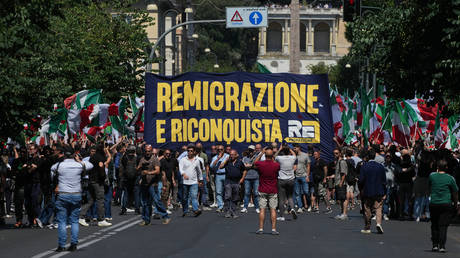
Hundreds of demonstrators filled the historic piazzas of Rome this week, waving flags and chanting slogans in a coordinated display of anger against Italy's current immigration policies. While casual observers might see this as a sudden flashpoint, it is actually the predictable result of years of economic friction, shifting political alliances, and a growing disconnect between Brussels and everyday citizens on the ground. The immediate trigger for these protests lies in a series of new migrant reception centers slated for the Lazio region, but the root causes run much deeper into Europe’s fractured approach to border management.
To understand why the streets of Rome are filling with protestors, one must look past the television cameras and examine the complex bureaucratic machinery that handles migration in the Mediterranean. Italy has long been the primary entry point for individuals crossing from North Africa. For over a decade, successive governments in Rome have argued that the rest of the European Union has abandoned them to manage this influx alone.
The Economics of Local Resentment
Money drives this conflict. In the working-class suburbs surrounding the capital, residents face rising inflation, stagnant wages, and underfunded public services. When the state allocates funds to construct or expand migrant reception facilities in these precise neighborhoods, the local population reacts with hostility.
The anger is not entirely driven by xenophobia. It is fueled by a perception of resource scarcity. A resident in a neighborhood like Tor Sapienza sees a local youth center close due to budget cuts, while a new facility for asylum seekers opens down the street. The arithmetic feels unfair to them. This creates a fertile ground for populist organizers who are eager to channel local frustrations into broader political movements.
Furthermore, the underground economy complicates integration. Italy’s massive informal sector often absorbs undocumented workers into agriculture and construction, where they face exploitation and sub-standard wages. This depresses wages for local laborers at the bottom of the economic ladder, creating a tangible sense of economic displacement that political parties quickly exploit.
The Broken Promises of the Border Coalition
The current Italian government secured power by promising a hardline stance on border security. They spoke of naval blockades and rapid deportations. Yet, the reality of international law and maritime geography has forced a much more complicated approach.
Under maritime conventions, vessels are obligated to rescue individuals in distress at sea. Once those individuals land on Italian soil, human rights frameworks guarantee them the right to apply for asylum. This process takes months, sometimes years, during which applicants must be housed and fed. The current administration has discovered that stopping arrivals completely is legally and logistically impossible without violating international treaties.
[Image of asylum application process flowchart]
This gap between campaign rhetoric and governing reality has left a segment of the electorate feeling betrayed. The recent rallies in Rome are not just a protest against migration itself; they are a direct challenge to the ruling political class from their own base, demanding that they deliver on the severe restrictions they promised during election cycles.
The Failure of the Dublin Regulation
At the heart of the European Union’s systemic failure is a piece of legislation known as the Dublin Regulation. This rule dictates that the country where an asylum seeker first enters the EU is responsible for processing their claim. For geographical reasons, this places an immense, disproportionate burden on southern states like Italy and Greece.
Northern European nations have consistently resisted mandatory relocation quotas. They prefer to offer financial compensation to frontline states rather than accepting physical transfers of migrants. Italy argues that money cannot solve the infrastructure strain or the social friction caused by concentrated processing centers. The Dublin system effectively traps migrants in the periphery of Europe, creating a pressure cooker environment in cities like Rome.
The Rise of Grassroots Nationalist Networks
The organization behind these Rome rallies points to a shifting dynamic within European nationalism. No longer reliant solely on established political parties, a decentralized network of neighborhood associations, student groups, and digital activists now coordinates these events.
Using encrypted messaging apps and localized social media pages, these groups can mobilize hundreds of people within hours. They bypass traditional media filters, spreading videos of local incidents, real or exaggerated, to build a narrative of a city under siege. This grassroots infrastructure means that even if mainstream politicians moderate their stance to cooperate with European partners, the street-level movement retains its momentum and remains uncompromised.
The Reality of the Numbers
To cut through the noise of the protests, one must examine the actual data regarding arrivals and processing times. The numbers reveal a system that is inefficient rather than entirely overwhelmed, but the inefficiency itself causes the crisis.
| Year | Total Maritime Arrivals | Average Processing Time (Days) | Deportation Execution Rate |
|---|---|---|---|
| 2023 | 157,000 | 280 | 12% |
| 2024 | 132,000 | 310 | 14% |
| 2025 | 145,000 | 295 | 11% |
The critical metric in this data is the deportation execution rate. Even when an asylum claim is legally rejected, Italy successfully repatriates fewer than fifteen percent of those individuals. The rest remain in a legal limbo, unable to work legally, unable to access formal housing, and highly visible in major urban centers like Rome. This visible population of individuals without legal status feeds the public perception that the state has lost control of its borders.
The Human Cost of Bureaucratic Stagnation
Behind the political grandstanding and the street protests lies a human reality that both sides often ignore. The conditions inside temporary reception centers are frequently substandard. Private contractors, paid by the state to manage these facilities, often cut corners to maximize profit margins.
When hundreds of young men are confined to a facility with minimal security, no language lessons, and no permission to work, boredom and tension inevitably lead to conflict. Incidents of petty crime or public disturbance outside these centers are then seized upon by protest organizers to justify broader anti-migrant sentiment. It is a cycle where systemic mismanagement breeds social friction, which in turn fuels political radicalization.
Consider a hypothetical example of a small municipality outside Rome that receives an unexpected allocation of two hundred migrants. The local council receives no extra funding for policing or healthcare. Within a month, the local clinic is overwhelmed, and public transport is strained. The issue is not the people arriving; it is the total lack of administrative planning and infrastructure support from the central government.
The Strategy of Tension
Political analysts recognize a familiar pattern in the recent Rome unrest. By focusing public anger on external scapegoats, municipal and national leaders can deflect attention away from systemic domestic failures. Italy's national debt remains alarmingly high, the youth unemployment rate in the south is among the worst in the eurozone, and public infrastructure is deteriorating.
A protest over a migrant center dominates the evening news, pushing stories about health service cuts or infrastructure delays off the front page. This strategy of tension serves a dual purpose. It allows right-wing factions to rally their base around national identity, while allowing opposition parties to accuse the government of incompetence, all while the fundamental economic structures remain unchanged.
The European Union's recent attempts to reform its migration pact offer little immediate relief. The new proposals allow wealthy nations to pay into a fund instead of accepting migrants, a mechanism that critics call a monetization of solidarity. This ensures that frontline cities like Rome will continue to bear the physical reality of border enforcement for the foreseeable future.
The crowds blocking the avenues of Rome are a symptom of a continent trying to manage a twenty-first-century global phenomenon with twentieth-century bureaucratic tools. The treaties governing asylum were written in the aftermath of World War II, designed for a completely different geopolitical landscape. Until Europe reconciles its legal obligations with its economic realities and infrastructure capacities, the piazzas of Rome will remain a battleground for the soul of the continent.