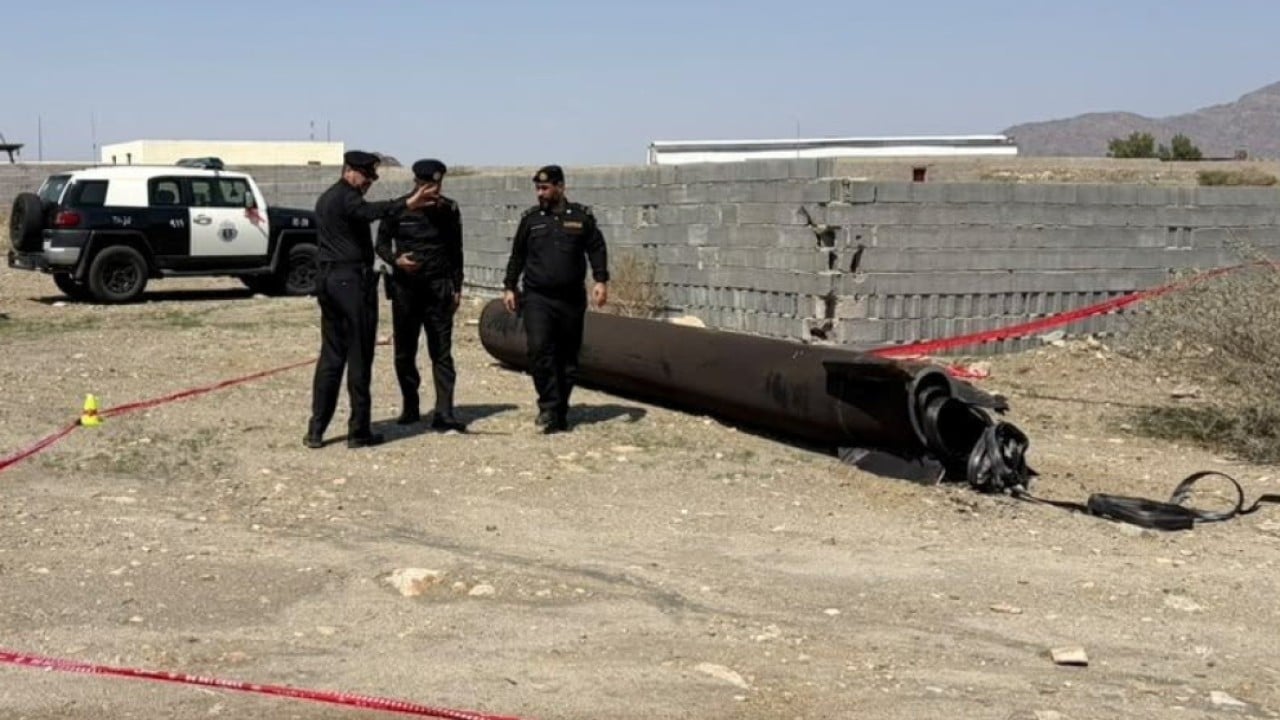
The Saudi-led coalition intercepted a ballistic missile over Riyadh targeting King Khalid International Airport, an attack immediately claimed by Yemen’s Houthi movement as part of its long-range aerial campaign against Saudi infrastructure. While air defense batteries destroyed the incoming projectile before it struck the terminal, the incident exposes a deeper, ongoing strategic reality in the Arabian Peninsula. Long-range drone and ballistic missile strikes against civilian aviation hubs are no longer rare border skirmishes; they represent a calculated, asymmetric war of attrition designed to test the limits of Western-built missile defense networks and threaten global economic stability.
For years, coverage of cross-border strikes between Yemen and Saudi Arabia followed a predictable script. A siren sounds in the Saudi capital. Patriot interceptors streak into the night sky. State media announces a successful interception, while Houthi military spokesmen claim a direct hit on a sensitive target. Yet stopping the narrative at the interception itself misses the real story. To understand what is actually happening over Riyadh, you have to look at the economics of air defense, the evolution of Houthi propulsion technology, and the geopolitical message sent every time an international airport becomes a crosshair. If you found value in this piece, you should check out: this related article.
The Anatomy of a Modern Ballistic Strike
King Khalid International Airport sits roughly 35 kilometers north of central Riyadh. It is not merely a domestic transit hub; it is a critical artery for global commerce, diplomatic travel, and the Kingdom's broader economic diversification ambitions. Targeting an international airport achieves two objectives simultaneously for an insurgent force operating out of northern Yemen. First, it forces the immediate suspension or rerouting of commercial air traffic, creating visible disruption without requiring a catastrophic kinetic impact. Second, it challenges the Saudi government's core promise of domestic security to foreign investors and expatriate workers.
When the Houthi movement—officially known as Ansar Allah—launches a long-range strike toward Riyadh, the projectile must cover a distance exceeding 800 kilometers from launch sites in mountainous northern governorates like Saada or Amran. Covering that range requires liquid-fueled ballistic missiles, such as variants of the Burkan series, which defense analysts have consistently linked to Iranian Scud and Qiam designs. For another look on this development, see the latest coverage from Reuters.
How Interception Actually Works
Intercepting a ballistic missile during its terminal phase is an engineering feat often compared to hitting a bullet with another bullet. As the missile re-enters the atmosphere, it travels at supersonic speeds, leaving radar operators seconds to track, calculate trajectory, and fire.
The Saudi military relies heavily on the American-made MIM-104 Patriot surface-to-air missile system, alongside Terminal High Altitude Area Defense (THAAD) batteries. When radar arrays detect an incoming ballistic signature, automated fire-control systems launch interceptor missiles designed to destroy the warhead via kinetic impact—literally colliding with the target at extreme velocity rather than detonating near it.
However, a successful interception in the sky does not mean zero risk on the ground. Debris from both the destroyed ballistic missile and the interceptor itself falls back to earth across populated districts. Falling shrapnel routinely damages vehicles, shatters windows, and occasionally causes injuries or fatalities in residential neighborhoods beneath the engagement zone. Furthermore, the visual spectacle of glowing contrails and mid-air explosions over a major capital city accomplishes the psychological objective of the launch even when the warhead fails to reach the tarmac.
The Asymmetric Economics of Air Defense
The defining feature of the aerial conflict over Saudi Arabia is not technological parity. It is an extreme financial imbalance that favors the attacker.
A single Patriot PAC-3 interceptor missile costs several million dollars. Standard military doctrine often dictates firing two or even three interceptors at a single incoming ballistic target to ensure a high probability of destruction. That means a single engagement over Riyadh can easily consume ten million dollars worth of advanced munitions in less than sixty seconds.
On the other side of the border, the cost calculus looks entirely different. While long-range ballistic missiles are more expensive than small loitering munitions, the Houthis assemble and modify their arsenal using smuggled components, commercial off-the-shelf electronics, and localized manufacturing facilities hidden in caves and rugged terrain. The cost to launch a strike is a fraction of the cost required to stop it.
This dynamic creates a sustained logistical strain. Air defense stockpiles are finite, and global supply chains for advanced interceptor missiles face competing demands from multiple theaters around the world. Every time batteries around Riyadh fire to protect King Khalid International Airport, defense planners in Washington and Riyadh must calculate replenishment timelines, production bottlenecks, and the long-term sustainability of defending vast territorial borders against an adversary willing to launch continuously.
Why Civilian Airports Remain Primary Targets
Military theorists have long debated the strategic utility of targeting infrastructure outside traditional front lines. In the Yemeni conflict, civilian airports—including Riyadh, Jeddah, and Abha—have repeatedly been placed at the center of Houthi targeting lists.
The reasoning is rooted in leverage and visibility. Strikes on remote desert military outposts rarely capture international headlines or alter diplomatic calculations. An attack aimed at the primary gateway to the Saudi capital guarantees immediate global media attention. Airlines monitor airspace advisories in real time; aviation insurers adjust risk premiums based on regional threat assessments; foreign governments issue travel warnings.
The Houthis have repeatedly framed these operations as direct retaliation for the Saudi-led coalition's military campaign in Yemen and the long-standing air and sea restrictions on Houthi-controlled ports and Sanaa International Airport. By threatening Riyadh's skies, the group seeks to establish a crude form of mutual deterrence: if Sanaa remains isolated from international air travel, Riyadh's skies will not remain uncontested.
The Intelligence and Verification Gap
One of the persistent challenges in covering these incidents is the sharp divergence between official statements from both sides. Following an interception, the coalition typically releases brief communiqués confirming that air defenses intercepted and destroyed a hostile ballistic missile launched toward Riyadh, emphasizing that the attack deliberately targeted civilians.
Conversely, Houthi military spokesmen routinely issue triumphant broadcasts claiming the missile evaded defense systems and struck its target with high precision. Because independent journalists rarely have immediate, unrestricted access to impact zones or military radar logs, verification requires cross-referencing multiple open-source indicators:
- Flight Tracking Data: Sudden holding patterns, diversions, or temporary ground stops at King Khalid International Airport visible on public aviation transponders provide objective confirmation of an active security alert.
- Geolocated Video: Footage uploaded by Riyadh residents showing interceptor launches, mid-air detonations, and falling debris allows analysts to triangulate the approximate altitude and location of the engagement.
- Satellite Imagery: Commercial high-resolution imagery captured days after an incident reveals whether airport runways, terminals, or fuel depots sustained any physical damage.
In almost every claimed strike on Riyadh's airport, commercial flight data confirms brief disruptions, while satellite imagery shows undamaged airport infrastructure—confirming that the interceptors successfully prevented a direct hit on the airfield itself.
Evolution of the Houthi Missile Arsenal
To appreciate how an insurgent movement gained the ability to threaten targets deep inside Saudi Arabia, it is necessary to look at how the Houthis transformed their military capabilities over a decade of war. When the conflict escalated in 2015, the group relied largely on legacy Yemeni army stockpiles of aging Soviet-era Scud missiles and short-range artillery rockets. Those early weapons suffered from poor accuracy and limited range, frequently breaking apart in flight or missing targets by kilometers.
That limitation no longer applies. Through sustained external technical assistance and smuggling networks running across the Arabian Sea and overland through Oman, the Houthis systematically upgraded their guidance systems, airframes, and propulsion units.
Analysts examining recovered missile wreckage in Saudi Arabia have documented lighter composite materials used in missile bodies—a modification that reduces weight and extends flight range—alongside improved inertial navigation systems and satellite guidance modules. Instead of firing unguided rockets blindly across the border, operators can now program flight paths designed to complicate radar tracking and approach targets from unexpected angles.
Multi-Vector Swarm Tactics
The threat to Riyadh is rarely limited to a single ballistic missile flying in isolation. Increasingly, attacks involve coordinated salvos combining different types of aerial threats:
- Ballistic Missiles: High-speed, high-altitude projectiles that require specialized upper-tier or terminal-phase interceptors like Patriot or THAAD.
- Cruise Missiles: Low-flying, terrain-hugging weapons that travel beneath standard radar horizons, giving defense batteries far less warning time.
- One-Way Attack Drones: Slow, low-cost unmanned aerial vehicles (such as the Samad series) launched in swarms to saturate radar screens and exhaust interceptor magazines before higher-value missiles arrive.
Defending an urban area against a mixed salvo forces air defense commanders into split-second decisions. Engaging cheap drones with multi-million-dollar missiles is financially ruinous, yet ignoring them risks allowing a warhead to slip through and strike a fuel depot or radar dish, blinding the defense network for the ballistic missiles following behind.
Geopolitical Ripples Beyond the Border
Every interception over Riyadh reverberates far beyond the immediate military theater. Saudi Arabia is actively pursuing massive economic transformation projects that depend entirely on foreign capital, international tourism, and regional stability. Major global corporations are being urged to establish regional headquarters in Riyadh, and the Kingdom is positioning itself as a central hub for global aviation and logistics.
Ballistic missiles streaking toward the capital's main airport complicate that pitch. Even when air defenses perform flawlessly, the mere necessity of maintaining active Patriot batteries around a commercial airport underscores the persistent security risks of the region.
At the same time, these strikes highlight the broader regional proxy dynamics in the Middle East. The weapons technology deployed from northern Yemen mirrors designs seen across other regional flashpoints, tying the security of Riyadh's airspace directly to wider diplomatic negotiations involving Iran, the United States, and regional Gulf states.
The Limits of Purely Defensive Measures
Military history offers a clear lesson regarding missile defense: no shield is impenetrable forever. While Saudi air defense crews have accumulated more real-world combat experience operating Patriot systems than almost any other military force on earth, relying exclusively on interception carries inherent vulnerability.
An attacker only needs one missile to slip past a radar blind spot or a reloaded launcher to cause severe damage, whereas the defender must succeed every single time. Furthermore, each interception leaves behind physical debris falling over densely populated urban areas, turning a tactical victory in the sky into an ongoing civil defense hazard on the ground.
Until a durable political settlement addresses the underlying conflict in Yemen and halts the flow of advanced missile components into the region, the skies over Riyadh will remain contested territory—where multi-million-dollar interceptors stand as the final barrier between commercial aviation and ballistic warfare.