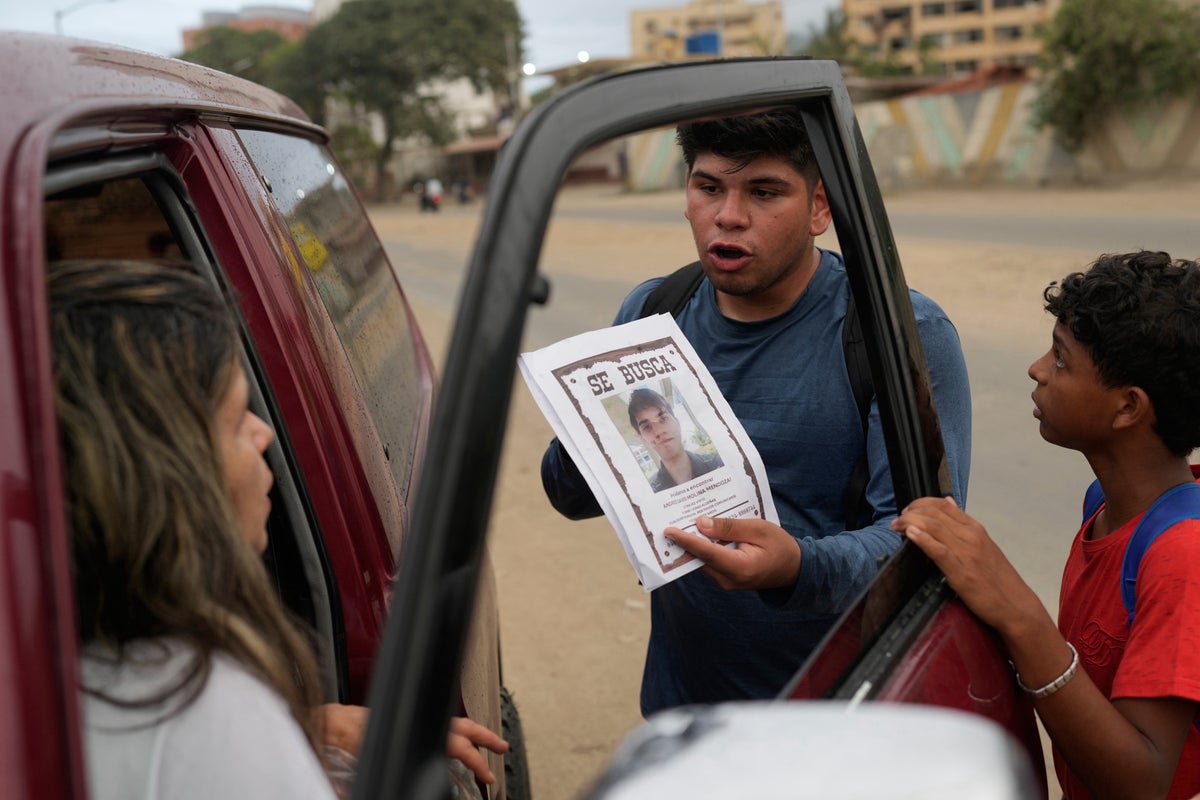
Ten weeks after twin catastrophic earthquakes flattened sections of La Guaira, Venezuela, official tallies report roughly 1,500 people missing. Independent civilian counts estimate the actual total stretches into the tens of thousands. In the vacuum left by institutional failure, families like the Molinas are performing the grim labor of the state, walking through concrete dust with handfuls of photocopied flyers. This is the anatomy of a systemic disappearance, where bureaucratic opacity meets the crushing weight of civic abandonment.
The double earthquake on June 24 tore open the coastal infrastructure just north of Caracas. It reduced apartment blocks to compacted layers of concrete and twisted rebar. Weeks prior to the current phase of the search, relatives pulled the bodies of eighteen-year-old Andrés Molina's mother and brother from the ruins of their collapsed ten-story building. Andrés vanished. His backpack, usually a permanent fixture on his frame, was nowhere among the debris.
The Mechanics of Discrepancy
Government officials maintain that disaster response protocols were executed swiftly and that casualty statistics are rigorously verified. On the ground, that claim dissolves into contradiction. Civil society groups note that official data lacks disaggregation, making it nearly impossible to track vulnerable demographics such as unaccompanied minors or individuals suffering from acute trauma-induced disorientation.
When the state fails to publish transparent registries, the burden shifts entirely to informal networks. Relatives scour makeshift camps, hospital corridors, and morgues that lack centralized databases. Rumors fill the data void. In the weeks following the tremor, viral WhatsApp voice notes claimed hundreds of children were wandering public parks alone, triggering chaotic waves of false hope across municipal lines. Families rushed from shelter to shelter, only to find empty benches and indifferent guards.
This information desert breeds a unique psychological torment. Every phone call reporting a sighting—a young man with a head injury near a golf course, a figure collecting scrap metal by the highway—serves as an emotional anchor and an anchor chain dragging families deeper into exhaustion.
When Civil Infrastructure Collapses
Disaster recovery relies on institutional trust. When that trust hits zero, community survival mechanisms take over, though they are fundamentally unequipped for large-scale forensic identification.
Consider the operational hurdles facing independent search parties. Without access to DNA databases, dental records, or coordinated regional communication channels, civilian searchers rely on physical recognition. They ask construction crews for details. They hand flyers to strangers outside shuttered storefronts.
Communication breakdowns run deep. In the Molina family's case, internal fractures compound the external tragedy. Years of separation between estranged relatives complicate the pooling of information. Extended family members connect via messaging applications across state lines, trying to piece together timelines for a teenager they have not seen in years, turning personal grief into a decentralized logistics operation.
The Cost of Waiting
Months after the earth shook, the physical landscape of La Guaira remains defined by ongoing demolition and heavy machinery noise. The transition from emergency rescue to long-term recovery has stalled. Thousands remain unaccounted for, lingering in a legal and existential limbo. They are neither officially confirmed dead nor registered as living survivors within the formal social safety net.
The state apparatus points to online chat lines and automated questionnaires as proof of accessibility. Yet these digital intake forms demand granular details—height, weight, dental traits, precise coordinates of disappearance—that traumatized families struggling to survive day-to-day cannot reliably provide under pressure. The barrier to entry for government assistance remains remarkably high, while the path of independent searching remains exhausting and open-ended.
Antonella Molina walks past broken windows and shattered asphalt, greeting neighbors with familiar warmth before holding out another flyer. The paper creases under heavy humidity and repeated handling. The search continues not because the system supports it, but because the alternative requires accepting an absence without proof.