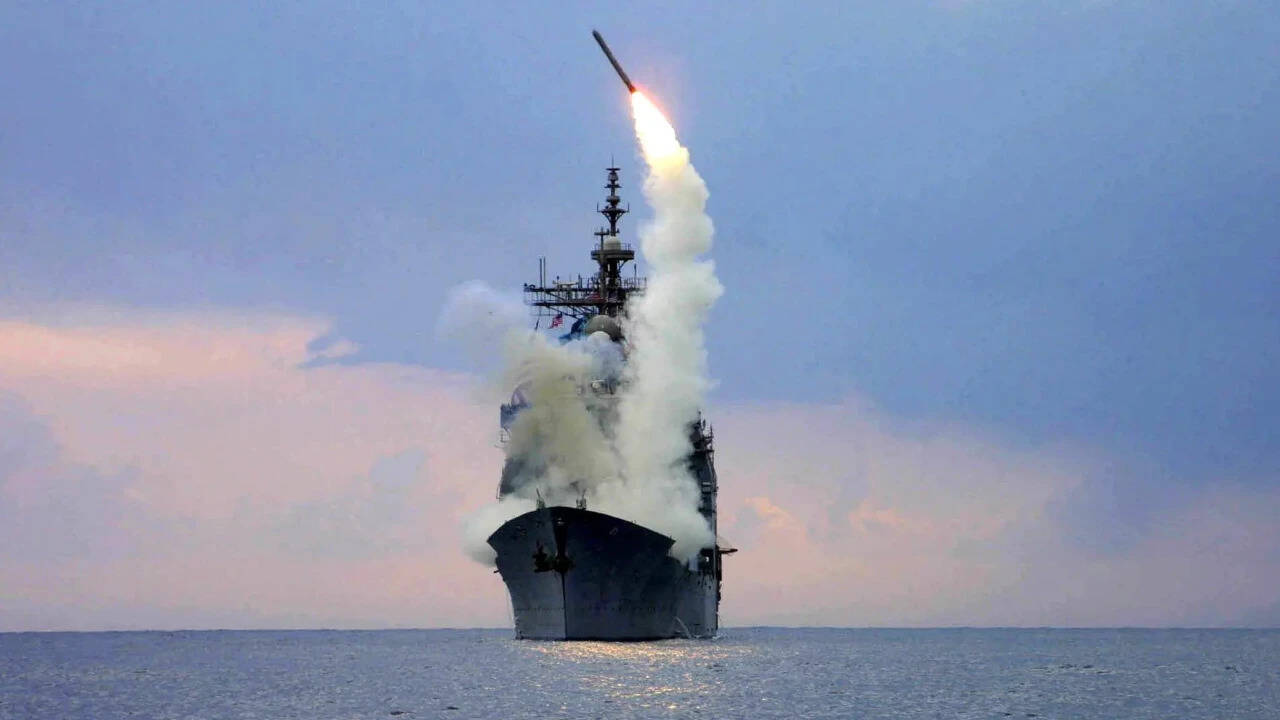
The United States military is rapidly running out of the high-end precision-guided munitions required to fight a modern great-power conflict, having burned through years of vital missile production during the ongoing military campaign against Iran. Months of intensive combat operations in the Middle East have drained critical stockpiles of Tomahawk cruise missiles, Patriot interceptors, and Army Tactical Missile Systems (ATACMS). This heavy expenditure has created a profound structural vulnerability for the Pentagon, leaving American forces dangerously short of the firepower needed to deter or fight a potential conflict with China in the Indo-Pacific.
For years, defense analysts warned that the American defense industrial base was structurally optimized for peacetime efficiency rather than sustained high-intensity combat. Those warnings have now materialized into an operational reality. The math driving modern warfare is unforgiving, and the bills are coming due.
The Cost-Exchange Trap
Every military engagement operates on an economic equation, and the current campaign against Iran has exposed a deeply unfavorable cost-exchange ratio for Washington. Iran and its regional proxies have relied heavily on low-cost, mass-produced asymmetric assets, including loitering munitions, ballistic missiles, and delta-wing drones. To neutralize these inbound vectors, American and allied air-defense networks must deploy multi-million-dollar interceptors.
A Patriot guidance-enhanced missile or a Terminal High Altitude Area Defense (THAAD) interceptor costs millions of dollars per round. When firing these complex systems against thousands of relatively inexpensive threats, inventory erosion happens exponentially faster than financial investments can correct it.
Worse still is the offensive ledger. Long-range surface-to-surface weapons like the ATACMS and the newer Precision Strike Missile (PrSM), alongside naval-launched Tomahawks, have been expended at a historic velocity to strike hardened underground command nodes, missile silos, and logistics hubs inside Iran. According to assessments from defense think tanks like the Center for Strategic and International Studies, returning these stockpiles to prewar baseline levels will require three years or more of uninterrupted manufacturing output.
Industrial Bottlenecks and Fragile Supply Chains
The core issue preventing a rapid recovery is not merely a lack of Congressional appropriations, but the physical limitations of the American defense industrial complex. Decades of post-Cold War consolidation left the United States with only a handful of prime contractors—primarily Lockheed Martin, RTX, and Boeing—capable of building these complex systems.
These manufacturing lines do not possess an arbitrary surge switch. They depend on fragile, highly specialized supply chains. Rare-earth minerals, precision rocket motors, solid propellants, and advanced microprocessors often rely on single-source suppliers or complex international logistics chains that are easily disrupted.
Consider the production lead time for a standard Tomahawk cruise missile. Even when the Pentagon places emergency multiyear procurement orders, the pipeline from factory floor to deployment can take nearly thirty months. Skilled labor shortages compound the crisis. Machinists, aerospace engineers, and certified technicians qualified to assemble guidance systems and rocket assemblies cannot be trained overnight. The industrial base is trapped in a slow-motion bottleneck while global threats accelerate.
The Pacific Calculus
This massive inventory drain carries severe strategic consequences far beyond the Persian Gulf. For over a decade, the Department of Defense has identified the People's Republic of China as the primary pacing challenge for American military planning. The core of Washington's strategy in the Western Pacific relies on maintaining a credible anti-access/area-denial deterrent posture, anchored by long-range anti-ship missiles, precision strike networks, and robust layered air defenses.
In any plausible contingency over Taiwan or the South China Sea, consumption rates for long-range precision munitions would dwarf those seen in the Middle East. War games repeatedly show that a conflict in the Taiwan Strait would exhaust regional missile inventories within days.
By committing significant portions of its premier missile stocks to the campaign against Iran, the Pentagon has forced a dangerous zero-sum dilemma upon its global force posture. Planners must now choose whether to keep theater commanders in the Indo-Pacific adequately supplied—potentially leaving forces exposed if deterrence fails—or accept a diminished defensive posture in the Middle East. Beijing is watching this consumption data closely, calculating the exact window where American strategic reach is stretched to its breaking point.
Reforming a Broken Procurement Ecosystem
Throwing emergency funding bills at the problem will not instantly fix a system built for a bygone era. The traditional Pentagon procurement process relies on rigid annual budgeting cycles, unpredictable year-to-year funding fluctuations, and adversarial contracting relationships that discourage private sector capital investment. Defense contractors are inherently hesitant to sink hundreds of millions of dollars into expanding factory footprints or purchasing heavy machinery without guaranteed multi-decade demand signals from the government.
To break this cycle, structural reform must go deeper than surface-level budget increases. The Department of Defense must aggressively expand multiyear procurement authorities, allowing prime contractors to buy raw materials in bulk and sign long-term sub-tier supplier agreements. Redundant manufacturing lines and domestic stockpiling of critical components must become baseline national security requirements rather than afterthoughts.
Until the structural velocity of American missile production matches the brutal tempo of modern warfare, every extended regional conflict will continue to hollow out the strategic reserves required to defend global power projection. The luxury of time has officially expired, and the industrial ledger demands an immediate reckoning.


