Iran builds most of its missiles and drones inside domestic underground complexes, sourcing the missing high-tech guidance chips, chemical propellants, and air-defense systems from China, Russia, and commercial shell networks stretching across Europe and North America. Even with a southern naval blockade in place since April and the November 2026 launch of Task Force Iron Gate, the United States cannot fully sever this supply chain because Tehran's hardware relies on ubiquitous civilian electronics moved across seven land borders and a landlocked sea beyond Western reach.
Understanding how Tehran keeps its factories humming requires looking past the theater of high-seas interceptions and examining the mundane commercial plumbing of global trade.
The Myth of the Self-Sufficient Fortress
For decades, Iranian military officials have boasted about total industrial self-reliance. The reality inside the Islamic Revolutionary Guard Corps (IRGC) manufacturing plants is far messier. Tehran possesses the heavy metallurgy, airframe fabrication, and solid-fuel casting capabilities to churn out vast numbers of Shahed attack drones and ballistic missiles like the Fath-360. Volume is not their problem. Precision is.
To make a drone navigate through electronic jamming or a ballistic missile hit within meters of a target, Iranian engineers need specialized microchips, inertial measurement units, servo motors, and high-grade circuit boards. Iran cannot fabricate these components at scale. Neither can most nations on earth.
Instead of building a domestic semiconductor industry from scratch, Tehran turned the global open market into its warehouse. Forensic teardowns of recovered Iranian munitions consistently reveal commercial microelectronics manufactured in the United States, Germany, and Japan. These are rarely military-grade restricted items. They are dual-use goods—off-the-shelf processors and sensors designed for civilian agricultural equipment, industrial robotics, and consumer appliances.
As Damien Spleeters of the arms-tracing organization Heimdall noted, manufacturers routinely lose visibility once a batch of microchips leaves their loading dock and passes through three or four international distributors. A crate of navigation sensors sold legally to an electronics wholesaler in the United Arab Emirates or Hong Kong can be broken down, relabeled as washing machine parts, and loaded onto a dhow or cargo plane bound for Bandar Abbas before an export compliance officer even reviews the invoice.
Beijing and Moscow Fill the Heavy Gaps
While Western commercial networks supply the brains of Iran's domestic arsenal, two state actors provide the heavy muscle and chemical precursors that cannot be bought on the open market.
The Chinese Supply Line
China acts as both Tehran's economic lifeline—purchasing sanctioned Iranian crude oil—and its primary source for specialized industrial inputs. Beyond commercial electronics and chipmaking equipment, Chinese suppliers have shipped vast quantities of sodium perchlorate, a critical chemical precursor required to manufacture solid rocket propellant. Intelligence assessments also point to finished hardware moving through Hong Kong intermediaries, including anti-ship cruise missiles, surface-to-air missile batteries, and roughly 400 shoulder-fired air defense systems (MANPADS). Beijing officially denies supplying lethal weaponry, hiding behind layers of opaque trading firms that insulate state-owned defense conglomerates from direct Western blowback.
The Russian Quid Pro Quo
The relationship with Moscow evolved from a one-way buyer-seller arrangement into a wartime barter system. After Iran shipped thousands of Shahed drones and Fath-360 ballistic missiles to sustain Russia's campaign in Ukraine, the Kremlin owed Tehran a massive strategic debt.
That repayment includes Yak-130 combat trainer aircraft, 90 helicopter-mounted missile launchers, shoulder-fired missiles, and long-delayed agreements for advanced Su-35 fighter jets. Yet Pieter Wezeman of the Stockholm International Peace Research Institute points out a crucial caveat: compared to the sheer volume of munitions Iran produces domestically, foreign-built weapons systems enter the country in relatively small batches. Foreign imports patch specific capability gaps, particularly in air defense and aviation, while domestic factories carry the offensive load.
Why Task Force Iron Gate Faces an Uphill Battle
In April 2026, the U.S. Navy clamped a maritime blockade onto Iran's southern coastline, choking off seaborne oil exports and intercepting vessels in the Persian Gulf and Arabian Sea. Tehran adapted immediately. It shifted its logistics northward, turning a maritime supply problem into an overland and inland-sea operation.
Washington's answer arrived in November 2026 with Task Force Iron Gate, a specialized unit created to choke off weapons and dual-use components moving across Iran's land borders and the Caspian Sea. On paper, the strategy targets the exact back doors Tehran relies on. On the ground, the math works against Washington.
Consider the sheer scale of the perimeter:
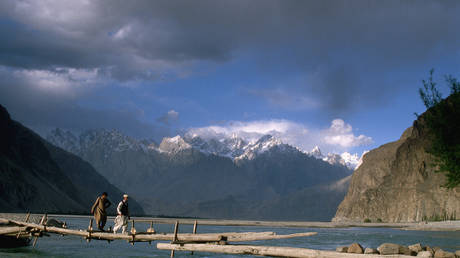
- Seven Land Neighbors: Iran shares porous, mountainous, and desert borders with Iraq, Turkey, Azerbaijan, Armenia, Turkmenistan, Afghanistan, and Pakistan.
- A Landlocked Sanctuary: The Caspian Sea sits completely isolated from international oceans, bordered only by Russia, Iran, Kazakhstan, Turkmenistan, and Azerbaijan. No U.S. Navy destroyer can sail into the Caspian to board a cargo ship running between Astrakhan and the Iranian port of Bandar Anzali.
- Skeletal Staffing: Task Force Iron Gate launched with roughly 20 civilian and military personnel. Even with access to satellite intelligence and Treasury financial tracking, twenty analysts cannot physically inspect millions of shipping containers and cross-border trucks.
"Twenty extra personnel is not going to do much, as far as I can see," Pieter Wezeman told Middle East Eye, questioning whether the unit can meaningfully dent an entrenched global procurement network.
Kinetic strikes offer only temporary friction. In March 2026, Israeli forces struck the Caspian port of Bandar Anzali, and in July, U.S. strikes destroyed a remote railway bridge in Iran's northeastern Golestan province along the transit line to Turkmenistan. Ukrainian forces even hit an Iranian tanker operating on the Caspian route. Iran rebuilt the Golestan rail bridge within days. Concrete and steel are cheap; the transit corridors remain open.
The Neighbor Problem Nobody in Washington Wants to Solve
A border interdiction strategy is only as strong as the customs officers standing on the other side of the fence. Right now, the countries surrounding Iran have zero appetite for enforcing an American siege.
Serhan Afacan, an Iran specialist at Marmara University, notes that Task Force Iron Gate attempts to force compliance from nations that deliberately stayed neutral during the regional war. For these governments, cooperating with Washington carries immediate domestic peril.
| Neighboring State | Primary Economic Dependency on Iran | Political Reality |
|---|---|---|
| Iraq | Relies heavily on Iranian natural gas to keep its national power grid running. | Refuses U.S. demands to seal border crossings; closing them triggers immediate blackouts and civil unrest. |
| Pakistan | Border provinces depend on smuggled Iranian petrol and diesel to function. | Wants to preserve its role as a regional diplomatic mediator and avoid destabilizing Balochistan. |
| Central Asia | Turkmenistan and neighbors rely on Iranian rail and transit corridors for trade access. | Russia dominates regional security; local leaders will not antagonize both Moscow and Tehran simultaneously. |
| Turkey | Major bilateral trade partner with complex energy and border security ties. | Balances NATO membership against commercial self-interest and regional autonomy. |
When Washington demands that Baghdad or Islamabad crack down on cross-border smuggling, it is asking fragile governments to commit economic suicide to advance American security objectives. Unsurprisingly, customs officials look the other way.
Whack-A-Mole in the Shell Company Economy
Even when U.S. intelligence successfully identifies a front company moving dual-use electronics into Iran, the legal machinery moves far slower than the cargo.
Throughout 2026—with major rounds of designations in May, June, July, and September—the U.S. Treasury and State Departments blacklisted dozens of individuals and entities procuring parts for the IRGC and Iran's Ministry of Defense and Armed Forces Logistics (MODAFL). By the time investigators trace corporate registries, verify shipping manifests, and publish a name on the Specially Designated Nationals list, the microchips are already soldered onto circuit boards inside an underground Iranian bunker.
The procurement agents simply liquidate the blacklisted shell company, register a new LLC in a free-trade zone under a cousin's name, open a fresh bank account, and place the next order. Task Force Iron Gate aims to speed up this cycle by integrating Department of Justice prosecutors directly into the intelligence loop to unseal indictments and blacklist the actual trucking and shipping conglomerates moving the freight. That raises insurance costs and forces smugglers to pay higher bribes, yet it acts as a tax on Iranian weapons production rather than an off switch.
The Uncomfortable Reality of Asymmetric Logistics
Modern warfare has exposed a brutal asymmetry in industrial economics. Intercepting a single Iranian ballistic missile or long-range drone costs the United States and its allies millions of dollars in interceptor munitions. Building that drone costs Tehran a few tens of thousands of dollars and a handful of commercially available circuit boards.
Washington can sink ships in the Persian Gulf, bomb rail bridges in Golestan, and sanction a new batch of front companies every Tuesday. None of those measures alter the fundamental math: as long as global capitalism relies on frictionless, high-volume trade in civilian microelectronics, and as long as Russia and China view a heavily armed Iran as a useful counterweight to American power, the supply lines will bend without breaking. You cannot blockade a country when its deadliest weapons are assembled out of the same silicon that powers the rest of the world's appliances.