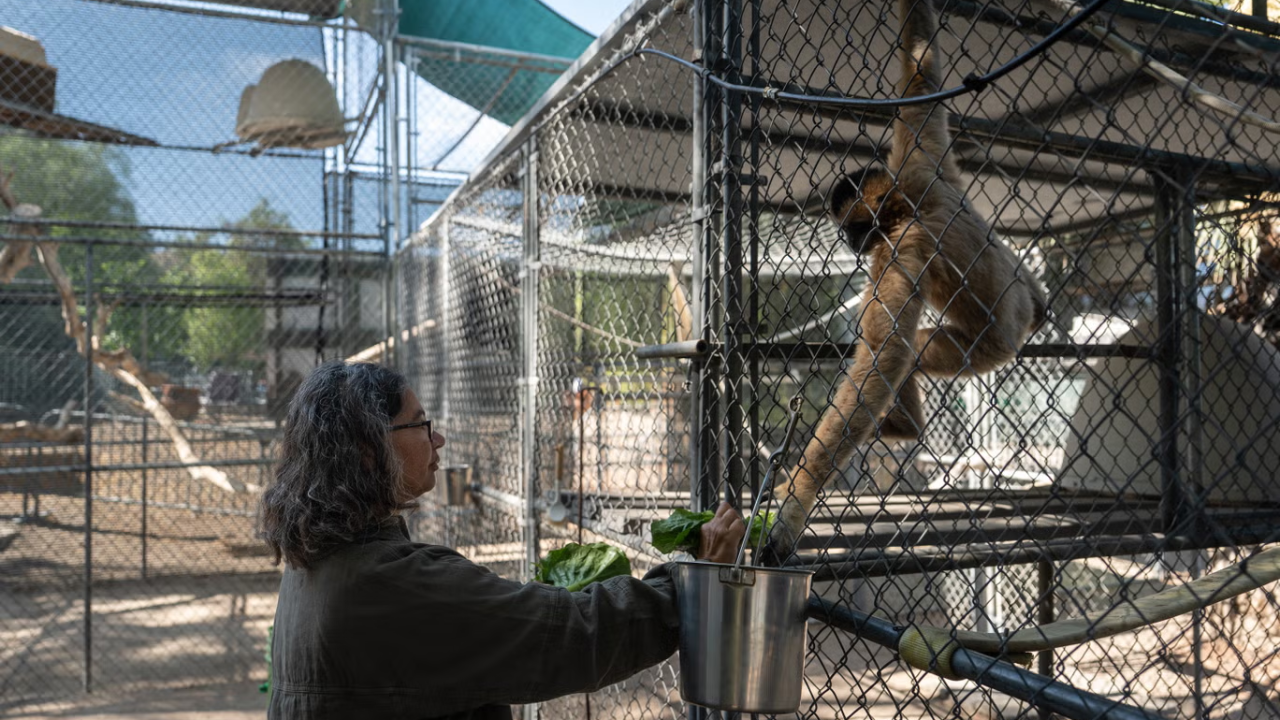
Every morning, long before the commuter traffic on the nearby highways swells, a strange and piercing sound cuts through the dry brush of the Santa Clarita Valley. It begins as a series of low, resonant bubbles, building rapidly into an escalating sequence of high-pitched whoops and lyrical calls that echo across the dry hills north of Los Angeles.
This is the morning song of the gibbon. It is a vocal display so complex and powerful that it can carry for miles through dense rainforest canopy. Yet here, these songs bounce off chain-link enclosures and rustic wooden platforms under a blazing Southern California sun. For a more detailed analysis into similar topics, we recommend: this related article.
For fifty years, the Gibbon Conservation Center has operated quietly in this arid pocket of Saugus. Founded in 1976 by Alan Mootnick, a self-taught primatologist who ran a local home remodeling business, the sanctuary houses roughly forty animals spanning five species and all four distinct gibbon genera. It remains the only institution on the planet dedicated entirely to housing and breeding every single genus of these small, slender Asian apes.
To understand why this facility matters, one must look past the picturesque valley setting and confront an uncomfortable biological reality. Gibbons are among the most overlooked primates on Earth. Overshadowed by the massive conservation campaigns directed at chimpanzees, gorillas, and orangutans, these small apes face an extinction crisis driven by relentless deforestation, illegal logging, and the ruthless Southeast Asian pet trade. For some species sheltered within these California enclosures, fewer than two thousand individuals remain in the wild. For further context on this topic, detailed analysis can be read on Al Jazeera.
The Blueprint of a Grassroots Sanctuary
Mootnick did not start with a multi-million-dollar endowment or backing from a major zoological society. In 1976, he responded to a classified advertisement, acquired a pet gibbon named Spanky, and found his life permanently altered. Four years later, utilizing capital scraped together from his contracting work, he purchased a ten-acre plot of scrubland.
He had no formal university degree in evolutionary biology. What he possessed instead was an obsessive, granular dedication to animal husbandry. Mootnick spent decades studying behavioral patterns, corresponding with global field researchers, and refining the architectural design of enclosures to mimic the arboreal realities of the tropics. He understood that gibbons do not walk or scramble like typical monkeys; they brachiate, swinging beneath branches with breathtaking velocity and specialized wrist anatomy.
When Mootnick died following heart surgery complications in 2011, the institution faced an existential threat. Leadership fell to Gabriella Skollar, a researcher who had relocated from Hungary in 2005 specifically to study under him. What was intended to be a temporary academic stint turned into a lifelong tenure. Skollar now lives on-site, managing a skeleton crew of dedicated animal caretakers and volunteers who rely primarily on public donations, memberships, and grants to keep the gates open.
The Mechanics of Captive Survival
Maintaining a population of endangered apes outside their native environment is an exercise in constant logistical compromise. Captive breeding programs require meticulous genetic tracking to prevent inbreeding depression, a risk magnified when dealing with isolated populations.
When a genetic line needs fresh vigor, international logistics come into play. For instance, the facility recently coordinated the transfer of two pileated females, named Iszie and Boo, to distant institutions—one bound for a safari park in France and the other to the Cincinnati Zoo—to pair with compatible mates. These high-stakes animal swaps are quiet diplomatic victories, requiring months of veterinary clearance, international permits, and specialized transport crates.
Yet, managing these animals involves more than shuffling coordinates on a spreadsheet. Gibbons live in tight family units characterized by strict monogamy and intense territorial bonds. Introducing a new partner to an adult gibbon can be a delicate, high-risk procedure. If a pair fails to bond, violent aggression can erupt instantly. Caretakers spend weeks observing behavioral cues through mesh partitions, monitoring body posture and vocalizations long before the physical doors are opened between enclosures.
The Broader Anthropocene Toll
The threats facing gibbons in the wild have intensified rather than abated over the past half-century. In countries like Indonesia, Malaysia, and Vietnam, lowland rainforests are systematically clear-cut to make way for industrial palm oil plantations and paper pulp production. As the canopy shatters into isolated fragments, gibbons lose their primary highway system. Unable to travel safely across open ground without exposing themselves to predators or poachers, family groups starve or become genetically isolated.
Compounding this habitat destruction is the commercial wildlife trade. Infant gibbons are prized targets for poachers. To capture a baby, hunters frequently have to kill the mother, who will fiercely defend her offspring until her last breath. Those infants that survive the traumatic capture often end up chained outside rural storefronts or smuggled into urban illegal pet markets before authorities intervene. Facilities like the one in Saugus serve as the ultimate safety net for these rescued victims—individuals that can rarely be reintroduced safely into the wild due to trauma, human habituation, or the complete destruction of their native home ranges.
Science in the Scrubland
Despite its modest physical footprint, the center punches far above its weight class in the global scientific community. Primatologists, anthropologists, and acoustic researchers regularly make the pilgrimage to the Santa Clarita Valley to record vocalizations and analyze social behavior.
Because gibbons produce complex, sexually dimorphic songs that function both in mate attraction and territorial defense, their acoustics offer a living laboratory for studying the evolution of communication. Researchers can track subtle dialects and structural variations across different species and hybrids, data that helps field biologists identify populations and monitor cryptic species remaining in remote Asian jungles.
The work happening here forces a confrontation with an uncomfortable ecological reality. Modern conservation is rarely about pristine restoration; it is an era of triage. While field organizations fight desperately to protect remaining pockets of Southeast Asian jungle, sanctuaries in consumer nations shoulder the burden of genetic archiving and emergency rescue.
The morning songs ringing out over the dry California hills do not belong to this landscape. They belong to the endangered mists of tropical Asia. For now, this dusty ten-acre plot remains the only place on earth where the full vocal spectrum of the gibbon family can still be heard in its entirety, a fragile monument holding the line against permanent silence.

/article-new/2021/09/iphone-13-pro-max-cameras.jpg)