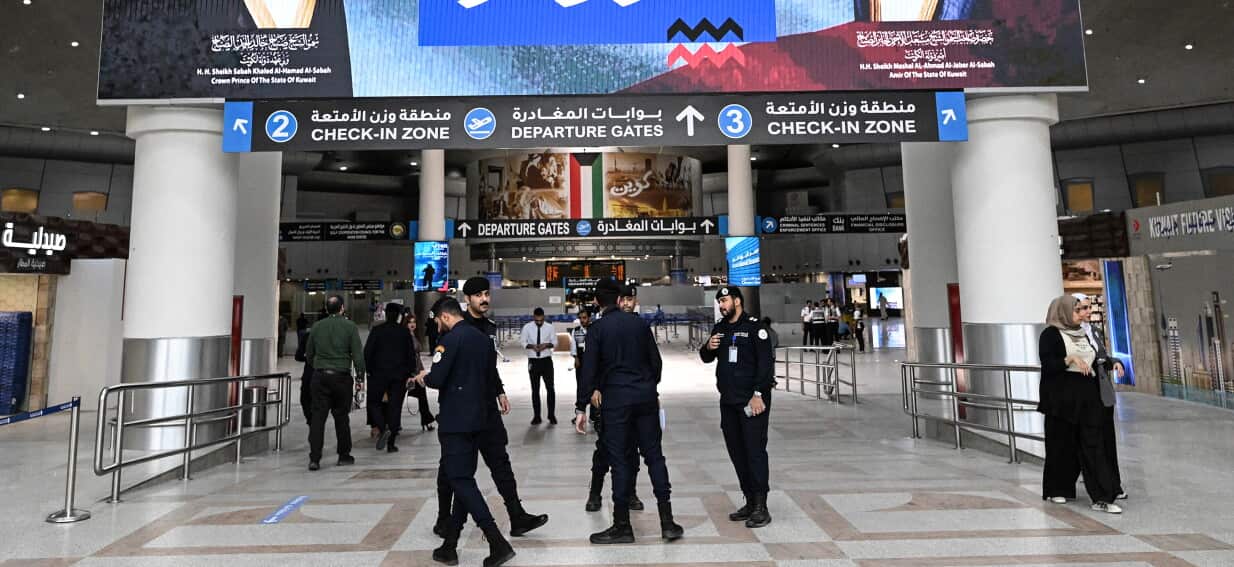
A single drone strike on Kuwait International Airport did more than halt regional flights and claim a human life. It exposed a terrifying reality that commercial aviation has ignored for a decade. While Washington and Tehran trade blame for the escalating military friction in the region, the actual mechanism of the disruption points to a systemic vulnerability in civilian infrastructure. The global aviation network is entirely unprepared for low-cost, asymmetrical drone warfare.
This is not a temporary geopolitical skirmish. It is a fundamental shift in how airspace is controlled, contested, and compromised.
The Cheap Weapon Shuttering Billion Dollar Hubs
Military analysts routinely focus on state-on-state missile capabilities, yet the disruption in Kuwait required neither a ballistic missile nor a state-of-the-art fighter jet. It required a loitering munition costing less than a used sedan.
The math is brutal for civilian defense. A commercial airport relies on predictable, highly regulated airspace. Air traffic control systems are designed to track massive aluminum hulls moving at hundreds of knots, not carbon-fiber drones drifting at low altitudes with minimal radar cross-sections. When one of these devices breaches the perimeter, the entire apparatus grinds to a halt.
Airports cannot gamble with passenger safety. If a drone is detected near a runway, the immediate response is a total ground stop. Diverting dozens of wide-body aircraft to alternative hubs in Saudi Arabia or the United Arab Emirates costs airlines millions of dollars per hour in fuel, crew logistics, and passenger compensation. The perpetrators of these attacks understand this economic leverage perfectly. They do not need to destroy a fleet of aircraft to win. They only need to force a closure.
Why Traditional Air Defense Fails Civilian Hubs
Deploying military-grade anti-air batteries around civilian installations sounds like an obvious solution. In practice, it introduces a logistical and safety nightmare.
- Collateral Damage: Firing interceptor missiles or heavy ammunition in a densely populated urban area surrounding a major metropolitan airport creates immense risk from falling debris.
- Radar Blind Spots: Civilian radar is calibrated to filter out ground clutter and birds. Altering these thresholds to detect small drones increases the risk of false positives, rendering the system unusable for actual traffic management.
- Electronic Warfare Risks: Jamming the radio frequencies used by drones can inadvertently interfere with the highly sensitive navigation and communication systems used by commercial airliners during critical landing phases.
The gap between military readiness and civilian vulnerability has become a canyon.
The Mirage of Immediate Technical Solutions
Security firms are rushing to market with counter-drone technologies, promising silver-bullet fixes ranging from directional jamming to trained hawks and net-firing interceptor drones. The industry is buying into a false sense of security.
The most prominent technology involves radio frequency (RF) jamming. By severing the link between the operator and the drone, these systems force the craft to land or return to its origin. However, modern hostile drones are increasingly autonomous. They use pre-programmed GPS coordinates or optical terrain mapping, meaning they do not rely on a continuous radio link at all. A jammer is useless against a machine that isn't listening to an operator.
The Problem with Kinetic Interception
Widespread adoption of directed-energy weapons, such as lasers or high-powered microwaves, faces intense regulatory scrutiny. No aviation authority is currently willing to authorize the use of high-energy lasers near commercial fuel depots or passenger terminals. The risk of missing the target and striking a passenger cabin or an external fuel tank is simply too high.
This leaves airports relying on passive detection systems, which can tell security teams that a threat exists but do not offer a reliable mechanism to neutralize it before it reaches the tarmac.
Geopolitical Blame Shifts the Focus from Ground Reality
The diplomatic theater following the Kuwait incident followed a weary, predictable script. Washington pointed directly to Iranian-backed proxy networks, citing weapon fragments that match known regional designs. Tehran issued a swift denial, suggesting the attack was a localized reaction to Western interference.
This rhetorical loop obscures the more dangerous truth. The proliferation of drone technology has advanced past the point of state control. The blueprints, software, and components required to build a long-range, payload-bearing drone are readily available on global markets. Even if state actors agree to a ceasefire, the knowledge and materials remain in the hands of non-state actors, militant factions, and criminal enterprises.
The focus on state attribution allows international bodies to treat this as a diplomatic issue rather than an infrastructural crisis. It shifts the burden of response from airport operators and civil aviation authorities to military commanders, ensuring that the vulnerabilities at the actual passenger terminals remain unaddressed.
The Economic Ripples Through Global Logistics
The Gulf region serves as the geographic hinge for global aviation logistics, connecting Europe, Asia, and Africa. A prolonged vulnerability at a major hub like Kuwait ripples through the entire global supply chain.
Air cargo carriers, which transport high-value, time-sensitive goods like electronics and pharmaceuticals, operate on razor-thin margins and tight schedules. If the airspace over the Gulf becomes unpredictable, logistics companies must reroute flights over more expensive, circuitous paths around Africa or through Central Asia. The increased fuel burn and extended flight times translate directly into higher costs for consumers worldwide.
Insurance markets are already reacting. Underwriters are reassessing the risk profiles for aircraft operating in or near the Persian Gulf. Premium hikes for war-risk insurance do not just affect airlines flying into conflict zones; they raise the operational baseline for every carrier utilizing that airspace.
The Structural Realignment of Airspace Security
Resolving this crisis requires a complete overhaul of how civilian airspace is managed and legally defined. The traditional boundary between an airport's internal security and a nation's military defense has dissolved.
Airports must be integrated directly into national air defense networks, treating the perimeter not as a fence on the ground, but as an inverted dome extending miles into the sky. This requires a level of intelligence sharing and operational cooperation that currently does not exist between civil aviation authorities and military command structures. It also demands a new legal framework that allows for the immediate neutralization of airborne threats over civilian areas without lengthy bureaucratic delays.
The incident in Kuwait was not an isolated act of terror. It was an opening salvo in a new era of infrastructure vulnerability, proving that the systems built to connect the physical world can be paralyzed by a handful of cheap components and a line of code.