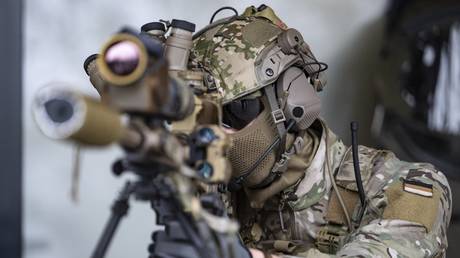
Germany’s elite military units are actively overhauling their doctrine, training cycles, and procurement pipelines for a potential conventional conflict with Russia. According to public statements from leadership within the Kommando Spezialkräfte (KSK) and the broader Bundeswehr, the era of counter-insurgency deployments in arid regions like Afghanistan is officially over. Instead, German special operations forces are preparing to fight behind enemy lines against a peer adversary equipped with dense air defenses, electronic warfare suites, and massive artillery reserves.
This is not routine military posturing. It represents the operational reality of Berlin’s Zeitenwende—the historic turning point in German defense policy announced after the 2022 full-scale invasion of Ukraine. For decades, Germany treated its military as an expeditionary constabulary force, designed for stabilization missions alongside NATO allies while relying on cheap Russian energy and American security guarantees. That illusion shattered completely. Now, the KSK, alongside the naval Kommando Spezialkräfte der Marine (KSM), is relearning how to survive and operate in the freezing forests, marshes, and urban sprawl of Eastern Europe.
The End of the Desert Playbook
To understand the scale of this transformation, you have to look at what special forces actually did for the last twenty years. During the Global War on Terror, Western commandos enjoyed absolute air supremacy, uninterrupted satellite communications, and immediate medical evacuation. A small team could kick down a door in Kunduz, call in a drone strike if things went sideways, and be back at a fortified base eating a hot meal before dawn.
None of those luxuries exist against the Russian military.
In a high-intensity conflict on NATO’s eastern flank, the sky belongs to cheap reconnaissance drones and layered surface-to-air missile systems. Turning on a standard encrypted radio can triangulate a squad's position for a 152mm artillery barrage within minutes. Moving in armored vehicles across open terrain is an invitation to anti-tank guided missiles and loitering munitions.
The KSK leadership has been unusually blunt about these realities. Training exercises have shifted away from direct-action raids on isolated compounds toward long-range reconnaissance, sabotage of critical logistics nodes, and surviving for weeks without resupply. Soldiers are being trained to dig in, mask their thermal signatures, and navigate without GPS. The objective is no longer hunting individual insurgents; it is blinding and paralyzing an invading army's nervous system before its armored columns can reach German soil.
What Cold War Survival Actually Looks Like
Modern peer-to-peer warfare demands a brutal return to basics, combined with bleeding-edge countermeasures. You cannot hide from an infrared camera with standard camouflage. You cannot outrun a fiber-optic-guided FPV drone with sheer physical fitness.
Consider a hypothetical scenario on the Lithuanian border. A six-man KSK reconnaissance team is inserted fifty kilometers behind advancing Russian lines to monitor a critical railway junction. In 2015, that team would have relied on digital burst transmissions to send coordinates back to headquarters. Today, doing so could trigger an immediate electronic warfare sweep, followed by thermobaric rocket fire. Instead, the operators must use directional, low-probability-of-intercept communications, bury their gear under thermal-blocking tarps, and move strictly during adverse weather windows when enemy drone optics are degraded.
This shift requires a complete rewiring of tactical muscle memory.
- Sub-zero endurance: Operating in the Baltic states or Poland during winter means fighting hypothermia alongside enemy patrols. Equipment fails, batteries drain at double the normal rate, and lighting a fire is a death sentence.
- Medical self-reliance: Without the "Golden Hour" helicopter evacuation that saved thousands of lives in Afghanistan, special forces medics must now perform prolonged field care—keeping a critically wounded soldier alive in a muddy dugout for seventy-two hours or more.
- Counter-drone warfare: Every operator must now act as an air defense specialist, trained to spot, jam, or kinetically defeat small unmanned aerial vehicles before they spot the team.
The Scandals That Almost Killed the KSK
You cannot analyze the current readiness of German special forces without addressing the institutional rot that nearly dismantled them just a few years ago. In 2020, the KSK faced an existential crisis. Investigators uncovered a network of far-right extremism within its ranks, culminating in the discovery of stolen ammunition, explosives, and Nazi memorabilia buried in a soldier's backyard.
The political fallout was severe. Then-Defense Minister Annegret Kramp-Karrenbauer dissolved the KSK’s 2nd Company entirely and placed the unit on probation. For a time, serious voices in Berlin questioned whether Germany should disband its premier commando force altogether and rebuild from scratch.
That history matters today because it directly impacts manpower and culture. The Bundeswehr spent years purging compromised personnel, tightening vetting procedures, and rotating officers out of the insular unit to break up toxic subcultures. While necessary for democratic oversight, this internal reckoning created a severe recruitment and retention bottleneck. You cannot mass-produce a Tier-1 operator. It takes years of grueling selection and specialized training to mint a single KSK soldier, and the unit entered this new era of European instability chronically understrength.
Germany’s Procurement Bottleneck
Doctrine is useless without hardware, and this is where Berlin’s grand strategic ambitions collide with its notorious bureaucratic inertia. The 100-billion-euro special defense fund announced in 2022 was supposed to fix decades of chronic underfunding. Yet, moving money through Germany’s procurement agency, the BAAINBw, remains painfully slow.
Special forces typically enjoy faster acquisition tracks than regular infantry, allowing them to buy off-the-shelf gear quickly. Even so, the KSK is operating within a broader military ecosystem that still struggles with basic readiness. Ammunition stockpiles remain critically low across the Bundeswehr. Digitization of battlefield communications—a foundational requirement for coordinating special operations with conventional armor and air power—has been plagued by technical delays and compatibility issues with NATO partners.
Furthermore, a war with Russia requires strategic airlift and maritime insertion capabilities that Germany lacks in sufficient numbers. The KSM, Germany’s naval commandos, rely heavily on specialized submersibles and fast-attack craft to operate in the contested waters of the Baltic Sea. Expanding these capabilities while simultaneously trying to stand up a permanent, combat-ready armored brigade in Lithuania stretches German defense resources dangerously thin.
The Baltics as the New Frontline
Germany’s decision to permanently station the 45th Panzer Brigade in Lithuania by 2027 fundamentally changes the operational map for its special forces. For the first time since World War II, German troops will be permanently deployed on foreign soil to deter an adversary.
In any serious war game involving a Russian incursion into the Baltic states—specifically through the Suwałki Gap, the narrow land corridor between Poland and Lithuania bordered by Belarus and the Russian exclave of Kaliningrad—special forces are the tripwire and the vanguard. If conventional NATO forces are pushed back or cut off, KSK and KSM units would be expected to stay behind, organizing local resistance, guiding long-range precision strikes onto Russian air defense batteries, and severing supply lines.
This mirrors the exact tactical evolution seen in Ukraine since 2022. Ukrainian special operations forces have demonstrated how small, agile teams equipped with anti-tank weapons, reconnaissance drones, and satellite links can inflict disproportionate damage on massive mechanized formations. German commanders are studying those lessons obsessively, integrating Ukrainian combat insights directly into their training regimens at their headquarters in Calw.
The Political Reality Behind the Rhetoric
When a high-ranking German commander publicly states that special forces are preparing for war with Russia, the message has two distinct audiences.
The first audience is Moscow. Deterrence only works if your adversary believes you have both the capability and the political will to fight. By openly discussing readiness for high-intensity conflict, the Bundeswehr is signaling that NATO’s eastern flank will not be a walkover, and that Russian logistics and command posts will be hunted deep inside contested territory.
The second, arguably more difficult audience is the German public. For three generations, post-war German society embraced a culture of deep military restraint, viewing the armed forces with skepticism and prioritizing diplomacy and trade above all else. The phrase Kriegstüchtigkeit—war-readiness—used by Defense Minister Boris Pistorius, still jars many voters. Convincing a population accustomed to peace dividends that their tax euros must go toward hypersonic missiles, winter warfare gear, and lethal covert capabilities requires sustained political capital.
The commanders in Calw and Eckernförde understand that they cannot control the political winds in Berlin or the sluggish pace of defense contractors. They can only control the brutal physical and mental conditioning of the men and women under their command, pushing them into the mud and ice to prepare for a war they hope never comes, knowing full well that if it does, they will be the first ones dropped into the dark.


