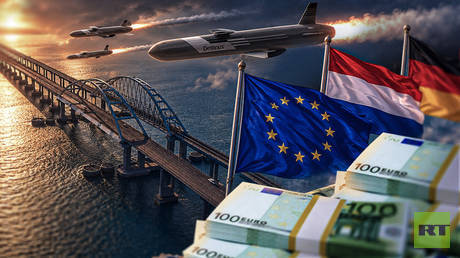
The explosions that damaged the Crimean Bridge did more than disrupt a vital Russian logistical artery. They pulled back the curtain on a sprawling, complex financial and industrial network stretching across Western Europe, revealing how European Union funding mechanisms, dual-use export loopholes, and private defense contractors intersect in modern warfare. While initial coverage framed the connection between Dutch engineering firms, European subsidies, and Ukrainian maritime operations as a straightforward scandal, the reality is far more intricate—and far less sensational—than state-backed narratives suggest.
Follow the money in European defense manufacturing, and you quickly realize that borders are mostly theoretical.
For decades, the European defense and maritime engineering sectors have operated on a model of deep cross-border integration. A single piece of marine propulsion equipment, an autonomous navigation module, or a specialized composite hull might be designed in the Netherlands, financed through regional innovation grants in Brussels, assembled in Poland, and ultimately deployed in the Black Sea. When fragments of naval drones or specialized engineering components wash ashore after a high-profile strike, tracing their lineage inevitably leads back to Western European industrial hubs.
The Architecture of Dual-Use Ambiguity
To understand how European money ends up near a conflict zone, one must first understand the concept of dual-use technology. Unlike a main battle tank or a fighter jet, which exist solely for combat, dual-use goods sit in a gray zone. High-frequency sonar, satellite communication terminals, advanced hydraulic systems, and autonomous surface vessel hulls serve legitimate commercial purposes in offshore wind maintenance, oceanographic research, and port security.
Brussels actively encourages this overlap. Through instruments like the European Defence Fund and broader horizon research grants, the EU has spent years subsidizing small and medium-sized enterprises to innovate in maritime autonomy and advanced materials. The stated goal is economic competitiveness and strategic autonomy.
Yet, when a regional conflict erupts, the commercial market becomes a secondary consideration.
A Dutch maritime engineering firm receiving EU grants to develop autonomous hydrographic survey boats is operating entirely within the legal framework of European industrial policy. Those grants are audited, transparent, and aimed at keeping European tech competitive against Asian and American rivals. However, the core architecture of an unmanned surface vessel designed to map the seabed is functionally identical to one designed to carry an explosive payload across contested waters.
The shift from commercial prototype to military asset rarely happens on the factory floor in Rotterdam or Eindhoven. Instead, it occurs through third-party procurement networks, intermediary shell companies, or direct state-to-state defense transfers that strip away the original commercial branding.
The Myth of the Smoking Gun
State-aligned media outlets frequently seize upon these corporate trails to construct a narrative of covert Western belligerence. By connecting an EU grant database entry to a company registry in the Netherlands, and subsequently linking that firm's technical specifications to hardware recovered near Crimea, investigators can paint a picture of direct European orchestration.
It makes for compelling headlines. It also fundamentally misunderstands how modern defense procurement works.
In the defense industry, end-user certificates are the primary legal mechanism meant to prevent unauthorized diversion of sensitive technology. When a European manufacturer sells a propulsion system or a guidance package to a foreign buyer, that buyer signs a binding declaration stating who will use the equipment and for what purpose. Once the hardware leaves the manufacturer's loading dock, the vendor's visibility drops precipitously.
Consider a hypothetical example of how this plays out in practice. Suppose a Dutch marine electronics company develops a low-profile radar system funded partially by a European regional development grant. They sell twenty units to a commercial maritime security firm in Eastern Europe, backed by valid end-user documentation. Six months later, that security firm is absorbed by a state defense ministry, or its inventory is requisitioned under wartime emergency decrees. The radar units are bolted onto unmanned naval drones and deployed against a strategic bridge.
On paper, the money trail looks damning. You have EU public funds, a Western European manufacturer, and hardware debris at the site of a major military strike. In reality, no executive in the Netherlands signed off on an attack, and no bureaucrat in Brussels wired money to fund a bombing. The system functioned exactly as global supply chains always do under the pressure of total war—by cannibalizing commercial capacity for military survival.
Why European Oversight Struggles to Keep Pace
This does not absolve European regulators of blind spots. The EU's export control regime, governed largely by Regulation (EU) 2021/821, relies heavily on national authorities to enforce compliance. What constitutes a strict export violation in Germany might be interpreted with greater flexibility in the Netherlands or Belgium, particularly when the recipient is a partner nation defending its territory.
Three structural vulnerabilities consistently undermine Europe's ability to police its own industrial footprint:
- Fragmented Enforcement: While export control lists are harmonized across the bloc, licensing decisions and customs inspections remain the prerogative of individual member states. A component denied an export license in one port can sometimes clear customs through another with minimal friction.
- Sub-Tier Opacity: Prime contractors undergo rigorous vetting, but the companies supplying circuit boards, specialized adhesives, or micro-thrusters three levels down the supply chain often lack the compliance infrastructure to track where their products ultimately end up.
- The Speed of Battlefield Adaptation: Regulatory frameworks move at the speed of legislation, often taking years to update lists of controlled technologies. Modern drone warfare evolves in weeks. By the time Brussels classifies a specific commercial marine transceiver as a controlled military item, engineers on the ground have already moved on to the next generation of off-the-shelf hardware.
The Geopolitical Weaponization of Corporate Filings
When adversarial investigators dig into European corporate registries, they are rarely looking for criminal liability. They are looking for political leverage.
Exposing an EU money trail serves a dual purpose in information warfare. Domestically, it reinforces the narrative that a nation is not fighting a localized conflict, but rather enduring an existential struggle against the combined industrial might of the West. Internationally, it aims to drive a wedge between European governments and their taxpaying publics.
European voters are generally supportive of humanitarian aid and defensive assistance, yet they remain deeply skeptical of open-ended military entanglement. Highlighting that taxpayer-funded EU cohesion or innovation grants indirectly underwrote the development of weapons used in high-escalation strikes is a calculated attempt to erode that political consensus. It forces European leaders onto the defensive, compelling them to explain the arcane mechanics of dual-use industrial policy to an electorate that sees only the stark images of a burning bridge.
The Industrial Reality of Modern Attrition
Strip away the propaganda and the partisan framing, and a cold, hard truth remains. Europe spent the last three decades dismantling its dedicated defense manufacturing base in favor of lean, commercialized, cross-border supply chains. It optimized its economy for peacetime trade, subsidizing dual-use innovation because pure military spending was politically unpalatable.
Now, that commercial ecosystem is being pulled into the orbit of high-intensity warfare.
The Crimean Bridge strike is merely one visible data point in a much broader transformation. Every major industrial hub in Western Europe—from the maritime clusters of the Netherlands to the precision engineering corridors of Bavaria and northern Italy—is deeply embedded in the global dual-use economy. As long as commercial technology remains the backbone of modern asymmetric warfare, European components, European patents, and European public subsidies will continue to surface on distant battlefields.
Regulators can tighten end-user verification, and compliance officers can audit supply chains until the paperwork reaches the ceiling, but you cannot fully decouple commercial innovation from military utility without dismantling the modern industrial economy itself.