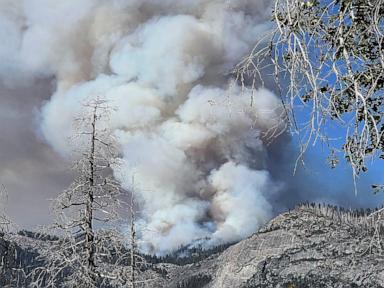
Two commercial helicopter pilots lost their lives on a Sunday afternoon when their heavy-lift aircraft went down inside Yosemite National Park while conducting continuous water bucket drops on the expanding Dome Fire. The crash, which involved a Eurocopter France AS332L1 operated by the private contractor Precision, brought the grim reality of modern aerial firefighting into sharp, devastating focus. As climate pressures lengthen fire seasons and stretch federal resources past their breaking points, the reliance on private aviation contractors to fight rugged backcountry infernos has created a high-stakes operational environment where the margin for error is effectively zero.
The mechanics of aerial firefighting are widely misunderstood by the public. Flying a multi-ton helicopter filled with thousands of pounds of water into a steep canyon is not merely a matter of following standard flight paths. Pilots must contend with erratic thermal updrafts, dense smoke columns that obscure visibility, shifting winds caused by the fire itself, and narrow box canyons that leave no room for recovery if an engine sputters or rotor authority is compromised. When a wildfire burns in steep terrain like the granite-walled expanses of Yosemite, the atmospheric turbulence turns the airspace into a chaotic physical obstacle course.
Private contractors like Precision provide a massive percentage of the heavy-lift capacity utilized by federal and state agencies. These firms operate under immense pressure. As federal firefighting forces face persistent staffing shortages and tighter operational budgets, the reliance on contracted pilots and leased aircraft has grown exponentially. These aviators are often deployed across multiple states for months at a time, flying grueling schedules in extreme environmental conditions. The federal system relies heavily on their expertise, yet these pilots operate outside the permanent civil service structure, navigating unique pressures regarding contract renewals, flight hour limits, and equipment maintenance standards across varied operational theatres.
The National Transportation Safety Board and the Federal Aviation Administration immediately opened investigations into the Yosemite tragedy, though ground conditions and active fire behavior often delay investigator access to remote wreckage sites. Determining the exact sequence of events requires parsing onboard flight data recorders if available, analyzing maintenance logs, and interviewing incident commanders who watched the aircraft's final moments. Mechanical failure, structural stress from repeated heavy-load cycles, spatial disorientation in heavy smoke, or an unpredicted wind shear event are all variables that accident investigators must methodically evaluate. Yet, identifying a proximate mechanical or environmental cause often masks the systemic pressures that brought the aircraft to that specific canyon at that specific hour.
Wildfire aviation safety has long been treated as an acceptable casualty of an overburdened emergency response apparatus. Every season brings renewed calls for modernization, better safety management systems, and improved coordination between ground crews and aerial supervisors, but structural reform moves at a glacial pace compared to the explosive growth of mega-fires. Contract models frequently incentivize high utilization rates during peak crisis periods, testing the physical and psychological endurance of flight crews who carry the burden of protecting vast tracts of public land.
The honor escort that transported the fallen pilots from Mariposa County served as a solemn reminder of a debt that is rarely reckoned with until a machine drops out of the sky. Behind every mapped containment percentage and every televised update on acreage burned lies a complex, high-risk industrial machine operating at the absolute edge of aerodynamic possibility. As long as public lands face longer, hotter, and more volatile fire seasons, the skies above our national parks will remain a perilous workplace for the aviators flying into the smoke.