China conducts combat readiness patrols around disputed shoals in the South China Sea to normalize its military presence, exhaust neighboring coast guards, and establish effective administrative control without firing a single shot. When the People's Liberation Army Southern Theater Command announces another round of sea and air patrols near Scarborough Shoal or Second Thomas Shoal, Western headlines usually treat it as a sudden spike in regional tension. It is not a spike. It is a metronome.
For decades, watching maritime security in the Indo-Pacific has meant watching the gradual erosion of international norms through sheer physical persistence. Routine wire reports focus on the immediate hardware—destroyers, bombers, and coast guard cutters—while missing the broader operational doctrine at work. Beijing is executing a strategy of coercive gradualism. By turning extraordinary military deployments into unremarkable daily bureaucracy, China alters the status quo on the water long before diplomats can convene an emergency summit.
The Mechanics of Combat Readiness Patrols
To understand why these patrols matter, you first have to strip away the military jargon. A standard naval patrol is about presence and surveillance. A combat readiness patrol is fundamentally different. It signals that the units involved—typically a mix of People's Liberation Army Navy (PLAN) surface combatants, PLA Air Force (PLAAF) fighter jets and bombers, and China Coast Guard (CCG) vessels—are operating with live ordnance, active fire-control radars, and integrated command-and-control networks.
They are not merely transiting through contested waters. They are rehearsing blockade scenarios, practicing electronic warfare jamming, and establishing real-time targeting data over specific geographic choke points.
The choreography is deliberate. Usually, these announcements coincide with joint naval drills conducted by the Philippines, the United States, Australia, or Japan. When Manila and Washington run a Maritime Cooperative Activity, Beijing responds within hours by flooding the perimeter of a disputed feature like Scarborough Shoal with naval assets. The message to regional capitals is blunt: external alliances will not deter local dominance.
The Gray Zone Blur
The most dangerous element of these operations is the deliberate blurring of military and law enforcement roles. In traditional maritime doctrine, navies fight wars and coast guards enforce domestic law. Beijing has erased that boundary.
Under China's 2021 Coast Guard Law, the CCG is authorized to use lethal force against foreign vessels operating in waters China claims as its own. Furthermore, the CCG answers directly to the Central Military Commission, the exact same body that commands the PLA. When a combat readiness patrol unfolds around a disputed shoal, the white hulls of the coast guard act as the inner ring of enforcement, using water cannons, high-intensity lasers, and shoulder-banging maneuvers to physically block foreign ships. Meanwhile, the gray hulls of the PLA Navy lurk just over the horizon, ready to escalate if a smaller nation dares to defend itself with naval force.
Why Scarborough and Second Thomas Shoal Matter
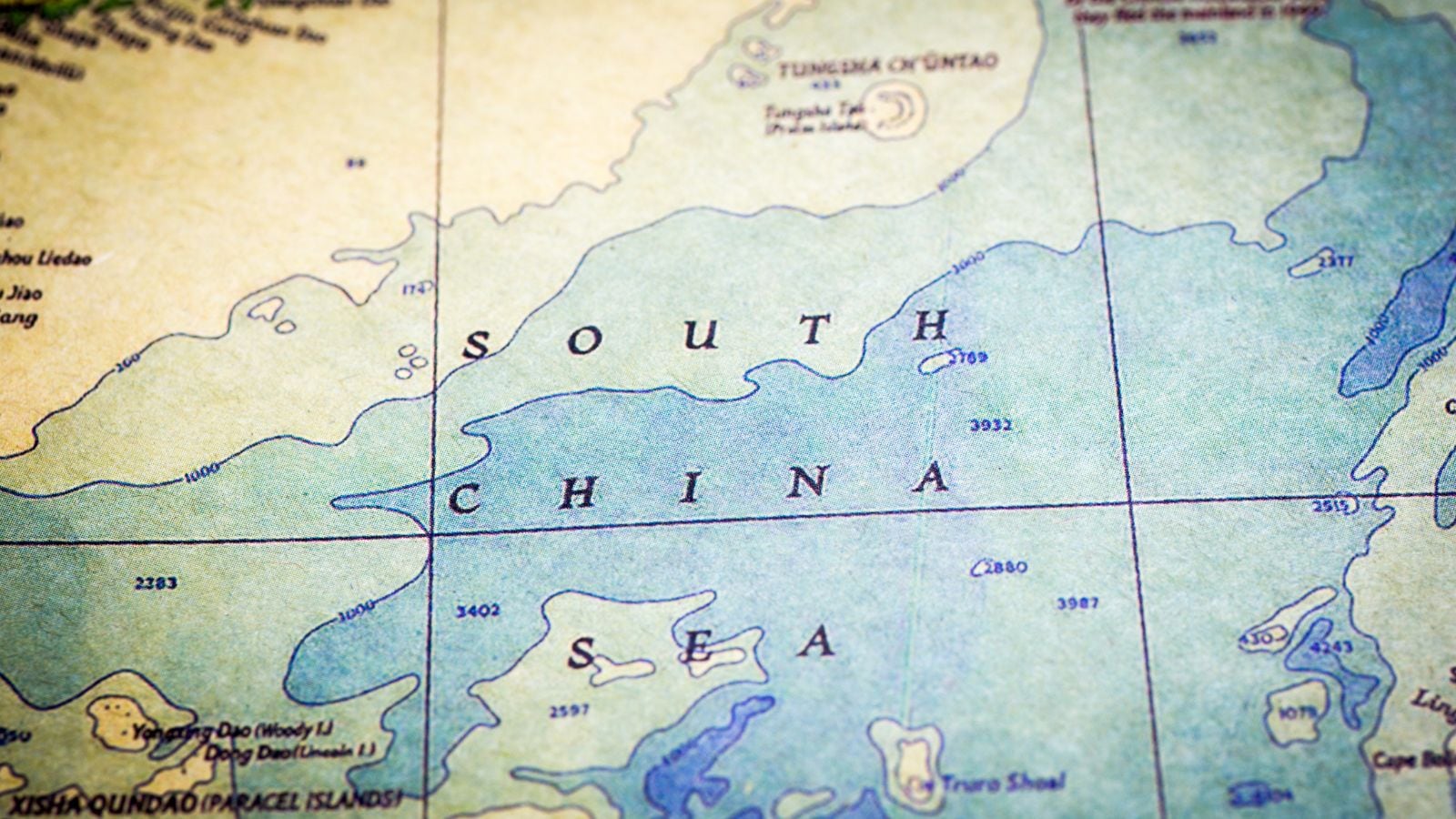
Not all rocks and reefs in the South China Sea carry the same strategic weight. While the Spratly and Paracel archipelagos contain dozens of contested features, Beijing's combat readiness patrols disproportionately target two specific locations: Scarborough Shoal (known in China as Huangyan Island and in the Philippines as Bajo de Masinloc) and Second Thomas Shoal (Ayungin Shoal).
Geography dictates everything here. Scarborough Shoal sits roughly 120 nautical miles west of the Philippine island of Luzon—well within the Philippines' internationally recognized 200-nautical-mile Exclusive Economic Zone (EEZ), and more than 500 nautical miles from the nearest Chinese coastline. Crucially, it lies just a short flight away from Subic Bay and Clark Air Base, two major military facilities that the United States has regained rotational access to under the Enhanced Defense Cooperation Agreement (EDCA).
If Beijing ever decides to dredge Scarborough Shoal and build an artificial island complete with a 3,000-meter runway and surface-to-air missile batteries—mirroring what it already did at Mischief Reef, Subi Reef, and Fiery Cross Reef—it would complete a strategic triangle in the South China Sea. Radar and missile coverage from Woody Island in the north, the Spratlys in the south, and Scarborough in the east would effectively allow Beijing to monitor and contest every square mile of airspace and sea lane in the region.
The Attrition War at Second Thomas Shoal
Further south, Second Thomas Shoal presents a different tactical problem. Since 1999, the Philippines has maintained a tiny detachment of marines aboard the BRP Sierra Madre, a rusted World War II-era landing ship deliberately grounded on the reef to serve as an outpost.
Beijing's patrols around Second Thomas Shoal are designed to sever the logistics lifeline to that ship. Every month, Manila must send civilian supply boats escorted by Philippine Coast Guard vessels to deliver food, water, and construction materials to prevent the hull from disintegrating into the sea. China uses its patrols to impose a localized quarantine. By deploying dozens of maritime militia trawlers—fishing boats with reinforced steel hulls and military-grade communications gear—alongside CCG cutters and PLA destroyers, Beijing forces Manila to expend enormous diplomatic, financial, and physical capital just to deliver groceries to a dozen sailors.
The Legal Fiction of the Nine-Dash Line
To justify sending warships into another country's Exclusive Economic Zone, Beijing relies on its ambiguous "nine-dash line" (recently expanded to ten dashes on official maps), which encompasses roughly 90 percent of the South China Sea.
In July 2016, an arbitral tribunal constituted under the United Nations Convention on the Law of the Sea (UNCLOS) issued a landmark ruling in a case brought by the Philippines. The tribunal found that China's historic rights claims within the nine-dash line had no legal basis under international law. It also ruled that Scarborough Shoal is a high-tide rock incapable of generating its own EEZ, and that Second Thomas Shoal is a low-tide elevation firmly within the Philippines' sovereign waters.
China refused to participate in the arbitration and rejected the ruling as "waste paper." Here lies the fundamental friction driving every combat readiness patrol: the collision between rules-based international maritime law and unilateral historical claims backed by superior naval tonnage.
Law without an enforcement mechanism is merely a suggestion. Because the Permanent Court of Arbitration has no navy, Beijing uses its own fleet to enforce its preferred reality on the water. Every time a foreign vessel asks permission to enter waters near a disputed shoal, or alters its course to avoid a Chinese destroyer, Beijing logs it as evidence of de facto administrative jurisdiction.
The Asymmetric Cost of Presence
Military analysts often fall into the trap of counting hulls and comparing missile payloads. On paper, the PLA Navy is now the largest navy in the world by battle force ships, outbuilding the United States Navy at a staggering pace. Yet, focusing solely on kinetic warfighting misses the economic and psychological toll of these patrols.
Consider the math of maritime attrition. Operating a modern naval task force is expensive, but China's shipbuilding capacity and state-subsidized fuel reserves allow it to sustain continuous deployments indefinitely. Contrast that with the Philippines, Vietnam, or Malaysia. Smaller Southeast Asian nations have limited coast guard fleets, tight defense budgets, and aging vessels.
When Beijing initiates a sustained combat readiness patrol, Manila must scramble its most capable cutters to monitor the perimeter. Crew fatigue sets in. Maintenance schedules are delayed. Hulls take structural damage from aggressive blocking tactics and high-pressure water cannons. Over years, this constant friction degrades the operational readiness of smaller neighbors without Beijing ever having to declare war.
The Trap of Escalation Control
Washington and its allies face a classic strategic dilemma known as the commitment trap. Under the 1951 Mutual Defense Treaty between the United States and the Philippines, an armed attack on Philippine public vessels, aircraft, or armed forces anywhere in the Pacific—explicitly including the South China Sea—triggers American defense obligations.
Beijing knows exactly where that red line sits, and it dances right up to the edge without crossing it. Ramming a wooden resupply boat does not trigger a mutual defense treaty. Blinding coast guard bridge crews with military-grade lasers does not trigger a war. Wielding axes and spears to puncture inflatable boats, as CCG personnel did during a violent clash near Second Thomas Shoal, falls agonizingly short of a conventional military attack.
If Washington responds to gray-zone harassment with overwhelming naval force, Beijing paints the United States as a reckless warmonger destabilizing Asian peace. If Washington restricts itself to stern diplomatic statements and Freedom of Navigation Operations (FONOPs) that pass miles away from the actual friction points, regional allies begin to doubt the reliability of the American security umbrella. Beijing wins either way.
What the Mainstream Coverage Overlooks
Most commentary frames the South China Sea dispute purely as a bilateral clash between China and the Philippines, or as a proxy theater for US-China great power competition. Both views are incomplete.
First, the economic stakes extend far beyond local fishing rights. Roughly one-third of global maritime trade—valued at over $3 trillion annually—passes through the South China Sea. Beneath the seabed lie massive, largely untapped reserves of oil and natural gas, alongside some of the world's richest commercial fisheries, which provide the primary source of protein for hundreds of millions of people across Southeast Asia. Control over these shoals means control over regional energy security and food supply chains.
Second, Beijing's patrols are heavily calibrated for domestic consumption. Amidst a sluggish post-pandemic economic recovery, a severe real estate crisis, and high youth unemployment, the Chinese Communist Party relies heavily on nationalist legitimacy. State media broadcasts dramatic footage of PLA fighter pilots warning off foreign aircraft and coast guard vessels defending "sacred ancestral territory." Demonstrating unwavering strength abroad serves as a vital pressure valve for domestic discontent at home.
Third, watch the acoustic and subsurface domain. While cameras focus on surface ships colliding on the waves, the real strategic value of the South China Sea lies beneath the surface. The deep waters of the central basin provide an ideal hiding ground for China's Jin-class ballistic missile submarines (SSBNs) operating out of Yulin Naval Base on Hainan Island. Establishing surface and air dominance over surrounding shoals creates a protected bastion where China's sea-based nuclear deterrent can operate safely from American anti-submarine warfare aircraft.
The Illusion of Diplomatic De-escalation
Periodically, Beijing and Manila announce provisional arrangements or "gentlemen's agreements" aimed at lowering the temperature around specific flashpoints. While these diplomatic pauses briefly reduce the frequency of violent collisions, they rarely alter the underlying trajectory.
History in the South China Sea shows a consistent pattern. In 2012, following a tense standoff at Scarborough Shoal, the United States brokered a deal where both China and the Philippines agreed to withdraw their vessels from the lagoon. Manila pulled its ships back. Beijing did not. China immediately cordoned off the entrance to the shoal and has maintained continuous control over it ever since.
Diplomacy without leverage simply buys time for the stronger party to consolidate its gains. When Beijing pauses kinetic harassment at one shoal, it routinely intensifies patrols at another, such as Sabina Shoal or Iroquois Reef, testing new boundaries and probing for weak points in regional resolve.
The Reality on the Water
The global community needs to stop viewing China's combat readiness patrols as isolated news events. They are the visible surface of a permanent, structural transformation of the Indo-Pacific maritime order.
International law cannot defend itself against steel hulls and water cannons. Until regional coalitions impose tangible economic, diplomatic, and operational costs on coercive behavior—moving beyond reactive protests to coordinated, persistent multilateral presence—the perimeter of free navigation in the South China Sea will continue to shrink, one patrol at a time.