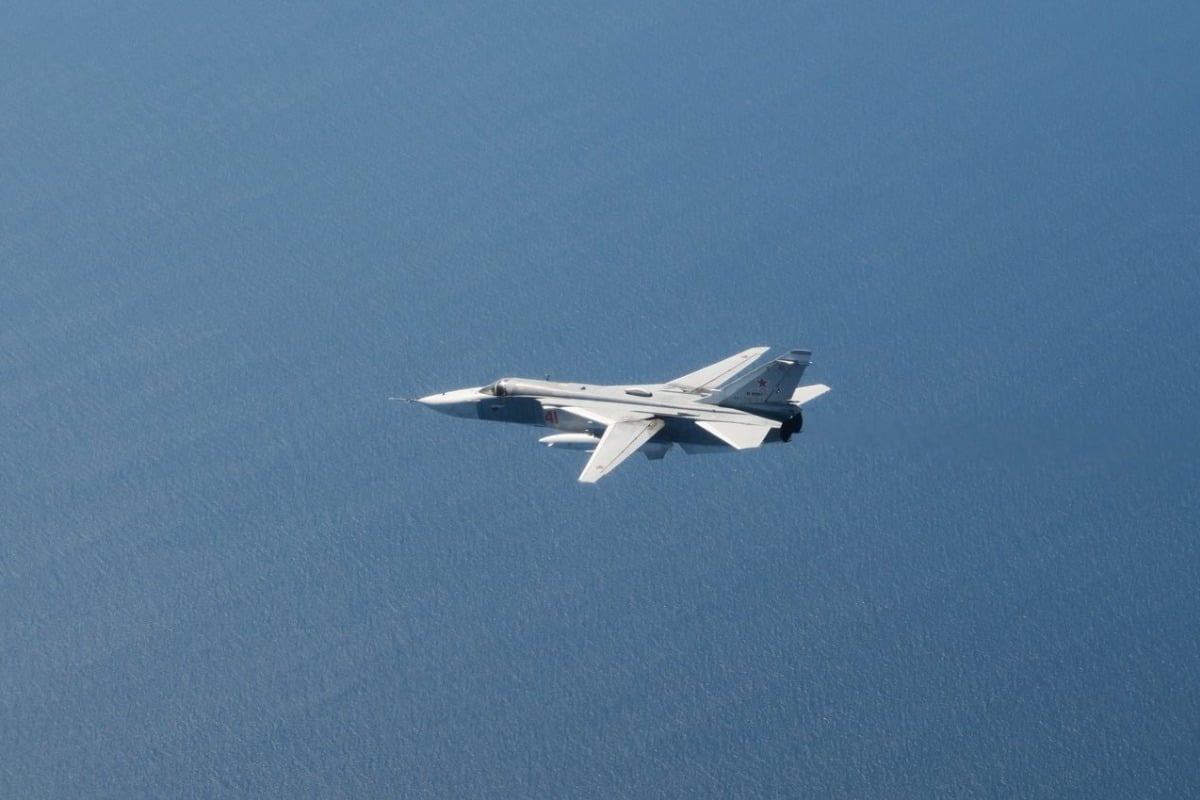
The Swedish Air Force scrambled two pairs of JAS 39 Gripen fighter jets on Friday to intercept Russian combat aircraft testing the boundaries of the Nordic defense sector. Operating over both the northern and southern sectors of the Baltic Sea, the Swedish Quick Reaction Alert teams intercepted a Russian Su-24 strike jet and a modern Su-34 fighter-bomber. Coordinated alongside Danish and broader NATO assets, the double scramble successfully checked the foreign planes without a violation of sovereign airspace, directly validating Sweden's newly integrated status within the alliance.
While wire services brushed off the double intercept as routine friction, the timing and geography of these encounters tell a far more volatile story. This was not a routine patrol gone astray. It was an intentional, multi-axis probe designed to map the shifting electronic and physical boundaries of a transformed maritime theater.
The Strategic Enclosure of Kaliningrad
For decades, the Baltic Sea functioned as a neutral buffer zone where non-aligned Sweden and Finland kept the superpower rivalry at arm's length. That geography has entirely evaporated. Following the integration of Helsinki and Stockholm into NATO, the Baltic has effectively transformed into an allied lake.
The strategic consequences for the Russian Federation are severe. Russia is now left with two highly vulnerable footholds on this body of water: the tightly restricted coastline near St. Petersburg and the heavily fortified but isolated exclave of Kaliningrad.
When the Russian Su-24 and Su-34 took off on Friday, their flight paths tracked toward Kaliningrad. This narrow air corridor is a logistical lifeline and a geopolitical flashpoint. Flying military aircraft between mainland Russia and the exclave requires navigating a tight gauntlet of international airspace flanked entirely by alliance territory.
To complicate matters, Russian crews routinely switch off their transponders and decline to file flight plans before entering these international corridors. This leaves Western defense radars blind to the identity and intent of oncoming targets. The silence is intentional. It forces Western air defense systems to illuminate their active tracking radars, revealing their exact locations and operational frequencies to Russian electronic intelligence assets waiting in international waters.
Breaking Down the Multi Axis Maneuver
The Friday intercepts were executed as a coordinated, two-pronged probe occurring in separate sectors of the Baltic Sea.
- The Northern Sector: A single Su-24 tactical bomber—a Cold War-era swing-wing platform that remains a highly capable maritime strike asset—moved toward the northern boundary.
- The Southern Sector: A sophisticated Su-34 fighter-bomber pushed down the southern maritime axis.
By splitting the flights across opposite ends of the sea, the Russian Aerospace Forces attempted to saturate the regional command and control apparatus. They wanted to see if the Swedish Air Force, now answering to a centralized NATO command structure, could handle simultaneous incidents at long range without lagging in response times or dropping tracking fidelity.
The answer came rapidly from the underground command bunkers of the Nordic defense sector. The Swedish Air Force immediately scrambled two distinct pairs of JAS 39 Gripen jets. Simultaneously, Danish fighters took to the sky to support the southern interception, demonstrating a level of joint interoperability that takes years to perfect. The allied response was seamless, shadowing the Russian warplanes until they turned away toward Kaliningrad.
Why the Gripen is the Perfect Baltic Gatekeeper
The choice of aircraft in these intercepts matters immensely. The Swedish-built JAS 39 Gripen was designed precisely for this specific fight.
Unlike massive, maintenance-heavy heavy interceptors, the Gripen is a lightweight, single-engine multirole fighter engineered around the concept of dispersed combat operations. During the Cold War, Sweden knew its main airbases would be targeted instantly in a conflict. The Gripen was built to land on ordinary highways, refuel and rearm in ten minutes using a small crew of conscripts, and take off again to contest the skies.
[Baltic Air Policing Scramble Dynamics]
Radar Tracking -> Command Evaluation -> QRA Scramble (<15 mins) -> Visual Intercept -> Escort Protocol
In the narrow, highly contested airspace of the Baltic Sea, the Gripen offers an unparalleled combination of data-link supremacy and electronic warfare capabilities. The aircraft utilizes advanced sensor fusion to pull data silently from ground radars, early warning aircraft, and naval vessels without radiating its own radar signature until the absolute last second. When a Gripen shadows an Su-34, it is not just acting as an escort. It is collecting immense volumes of electronic signatures, analyzing the radar emissions of the Russian fighter-bomber to update allied threat libraries.
The Overlooked Hybrid Warfare Layer
This aerial posturing cannot be separated from the broader shadow war playing out across northern Europe. The skies over the Baltic are increasingly thick with invisible electronic interference. Commercial pilots across the region have reported severe GPS jamming and spoofing incidents, heavily concentrated around Kaliningrad and stretching into the Nordic borders.
These electronic warfare campaigns are designed to degrade civil aviation safety and inject friction into military tracking networks. By flying frontline strike bombers like the Su-24 and Su-34 through these electronically degraded zones, Russia tests how effectively allied fighter radars can cut through localized electronic noise to lock on and track high-speed targets.
Vice Admiral Ewa Skoog Haslum, Head of the Swedish Armed Forces’ Joint Operations Command, explicitly framed the dual intercept as part of a "recurring pattern of behaviour that threatens both our territorial integrity and security." The use of the word pattern is critical. These flights are data-gathering expeditions disguised as provocative posturing.
The Risk of the Perfect Accident
The true danger in the Baltic is not a sudden, premeditated invasion. The real threat lies in a catastrophic mid-air miscalculation.
When high-performance combat aircraft maneuver within meters of each other at near-supersonic speeds, the margin for error drops to zero. History shows that these encounters can rapidly spiral out of control. Just weeks prior to this Baltic incident, the British Ministry of Defence lodged a formal diplomatic protest over an encounter where Russian jets repeatedly flew dangerously close to an unarmed Royal Air Force reconnaissance plane over the Black Sea.
When a pilot is operating under high g-forces, surrounded by active electronic jamming, a single panicked twitch or an uncoordinated bank can result in a mid-air collision. If a Swedish Gripen and a Russian Su-34 were to collide over international waters, the political pressure on Stockholm and Brussels to respond decisively would be immense.
The Friday intercepts proved that Sweden's transition into NATO has not degraded its operational readiness. By responding to a multi-axis probe with immediate, overwhelming tactical competence, the Swedish Air Force signaled that the Baltic Sea is no longer an open playground for testing Western resolve. The borders are drawn, the radar networks are locked, and the Gripens are sitting on the runways with their engines warm.