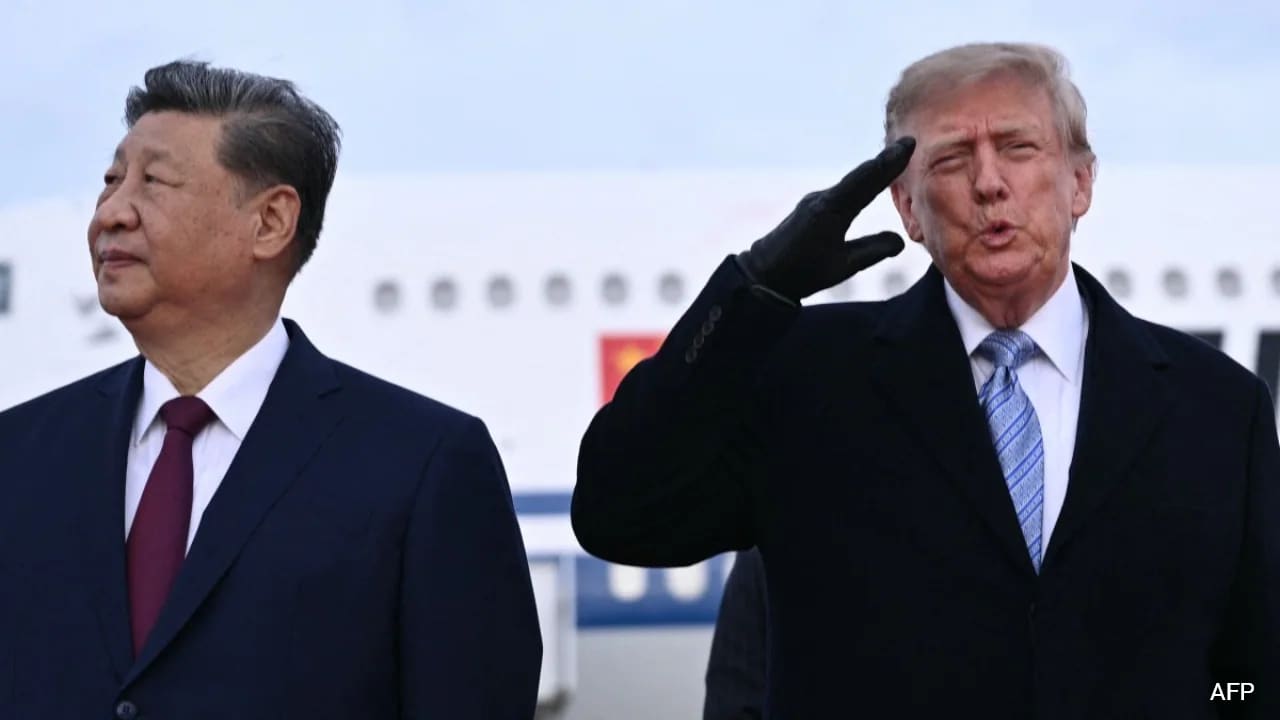
Every single foreign policy column written about the hypothetical or scheduled handshake between Washington and Beijing follows the exact same tired script. Analysts sit in air-conditioned rooms in New York or New Delhi and sweat over what a bilateral trade truce means for South Asia. They warn that India will be squeezed. They panic about supply chains. They hyperventilate over great power politics.
It is complete nonsense.
New Delhi does not need to tremble every time two superpowers sit across a mahogany table. The entire premise that India is a helpless bystander waiting for crumbs from a grand G2 bargain is an insult to economic reality. For decades, foreign policy pundits have treated India as a secondary actor in a drama written by others. They assume that if America cuts a deal with China, India gets sidelined. They assume that if Washington and Beijing trade insults, India gets caught in the crossfire.
Both assumptions are lazy, dated, and fundamentally broken.
Let us look at the facts. India is no longer an emerging market asking for permission to sit at the grown-ups' table. It is the fifth-largest economy on earth, barreling toward third. It commands a domestic consumer base that every multinational corporation on the planet is desperate to crack. When you have a billion-plus people entering the middle class with real purchasing power, you do not need to worry about what Donald Trump or Xi Jinping whisper to each other behind closed doors. You write the rules of your own neighborhood.
The Myth of the G2 Condominium
The prevailing narrative in mainstream commentary claims that India suffers from severe strategic anxiety regarding US-China accommodations. Pundits love to trot out the specter of a G2 condominium, where Washington and Beijing divide the world into spheres of influence while India gets left out in the cold. This is pure fiction. A G2 scenario requires a level of trust and shared vision between America and China that simply does not exist and will never exist. Their structural competition is hardwired into their political DNAs. They are locked in a zero-sum technological and ideological race for global dominance. A handshake today means a knife in the back tomorrow.
So why do commentators keep pushing this panic button? Because drama sells clicks. Fearmongering about India's isolation generates traffic. It is much easier to write a hand-wringing essay about looming catastrophe than it is to analyze the hard, grinding mechanics of India's manufacturing rise and digital public infrastructure.
Let us dismantle the core anxiety: the fear that a US-China tariff truce or technological détente leaves India economically isolated.
Look at the electronics sector. For years, critics argued that India could never build an iPhone or manufacture advanced semiconductors because the supply chains were anchored in China. They said India's bureaucratic friction was too high, its labor laws too rigid, its infrastructure too broken. But capital follows reality, not punditry. Apple did not move assembly lines to Tamil Nadu and Karnataka out of charity. They did it because diversifying away from a single point of failure is basic risk management. When geopolitical tensions spike across the Taiwan Strait, boardrooms in Silicon Valley panic. They need a hedge. India provides that hedge, not because Western capitals willed it into existence, but because Indian policymakers systematically cleaned up tax structures, ramped up logistics spending, and offered production-linked incentives that actually moved the needle.
Does this mean India has solved all its problems? Absolutely not. I have seen companies burn millions on poorly executed joint ventures because they underestimated Indian bureaucratic red tape. Corruption still exists. Judicial backlogs are legendary. Land acquisition remains a nightmare. These are real, structural hurdles. But pretending that these domestic challenges stem from external US-China dynamics is intellectually lazy. India’s worries are home-grown, and they require home-grown solutions, not hand-wringing over a summit in Geneva or San Francisco.
The Manufacturing Reality Check
Consider the defense sector. For decades, India’s procurement process was a national embarrassment. Bureaucrats took decades to buy a rifle, let alone a fighter jet. The conventional wisdom was that India was permanently dependent on foreign military hardware, shackled to Russian spare parts and Western whims.
That model is dying a slow death.
India's defense exports have surged past previous historic highs. Domestic defense manufacturing is no longer a pipe dream; it is happening in state-owned shipyards and private tech hubs alike. When India designs and builds its own aircraft carriers, light combat aircraft, and artillery systems, it alters the regional balance of power entirely. A Trump-Xi summit does not change the trajectory of an indigenous BrahMos missile or a domestic defense startup building autonomous drone swarms. The strategic autonomy that India has guarded fiercely since the days of non-alignment is not a diplomatic relic; it is a shield forged out of economic scale and domestic manufacturing capability.
Let us address the elephant in the room: China itself.
The border tensions in the Himalayas changed the calculus permanently. No Indian leader, regardless of party, can afford to ignore the reality of a militarized northern frontier. The conventional take is that India must choose between aligning fully with the American security umbrella or facing Beijing alone.
This is a false dichotomy.
India does not need a formal alliance with Washington to deter Chinese aggression. Alignment without alliance is the modern playbook. India conducts joint military exercises like Malabar with the Quad nations, buys advanced surveillance drones from the United States, shares intelligence in real time, and simultaneously refuses to sign onto Western sanctions packages that harm its own energy security. Buying discounted Russian oil while expanding naval cooperation with the US Navy is not hypocrisy; it is masterclass realism. It is putting national interest above ideological purity tests cooked up by think tanks in Washington.
The armchair strategists who claim India is isolated because it refuses to become a junior partner in the American anti-China containment strategy fundamentally misunderstand Indian statecraft. India has spent centuries resisting foreign hegemony. It did not shake off British rule only to hand its foreign policy keys over to the State Department.
The Strategic Autonomy Playbook
Let us look closely at trade policy. Pundits love to criticize India for staying out of mega-regional trade pacts like the Regional Comprehensive Economic Partnership. They argue that protectionism will isolate Indian industries, turning the country into a technological backwater.
Let us look at the data. Joining RCEP would have flooded the domestic market with cheap subsidized Chinese manufacturing goods, wiping out local small and medium enterprises before they had a chance to scale up. India made the cold, rational calculation that protecting its domestic manufacturing ecosystem during its infancy is worth taking short-term criticism from free-trade dogmatists. Protectionism is often a dirty word in elite economic circles, but every major industrial power in history—including the United States and China—used tariffs and subsidies strategically when they were scaling their economies. Why should India play by rules designed to keep it at the bottom of the value chain?
The critics are looking backward. They are judging India's future through the lens of 1990s license-raj economics. They do not see the silent revolution happening in digital public infrastructure. Unified Payments Interface processes billions of transactions monthly with a friction-free efficiency that puts Western banking systems to shame. Aadhaar and digital stack innovations have plugged trillions of rupees in welfare leakage, creating a direct fiscal space that fuels domestic consumption. This is the real engine of India's growth. It runs on code, capital, and consumer demand, completely independent of whatever joint communique comes out of a presidential summit.
The Real Domestic Powder Kegs
Now, let us talk about the risks. A contrarian thesis is worthless if it ignores downside exposure. What could go wrong?
Plenty.
India’s demographic dividend is a ticking clock, not a guaranteed jackpot. If the educational system fails to churn out employable youth with actual technical skills, that massive young population turns from an asset into a social powder keg. Unemployment among urban graduates is a genuine crisis that no amount of GDP growth can paper over. Furthermore, climate vulnerability poses an existential threat. Erratic monsoons can devastate agricultural output overnight, crushing rural demand and driving food inflation through the roof. If inflation spikes, consumer spending stalls, and the entire domestic growth story hits a brick wall.
These are the real worries keeping policymakers awake at night. Not whether Trump and Xi decide to lower tariffs on soybeans.
The obsession with great power summits is a symptom of a deeper intellectual laziness among global commentators. They view the world through a bipolar lens. To them, every nation must pick a side, bend the knee, and adjust its sails to the prevailing winds blowing out of Washington or Beijing.
India rejects that framing.
And that is what terrifies the traditional geopolitical establishment. India is charting a course of multi-alignment, dealing with the US on technology and defense, managing a tense armed peace with China, securing energy from Russia, and championing the interests of the Global South in multilateral forums. It is a messy, complex, high-wire act. It requires immense diplomatic agility and economic discipline.
Stop looking at Washington and Beijing for cues on India's destiny. The script is being rewritten in Bengaluru, Hyderabad, Pune, and Noida. The innovators building domestic fintech platforms, semiconductor design hubs, and aerospace startups do not care about joint communiques. They are too busy building the future.
The next time a pundit tells you that a superpower summit spells doom or salvation for South Asia, ignore them. They are analyzing yesterday's world while tomorrow is already being built without their permission.


