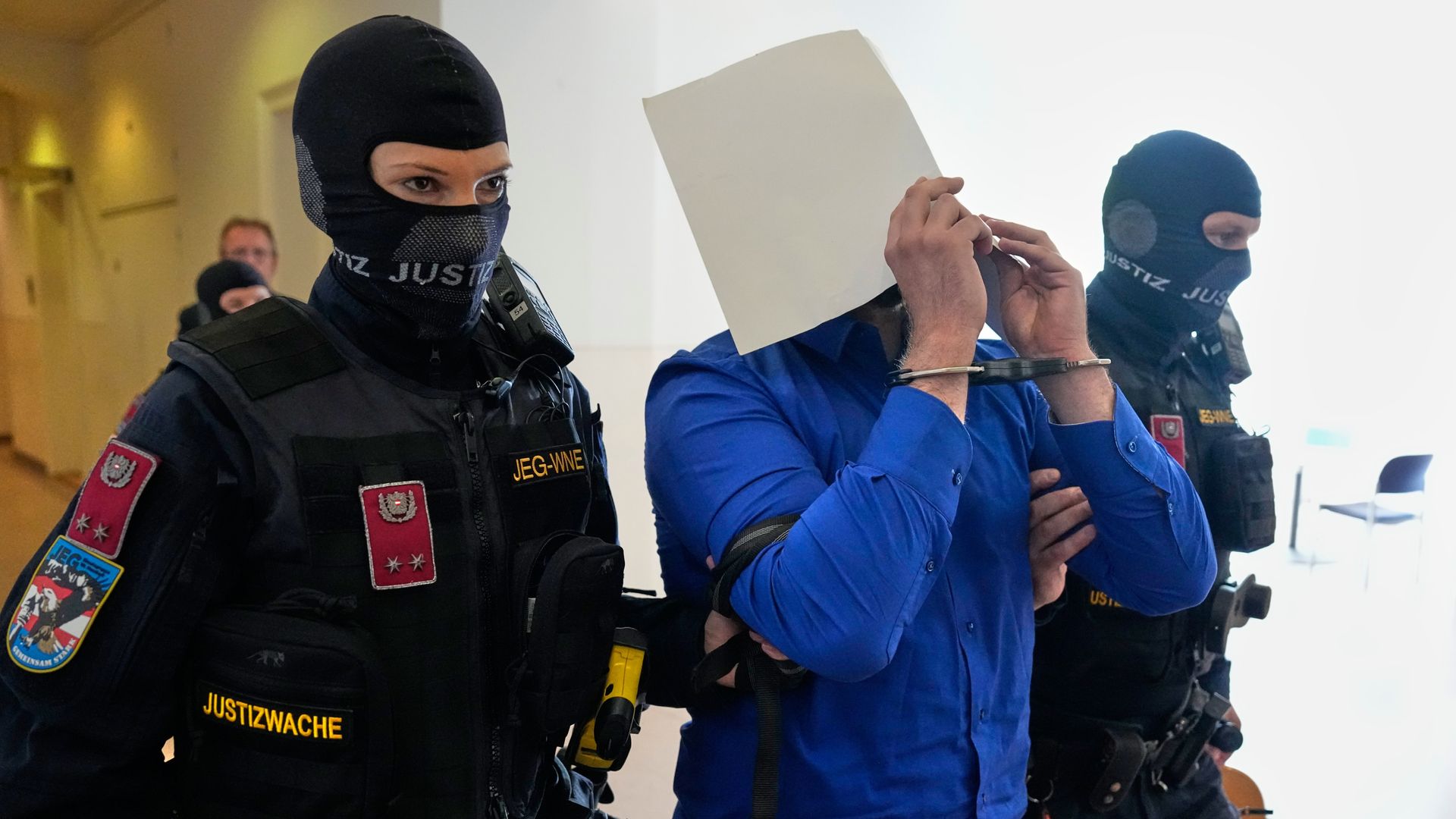
The headlines scream about a victory for global security because a teenager in Austria pleaded guilty to planning a mass casualty event at a Taylor Swift concert. The mainstream media is busy taking a victory lap, patting the back of the intelligence community for "stopping the unthinkable." They want you to believe the system worked. They want you to think that because one radicalized kid got caught before he could detonate a device, the multi-billion-dollar security apparatus surrounding the Eras Tour is a triumph of modern engineering.
They are lying to you.
The reality is far more uncomfortable: the arrest of Beran A. isn't a sign that the system is working. It is a glaring admission that our current approach to high-profile event security is reactive, bloated, and fundamentally flawed. We are pouring resources into "security theater" while ignoring the actual mechanics of modern radicalization and the physics of crowd dynamics. If we continue to rely on the "lucky break" of intercepted Telegram messages, the next tragedy won't be a "near miss"—it will be a statistical certainty.
The Myth of the Hardened Perimeter
Every time a stadium gets "locked down," we see the same imagery: concrete barriers, K9 units, and private security guards making $18 an hour checking clear plastic bags. The assumption is that if you harden the venue, you protect the people.
This is a fundamental misunderstanding of the target. In the case of the Vienna plot, the suspect wasn't just aiming for the seats inside the Ernst Happel Stadium; he was aiming for the thousands of fans gathered outside—the "Taylor-gaters" who couldn't get tickets but showed up for the atmosphere.
Security professionals call this "displacement of risk." When you make the inside of a stadium a fortress, you push the vulnerability to the sidewalk. You create a dense, unprotected mass of humanity in a "soft zone" where local police are stretched thin and private security has no jurisdiction. We saw this at the Manchester Arena bombing in 2017. The attack didn't happen during the show; it happened at the exit, in the foyer, where the "hard" security perimeter ended.
By obsessing over the "plot" and the "guilty plea," the media ignores the fact that 65,000 people inside a stadium are a distraction from the 30,000 outside who are effectively sitting ducks. Hardening the venue doesn't solve the problem; it just moves the target ten feet to the left.
The Intelligence Community’s Survivorship Bias
We are told that "foreign intelligence services" (specifically the U.S. CIA) tipped off Austrian authorities. The narrative is that "the net is catching the big fish."
This is textbook survivorship bias. We only hear about the plots that get intercepted because the plotters were sloppy enough to use monitored channels. The Vienna suspect was nineteen years old. He was a "lone wolf" who radicalized online in a matter of months.
I’ve spent years analyzing risk profiles for high-net-worth events, and the most terrifying realization is that we are currently playing a game of Whac-A-Mole against an algorithm. The "lazy consensus" says that more surveillance equals more safety. But as data grows exponentially, the signal-to-noise ratio collapses.
Consider the mathematics of surveillance. If an intelligence agency monitors 1,000,000 communications a day with a 99.9% accuracy rate, they still face 1,000 false positives daily. That is 1,000 leads that require man-hours to investigate. While the authorities were focused on Beran A., how many others were operating in the 0.1% noise?
We didn't "win" because the system is invincible. We won because a teenager was bad at operational security (OPSEC). That isn't a strategy; it’s a coin flip.
The Swift Factor: Why Pop Stars are the New Geopolitical Targets
The media treats the Taylor Swift plot as a localized criminal matter. This is a massive analytical error. We need to stop viewing these concerts as "shows" and start viewing them as high-value geopolitical targets.
Taylor Swift is not just a singer. She is a cultural hegemon with an economic impact that rivals small nations. When an entity like ISIS-K targets an Eras Tour date, they aren't just looking for a body count. They are looking for the "global megaphone effect."
- Economic Sabotage: The cancellation of three Vienna shows resulted in an estimated loss of tens of millions of dollars in local tourism revenue.
- Psychological Warfare: By targeting a demographic primarily composed of young women and girls, the attackers strike at the most sensitive emotional chord of Western society.
- Media Saturation: A successful attack on a Taylor Swift concert would generate more global media impressions than an attack on a government building.
The "status quo" approach treats this as a police matter. It’s not. It’s a defense matter. Yet, we leave the primary responsibility for "safety" to private promoters and local municipalities who are incentivized to keep costs low and the show going at all costs.
Stop Asking if the Show is Safe—Start Asking if the Crowd is Manageable
People also ask: "Is it safe to go to large concerts anymore?"
The answer isn't a simple yes or no. It’s "only if we rethink crowd physics."
The real danger in these scenarios isn't just the bomb; it’s the stampede. When the news of the Vienna plot broke, the immediate reaction was fear. If a firecracker had gone off at a London or Paris show the following week, the resulting crush would have killed more people than a small explosive.
We are obsessed with the "terrorist" but we ignore the "panic." A truly superior security strategy would prioritize:
- Acoustic Disruption Tech: Systems designed to neutralize the sound of explosions or gunfire to prevent mass panic.
- Dynamic Egress Mapping: Using AI-driven real-time heat maps to guide crowds away from perceived threats without creating bottlenecks.
- Aggressive Counter-Radicalization: Moving the "perimeter" from the stadium to the digital spaces where these kids are recruited.
The Uncomfortable Truth About "Guilty Pleas"
Beran A. pleaded guilty. The case is "closed" in the eyes of the public. But the guilty plea is a PR win for the state, not a security win for the fans. It allows the government to avoid a public trial where the specifics of their "intelligence failure" or their "reliance on luck" might be scrutinized.
It’s easy to prosecute a nineteen-year-old with a basement full of chemicals. It’s much harder to admit that our cities are fundamentally unprepared for the decentralization of terror. We are using 20th-century policing tactics to fight a 21st-century ideological virus.
If you are a parent or a fan, don't find comfort in this guilty plea. Find it in your own situational awareness. The "authorities" are overwhelmed. They are looking for the guy with the bomb, but they aren't looking at the exit door that’s chained shut, or the lack of police presence in the fan-zone three blocks away.
The Cost of the "Safety" Narrative
We are currently building a world where the price of cultural participation is a total surrender to the surveillance state. We accept facial recognition at the gates, we accept the scanning of our private messages, and we accept the presence of paramilitary police at a pop concert.
And yet, despite all of this, the shows were cancelled. The "terrorist" won his primary objective without ever leaving his house: he stopped the music, he damaged the economy, and he instilled a lingering, permanent fear in a generation of fans.
True security isn't about catching a kid after he's already bought the hydrogen peroxide. It’s about building a society where the target doesn't exist, or a venue where the crowd isn't a liability. Until we move past the theater of bag checks and "intercepted tips," we are just waiting for the one guy who knows how to keep his mouth shut on Telegram.
The Vienna plot wasn't a success story. It was a final warning. Stop looking at the handcuffs and start looking at the gaps in the fence.