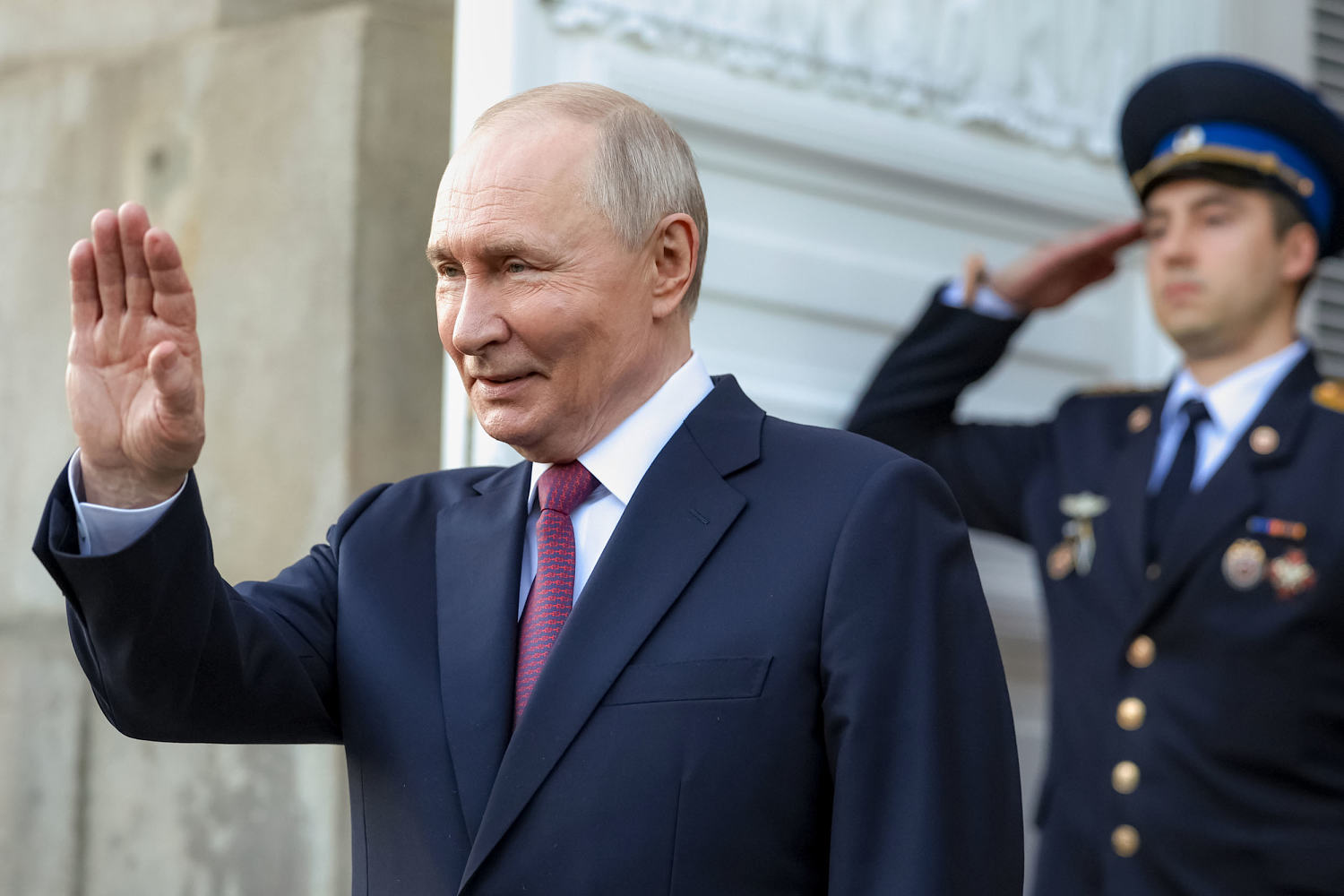
Plumes of black smoke rising over the Neva River tell a story that Moscow desperately tried to hide this week. As the St. Petersburg International Economic Forum opened, a swarm of Ukrainian drones slammed into the Petersburg Oil Terminal and nearby Kronstadt naval base. The targets sat nearly 1,100 kilometers from the Ukrainian border. Inside the pristine halls of the Expoforum, the elite pretended everything was fine. It is the classic contradiction of modern Russia. Vladimir Putin wants to project absolute global authority while the war he started bleeds into his hometown.
The forum was once a glamorous playground for Wall Street CEOs and European financiers. Today, the "Russian Davos" feels more like a surreal survivalist convention mixed with an anti-Western grievance party. The suits from Goldman Sachs are gone. In their place stand massive military displays of drones and machine guns, flanked by delegations from the Global South and a bizarre mix of Western fringe figures.
The Kremlin wants you to look at the numbers. They claim 20,000 guests from 130 countries showed up. They point to Saudi Arabia as the guest of honor, bringing a massive 200-person delegation led by Energy Minister Abdulaziz bin Salman Al Saud. They boast about the presence of Chinese Vice President Han Zheng and a heavily hyped, though highly disputed, "official" US representative in the form of fine arts chairman Rodney Mims Cook Jr. But behind this crowded house lies a deeply fragile reality. The economic foundation supporting Putin's war machine is showing severe signs of cracking.
The Cracks in the War Economy
You can't run a massive military campaign forever without paying the price. Russia's economy looks decent on paper if you only look at GDP growth driven by massive state spending on tanks, shells, and soldier salaries. But that's a mirage. It's sugar-high economics. The reality on the ground is an economy suffering from structural exhaustion.
- The Labor Vacuum: Millions of young men are either fighting on the front lines, working in munitions factories, or fleeing the country. Businesses face crippling labor shortages that drive up wages artificially and choke out non-military industries.
- The Price Spike: Inflation is raging. The central bank has been forced to keep interest rates painfully high to keep the ruble from collapsing, making it nearly impossible for ordinary businesses to secure affordable credit.
- The Budget Hole: The Kremlin is running persistent budget deficits. Selling oil to India and China at steep discounts keeps the lights on, but it doesn't cover the exploding costs of a prolonged war of attrition.
Business owners attending the forum privately whisper about mounting logistics costs and weakening domestic demand. They are trapped. If you aren't manufacturing something that explodes on a battlefield, you're struggling to survive.
Drone Warfare Comes to the Boardroom
The physical threat has shifted the entire mood of the event. It's hard to pitch your country as a safe harbor for international capital when a kamikaze drone just set fire to a navy corvette, the Boikiy, a few miles down the road.
Ukraine's drone forces aren't just hitting military assets anymore. They are systematically targeting the economic arteries that fund the Kremlin. Refineries, ports, and fuel depots are blowing up with rhythmic regularity. By striking St. Petersburg hours before the opening ceremony, Kyiv delivered a psychological gut punch. They proved that Putin cannot protect even his most heavily fortified economic showcases.
The security footprint inside the venue is suffocating. Electronic jamming devices disrupt cell signals. Guards with anti-drone rifles patrol the perimeters. The message to the visiting delegates from Uzbekistan, Tanzania, and the Gulf states is clear: the war isn't a distant news broadcast. It is right outside the window.
A New Global Order or an Island of Misfits
The Kremlin uses the forum to pitch what it calls "Pragmatic Dialogue" and a multipolar world order. Putin’s strategy relies heavily on proving that Western sanctions have failed to isolate him. To some extent, he has succeeded in shifting Russia's trade patterns eastward and southward.
But look closely at the guest list. Outside of legitimate trade partners like China and Saudi Arabia, the Western representation has devolved into a circus. The American and European presence is led by figures like actor Steven Seagal, conservative commentator Candace Owens, and representatives from the far-right Alternative for Germany party. This isn't a gathering of global financial powerhouses. It’s an assembly of people who enjoy thumbing their noses at Washington and Brussels.
Even the economic deals being signed feel different. In the old days, the forum yielded multi-billion-dollar partnerships with BP, Shell, and Siemens. Now, the agreements focus on alternative financial systems, bypassing the SWIFT network, and technological cooperation with BRICS nations. They are defensive alliances born out of necessity, not lucrative opportunities born out of mutual growth.
What Happens When the Sugar High Wears Off
The ultimate test for Russia won't happen in the conference halls. It will happen when the state can no longer afford to pump trillions of rubles into the defense sector.
If you're trying to figure out where this economy goes next, watch the Russian central bank and the domestic energy infrastructure. The government is rapidly burning through its liquid reserves. At the same time, the cost of repairing drone-damaged refineries is skyrocketing because of Western component sanctions.
For international observers and businesses watching from afar, the takeaway is simple. Don't buy the Kremlin's hype about an unbreakable economy. The Russian Davos proved that the regime is running on borrowed time, high interest rates, and burning oil infrastructure. The smoke over St. Petersburg wasn't just a security breach. It was a preview of a destabilized future.



:max_bytes(150000):strip_icc()/how-many-types-of-dwarfism-are-there-2860725-v1-8dae2c531b4b47d9ae36ae404d3308a0.png)