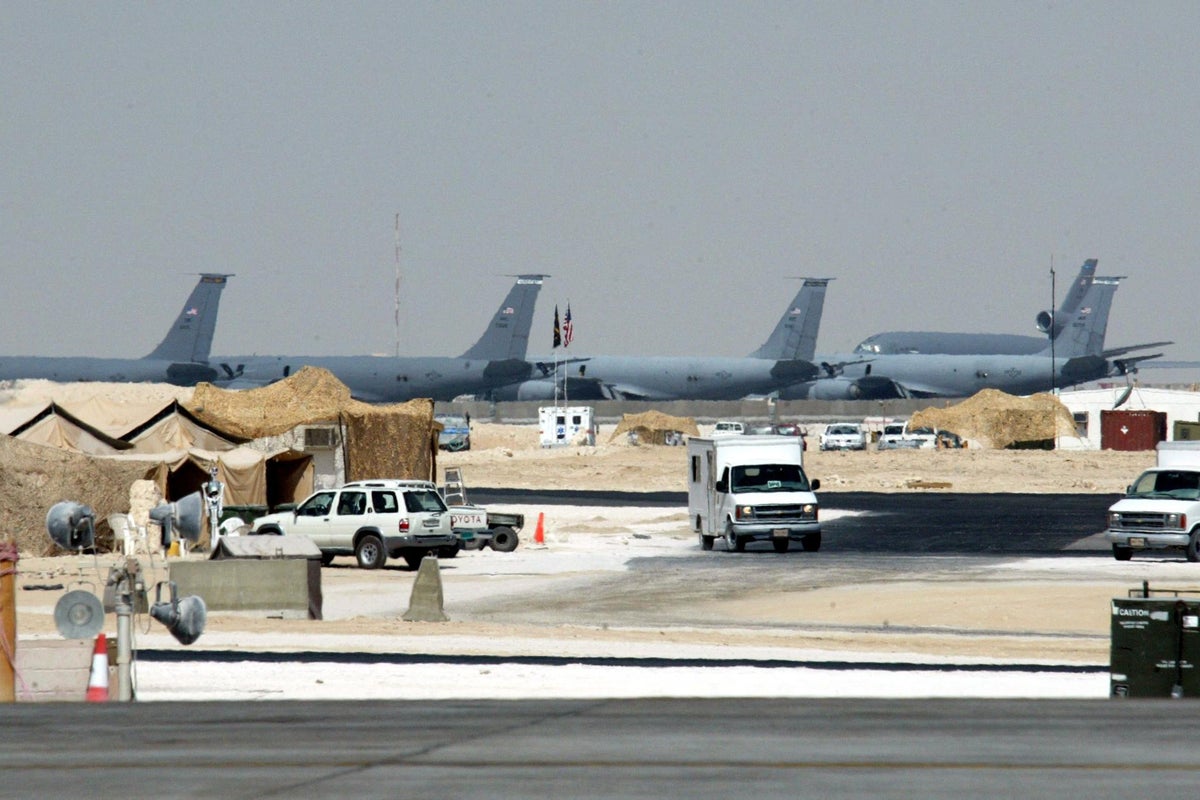
The Western military architecture across the Middle East is no longer a shield. It is a grid of targets. When the United States and Israel launched joint airstrikes on Iran, the immediate retaliatory salvos proved that the vast network of American and British bases across the region cannot guarantee security; instead, they have become highly vulnerable focal points of conflict. More than 50,000 U.S. personnel and thousands of British troops are stationed throughout these installations. They are not fighting a traditional war from a position of isolated safety, but are operating under a sky filled with precision-guided ballistic missiles and one-way attack drones.
The primary rationale for maintaining these outposts has always been regional stability and the containment of hostile state actors. That theory has collapsed under the weight of reality.
The Strategic Geography of Vulnerability
The Western military footprint in the region is massive, yet its dispersion is now its primary weakness. The U.S. Central Command directs forces from a sprawling archipelago of facilities, each originally designed for specific, historically isolated missions like the 1991 Gulf War, the 2003 invasion of Iraq, or the counter-ISIS campaign.
- Kuwait: Hosting roughly 13,500 American troops, primarily at Camp Arifjan and Ali al-Salem Air Base, this remains the largest concentration of ground forces.
- Qatar: Al-Udeid Air Base serves as the forward headquarters of U.S. Central Command and houses thousands of personnel alongside British Royal Air Force Eurofighter Typhoons.
- Bahrain: Naval Support Activity Bahrain serves as the homeport for the U.S. Fifth Fleet, managing maritime security in the volatile Persian Gulf.
- Jordan and Iraq: Forward locations like Muwaffaq Salti Air Base in Jordan host advanced American strike fighters, while smaller garrisons remain scattered across Iraq and eastern Syria.
The United Kingdom relies heavily on its Sovereign Base Areas of Akrotiri and Dhekelia on Cyprus. This territory acts as a primary staging ground for Mediterranean and Middle Eastern air operations. Further east, the British military maintains an air defense and naval presence in Qatar, Bahrain, and Oman.
The Failure of the Shield
For decades, the presence of these bases was thought to prevent aggressive state action through the sheer threat of overwhelming counter-escalation. Recent events have exposed the flaw in this logic. Western forces have spent billions constructing advanced, layered missile defense systems. Patriots, Terminal High Altitude Area Defense batteries, and naval Aegis systems guard these bases night and day.
They are being overwhelmed. The sheer volume and technological evolution of modern drone and missile technology mean that defensive systems are mathematically disadvantaged. Intercepting a swarm of cheap, mass-produced loitering munitions with million-dollar interceptor missiles is financially and logistically unsustainable.
When an Iranian Shahed drone struck the runway at RAF Akrotiri on Cyprus, it shattered the assumption that geographic distance offered protection. The attack caused minimal structural damage, but the psychological implications were deep. A sovereign British installation, located on an island in the Mediterranean, was reached and struck. The immediate evacuation of service members' families that followed demonstrated the stark reality that these bases are no longer safe rear-guard sanctuaries.
The Diplomatic Strain on Host Nations
The escalating conflict has triggered severe political friction between Washington, London, and the Arab capitals hosting these forces. Countries like Qatar, Kuwait, and the United Arab Emirates find themselves caught in a dangerous geopolitical vice. They want the security guarantees that come with an American military alliance, but they cannot afford the domestic political fallout or the physical destruction of being used as launchpads for Western offensive strikes against their neighbors.
This tension has altered how these bases can be used. Host nations are increasingly placing restrictions on Western operations, refusing to allow offensive sorties to be flown from their soil. This explains why the U.S. military buildup has relied so heavily on naval assets. Operating three aircraft carrier strike groups—including the USS Abraham Lincoln and the USS Gerald R. Ford—in the Arabian Sea and the Eastern Mediterranean allows Western forces to launch strikes without needing permission from local governments.
The United Kingdom has experienced its own internal rifts. Prime Minister Keir Starmer initially denied requests to allow U.S. forces to use British bases for the opening round of strikes, highlighting the deep hesitancy within European governments to become entangled in an open-ended regional war. Though permission was later granted for limited, defensive operations to destroy missile threats at their source, the initial hesitation strained relationships and revealed a lack of strategic alignment.
The Logistic Nightmare of the Frontline Outpost
The physical vulnerabilities of these installations are compounded by immense logistical challenges. A forward airbase requires an endless supply of aviation fuel, spare parts, and ammunition to remain operational. In a regional war where the Strait of Hormuz is heavily contested or effectively blocked, keeping these bases supplied becomes an incredibly difficult task.
Consider a hypothetical example where an airbase in the Persian Gulf requires a continuous resupply of specialized components for its air defense radar systems. If commercial shipping lanes are shut down and regional airspace is restricted by active missile engagements, those components must be brought in via heavily guarded military transport aircraft. These cargo planes must fly through contested skies, consuming vital security resources just to keep basic defenses functioning.
This reality has forced a dramatic shift in how forces are deployed. In Bahrain, the U.S. Fleet Headquarters was reduced to fewer than 100 mission-critical personnel, and naval vessels left port to avoid being trapped in a confined harbor during a missile bombardment. When a multi-billion-dollar naval base has to be emptied to preserve the fleet, the very utility of that base must be questioned.
The New Reality of Power Projection
The era of secure, uncontested Western military dominance in the Middle East has ended. The current architecture of fixed, easily mapped bases was built for a different time—an era when adversaries lacked the precision guidance, drone swarms, and satellite intelligence to strike back effectively. Today, a fixed runway is simply a target with a known coordinate.
Western powers are finding that their massive regional presence is as much a liability as it is an asset. Instead of deterring conflict, these bases provide adversaries with high-value targets, drawing the U.S. and the UK deeper into an escalatory cycle. True security will not be found by pouring more concrete or deploying more air defense batteries to vulnerable outposts. The current conflict has shown that fixed bases cannot withstand the realities of modern warfare; they must either adapt to a more mobile, distributed footprint or continue to serve as targets in a war that has outgrown them.