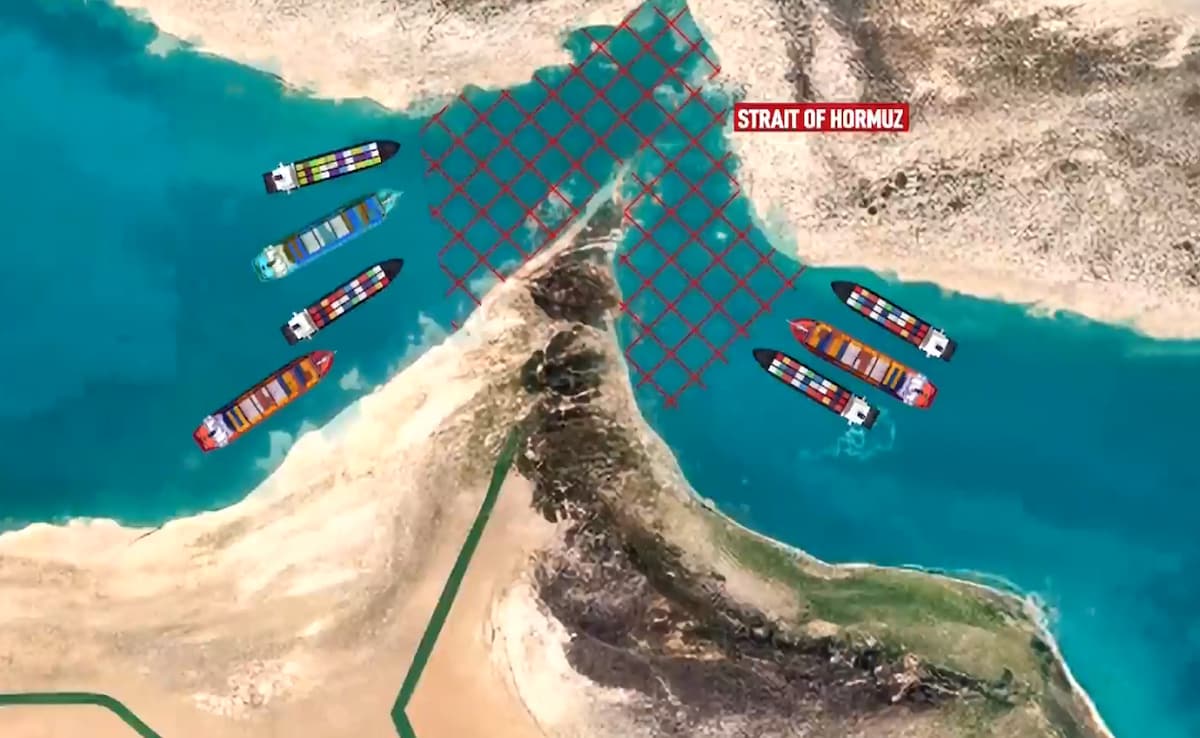
Fear sells. It sells newspapers, it sells expensive consulting retainers, and it sells "emergency" surcharges for logistics companies that haven’t seen a real crisis in a decade. The current narrative around the Hormuz Strait—that it is a "choke point" on the verge of strangling global civilization—is a masterpiece of hyperbole.
The headlines scream about a 97% drop in shipping. They point to tragic loss of life as a harbinger of the end of global trade. But if you actually look at the mechanics of energy markets and the cold, hard logic of maritime insurance, you realize the "choke point" is more of a filter. It isn't closing; it's just getting more expensive for the people who didn't plan ahead.
The 97% Myth and the Math of Diversion
Let’s start with the most cited, most terrifying number: the 97% drop in shipping volume. This is a classic case of data manipulation through narrow framing. Yes, specific vessel classes—mostly Western-flagged container ships that are easy targets for kinetic strikes—have diverted.
But trade doesn't just stop. It shifts.
The global economy is a fluid system. When the Hormuz Strait or the Bab al-Mandab becomes "hot," the cargo doesn't vanish into the ether. It goes around the Cape of Good Hope. Is it slower? Yes. Does it add 10 to 14 days to a transit? Absolutely. But a delay is not a "choking" of trade. It is a recalibration of the "Just-In-Time" (JIT) insanity that has plagued manufacturing since the 1990s.
If your business model collapses because a ship takes two extra weeks to arrive, your problem isn't the Middle East. Your problem is your inventory strategy. I’ve watched C-suite executives panic over these delays while sitting on mountains of useless "safety stock" that they’re too disorganized to deploy. They blame the war because it's an easier story to tell shareholders than "we optimized our supply chain for a world that no longer exists."
The Insurance Racket
The real "strangling" isn't happening in the water; it's happening in the high-rise offices of London and Zurich. War risk premiums are the hidden tax on global stability.
When a conflict flares up, underwriters don't just assess risk; they price for the worst-case scenario plus a healthy margin for uncertainty. During these spikes, the cost of insuring a hull can jump from 0.01% to over 1% of the vessel's value. For a $100 million tanker, that’s a million-dollar check just for the privilege of sailing through the Gulf.
The "choke point" is a financial construct. The physical strait remains wide enough for the world's fleet. The blockage is the cost of entry. What the mainstream media misses is that these costs are often passed directly to the consumer, but they also act as a massive subsidy for the regional players who operate outside the traditional Western insurance markets. "Dark fleets" and "shadow tankers" aren't deterred by Hormuz; they thrive in it. While the big players complain, the smaller, more agile (and often less regulated) operators are making a killing.
Energy Independence is a Geographic Fantasy
There is a common misconception that the U.S. or Europe can "decouple" from the Hormuz Strait through domestic production. This is a fundamental misunderstanding of how the global oil market functions.
Oil is a fungible commodity. Even if not a single drop of Middle Eastern crude reaches American shores, a disruption in Hormuz spikes the global price. You can’t drill your way out of a global price shock.
The math of the Strait is simple:
$$P_{local} = P_{global} + (R \times I)$$
Where $P$ is the price, $R$ is the perceived risk, and $I$ is the insurance premium.
Even if you have a well in your backyard, you are still paying the "Hormuz Tax." The contrarian truth is that the physical security of the Strait matters less than the psychological state of the traders in Singapore and New York. We aren't fighting for the water; we’re fighting for the price of a barrel.
Why the "Total Closure" Scenario is a Paper Tiger
Every armchair general loves to talk about the "total closure" of the Strait. Imagine a scenario where a regional power sinks enough ships to physically block the 21-mile-wide channel.
It won't happen.
Why? Because the very entities capable of closing the Strait are the ones most dependent on it. China, the primary buyer of Iranian and Iraqi crude, would see its economy crater within weeks. The regional actors who use the Strait as a geopolitical lever know that pulling the trigger is an act of economic suicide.
The Strait of Hormuz is the ultimate Mexican Standoff. Everyone has a gun pointed at everyone else’s head, which means nobody actually wants to fire. The "choke point" is a theatrical prop used to extract concessions, not a tactical objective.
Stop Watching the News, Start Watching the Tonnage
If you want to know what’s actually happening, ignore the 24-hour news cycle and look at the "Deadweight Tonnage" (DWT) passing through the region.
- Fact: Energy exports from the Persian Gulf have remained remarkably resilient through every "crisis" of the last forty years.
- Fact: The Tanker War of the 1980s saw over 500 ships attacked, yet trade continued.
- Fact: Technology has made the Strait more, not less, navigable. Modern surveillance and automated pilotage mean that "accidental" blockages are nearly impossible.
The "crisis" is a feature of the system, not a bug. It allows oil producers to justify higher prices, it allows shipping lines to hike rates, and it allows politicians to grandstand about "securing vital lanes."
The Brutal Advice for the 2020s
If you are a business leader waiting for the Middle East to "stabilize" so your shipping costs go back to 2019 levels, you are delusional. Stability was the anomaly. Volatility is the new baseline.
Stop asking when the Hormuz Strait will be "safe." It’s as safe as it’s ever going to be. Instead, do this:
- Ditch JIT: Move toward "Just-In-Case" (JIC) inventory models. If your margins can’t handle the carrying cost of three months of inventory, your business is a zombie.
- Regionalize Everything: If you're shipping raw materials from the Gulf to refine in Europe to sell in America, you’re just paying the "Hormuz Tax" three times over.
- Hedge Your Logistics, Not Just Your Fuel: Most companies hedge their fuel costs but leave their shipping rates to the mercy of the spot market. Lock in your tonnage years in advance.
The Hormuz Strait isn't choking the world. It's just exposing the people who were too lazy to build a resilient business. The 97% drop isn't a tragedy; it’s a massive market correction for the over-leveraged.
Would you like me to analyze the specific tonnage shifts in the "dark fleet" to see who is actually profiting from this perceived closure?