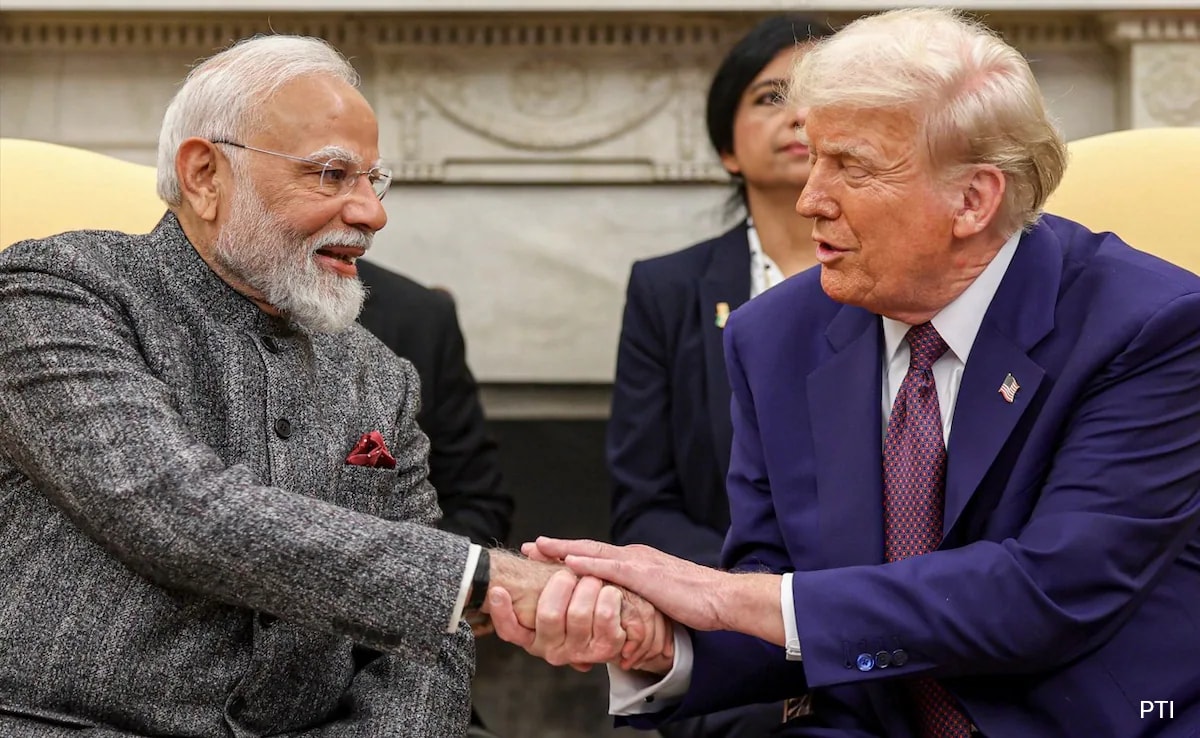
The phone call between Donald Trump and Narendra Modi was never about simple pleasantries. While official readouts often mask the grit of high-stakes diplomacy with phrases like "shared values" and "bilateral cooperation," the timing of this communication reveals a much sharper reality. Washington is tightening its grip on global energy arteries, and it expects New Delhi to act as more than just a passive buyer. The core of this interaction centers on the Strait of Hormuz, a narrow chokepoint through which 20% of the world’s liquid petroleum flows every single day. For Trump, the goal is clear: stabilize the flow of oil to keep global prices from spiking while simultaneously squeezing regional adversaries. For Modi, the calculation is far more complex, balancing India’s desperate need for energy security with its historical aversion to joining Western-led military or maritime blocs.
This isn't just a chat between two leaders. It is a collision of two distinct nationalisms. Trump’s "America First" energy dominance meets Modi’s "Atmanirbhar Bharat" (Self-Reliant India), and the friction point is a thin strip of water in the Middle East.
The Chokepoint Dilemma
The Strait of Hormuz is the most sensitive valve in the global economy. If that valve closes, or even leaks, the shockwaves hit New Delhi harder than almost any other capital. India imports over 80% of its crude oil, and a significant portion of that volume originates in the Persian Gulf. Any disruption in the Strait doesn't just mean higher prices at the pump in Mumbai; it means a direct hit to India’s fiscal deficit and its ability to fund massive infrastructure projects.
Trump’s focus on this specific geography signals a shift toward a more aggressive maritime security posture. The U.S. wants a coalition that shares the burden of patrolling these waters, but India has traditionally preferred to send its own naval assets—Operation Sankalp being a prime example—rather than folding into a U.S.-commanded task force. The tension here is palpable. Washington views Indian participation as a litmus test for the "Major Defense Partner" status it granted New Delhi. Meanwhile, Indian strategists worry that being too closely aligned with U.S. maneuvers in the Strait could provoke Iran, a country that provides India with a strategic gateway to Central Asia through the Chabahar port.
Beyond the Official Script
Why did the Strait of Hormuz take center stage now? Look at the numbers. Global oil markets are currently on a knife-edge. Despite the transition to renewables, the world’s industrial base remains tethered to fossil fuels. Trump knows that his political capital at home is directly tied to the price of a gallon of gas. By engaging Modi, he is essentially attempting to lock in a massive consumer of energy into a security arrangement that protects the supply chain.
There is also the "China Factor" that neither side wants to scream about but both are whispering. Beijing has been aggressively courting Middle Eastern powers, offering massive infrastructure deals in exchange for long-term energy guarantees. If the U.S. and India don’t coordinate their moves in the Persian Gulf, they risk leaving a vacuum that the People's Liberation Army Navy is more than happy to fill. This isn't theoretical. We’ve already seen Chinese naval exercises in the Gulf of Oman. The message to Modi is blunt: if you want the oil to keep flowing without a Chinese shadow over every tanker, you need to step up your presence in the Strait.
The Energy Leverage
India’s energy strategy is a masterclass in hedging. Over the last few years, New Delhi has significantly increased its imports of Russian crude, often to the chagrin of Western powers. This move saved the Indian treasury billions of dollars. However, the Russian supply line is a tactical convenience, not a long-term strategic replacement for the Middle East. The Persian Gulf remains the bedrock.
When Trump talks about "bilateral cooperation," he is also talking about American LNG (Liquefied Natural Gas). The U.S. wants to replace traditional suppliers with American exports. This would tie India’s energy future to American shale, creating a dependency that functions as a diplomatic leash. Modi is aware of this. He wants the gas, but he wants it on terms that don't force him to abandon his "strategic autonomy." It is a delicate dance of demanding lower prices while offering increased security cooperation as a form of payment.
The Security Burden
The Indian Navy is no longer a "brown water" force limited to its own coastlines. It is an ambitious "blue water" navy with aspirations to police the Indian Ocean Region. But patrolling the Strait of Hormuz is a different beast entirely. It involves navigating the intense rivalry between Riyadh and Tehran.
If India increases its naval footprint in the Strait at Trump’s urging, it risks being perceived as a deputy of the U.S. Navy. This would jeopardize the carefully maintained balance India has kept with Iran. On the other hand, if India stays out and a crisis occurs, it loses its seat at the table when the new rules of maritime trade are written. The "hard-hitting" truth is that India can no longer afford to be a silent spectator in the waters that fuel its rise.
Countering the Narrative of Pure Harmony
The mainstream media likes to portray the Trump-Modi relationship as a "bromance" fueled by shared populist rhetoric. This is a shallow interpretation. Behind the rallies and the bear hugs lies a transactional reality. Trump is a deal-maker who views foreign policy through the lens of a balance sheet. Modi is a nationalist who views foreign policy through the lens of civilizational resurgence and domestic stability.
They are allies because their interests currently overlap, not because they share a soul. The moment those interests diverge—say, on trade tariffs or H-1B visas—the warmth cools instantly. The mention of the Strait of Hormuz in their discussion is proof that the relationship is moving into a more demanding, more dangerous phase. It is no longer just about buying jet engines or drones; it is about shared risk in a volatile war zone.
The Strategic Shift
We are witnessing the end of the era where India could rely on the U.S. to provide a "security umbrella" over global trade routes for free. The U.S. is exhausted. It is looking for partners who can carry their own weight. This is the "Why" behind the call.
Trump is signaling that the era of the free ride is over. If India wants a stable energy market, it must contribute to the stability of the regions that produce that energy. This might mean more joint exercises, more permanent deployments, and a move away from the non-aligned posture that defined Indian foreign policy for seventy years.
The Real Cost of Cooperation
There is a price for this level of alignment. Increased cooperation in the Strait of Hormuz likely comes with a quid pro quo on trade. The U.S. has been pushing for greater market access for its medical devices and dairy products, areas where India has been stubbornly protectionist. By agreeing to discuss maritime security, Modi might be trying to stave off pressure on the trade front. It is a game of geopolitical chess where the pieces are oil tankers and trade tariffs.
The Strait of Hormuz is a pressure cooker. With the U.S. looking to pivot more resources toward the Indo-Pacific to counter China, it needs a reliable "constable" in the Middle East. India is the only candidate with the naval capacity and the economic incentive to fill that role. But New Delhi must be careful. Entering the Strait isn't just about protecting ships; it's about entering a geopolitical minefield where a single misstep can ignite a regional conflagration.
The Infrastructure of Diplomacy
Bilateral cooperation isn't just about high-level calls; it's about the plumbing of international relations. This includes intelligence sharing, logistics agreements, and the synchronization of radar systems. When Trump and Modi discuss these topics, they are laying the groundwork for a military integration that would have been unthinkable two decades ago.
The LEMOA (Logistics Exchange Memorandum of Agreement) already allows the two navies to refuel at each other’s bases. The next step is operationalizing this in the Persian Gulf. Imagine an Indian destroyer refilling its tanks at a U.S. facility in Bahrain before heading out to escort a fleet of oil tankers through the Strait. This is the reality being built behind the scenes.
Risks of the New Alignment
The most significant risk for India is "mission creep." What starts as protecting oil tankers can easily spiral into being dragged into a conflict with regional powers. Iran, in particular, views any increased foreign naval presence in its backyard with extreme suspicion. For India, which has a massive diaspora working in the Gulf and deep historical ties with Tehran, the stakes are existential.
Furthermore, the U.S. political landscape is volatile. A deal struck with Trump might be viewed differently by a future administration. This inconsistency makes it difficult for New Delhi to commit to long-term strategic shifts. The Indian bureaucracy is notoriously risk-averse, and the prospect of being "abandoned" in a regional conflict is a recurring nightmare in the South Block.
The Economic Imperative
Ultimately, the conversation returns to the economy. India’s goal is to become a 5-trillion-dollar economy, and then a 10-trillion-dollar one. That growth is impossible without a steady, affordable supply of energy. The Strait of Hormuz is the artery of that growth. If the U.S. offers a way to secure that artery, India will take it, but the "Atmanirbhar" spirit means it will try to do so on its own terms.
The "Strait of Hormuz" mentioned in the call isn't just a location; it's a symbol of the new burden of power. India is being asked to step up. Not as a junior partner, but as a regional heavyweight with skin in the game. The days of "strategic patience" are being replaced by a period of "strategic participation."
The real story isn't that they talked; it’s that they had to talk about this specific, dangerous piece of water. It confirms that the U.S.-India partnership has moved past the honeymoon phase and into the trenches of global realpolitik. The maritime commons are no longer a given; they are a contested space that must be defended.
The move toward the Strait of Hormuz indicates that India is finally ready to trade its traditional neutrality for a more muscular role in global affairs. This transition will be messy, it will be expensive, and it will be fraught with diplomatic landmines. But for a nation that aims to lead the global south, there is no other way forward. The phone call was the opening bell for a new era of Indian maritime ambition. It remains to be seen if the Indian Navy is ready for the heat of the Gulf, or if the political cost of this "cooperation" will eventually outweigh the benefits of secured oil. New Delhi has spent decades trying to avoid choosing sides in the Middle East, but the geography of energy may finally be forcing its hand.