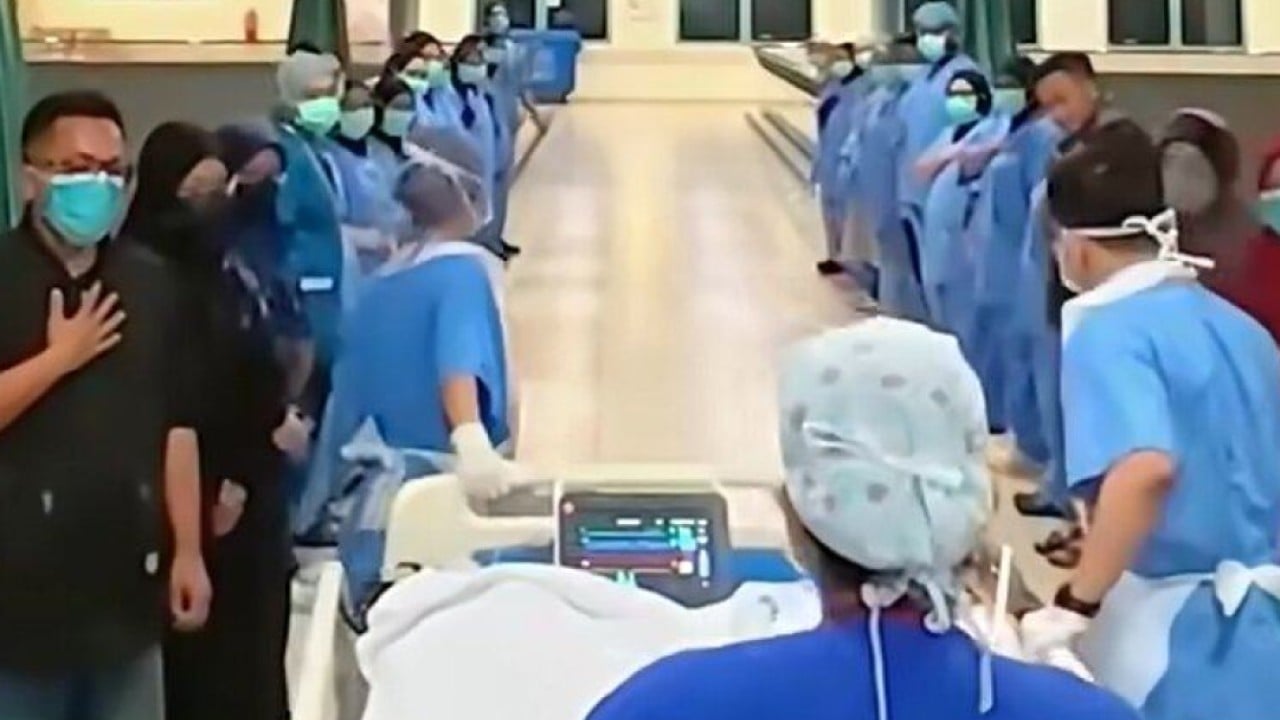
The viral video of a hospital honor walk makes you feel something. It is designed to. A line of weeping healthcare workers stands in a sterile corridor, bowing their heads as a brain-dead patient is wheeled toward an operating room for organ harvesting. The comment sections overflow with tears, heart emojis, and praise for the "ultimate gift."
It is a beautiful narrative. It is also an emotional band-aid on a gaping structural wound.
We love the theater of the honor walk because it allows us to celebrate a tragedy without interrogating the system that requires it. We treat organ donation as a localized, individual triumph of altruism. If only more people were inspired by these videos, the logic goes, the waitlists would evaporate.
That is a comforting lie. The bottleneck in transplantation is not a lack of human generosity. It is an infrastructure problem, an administrative failure, and an ethical refusal to look at the math. If we actually want to save lives instead of just collecting digital clicks on tear-jerkers, we need to stop romanticizing the tragedy and start fixing the mechanics of procurement.
The Mathematical Mirage of the Willing Donor
The foundational myth of organ procurement is that the waitlist remains long because people are too selfish to sign the back of their driver's licenses. This is mathematically illiterate.
To become an organ donor, you cannot just die. You have to die in a highly specific way. You must suffer brain death or a catastrophic neurological injury while on mechanical ventilation in an intensive care unit. Your organs must remain perfused—flooded with oxygenated blood—until the surgical team can slice them out.
Only about 1 to 2 percent of all deaths in a given year meet these criteria.
Imagine a scenario where 100 percent of the population registers as donors tomorrow. The waitlists would barely nudge. Why? Because the vast majority of those people will die at home, in hospice, or from systemic infections that render their organs useless for transplantation. The pool of potential donors is a hard physical ceiling. We are chasing a supply that cannot naturally meet the demand through sentimentality alone.
The Invisible Gatekeepers Who Lose Organs
When an eligible death does occur, the process enters a bureaucratic black box managed by Organ Procurement Organizations (OPOs). These are the regional monopolies tasked with identifying donors, managing families, and preserving organs.
If you want to know why people are dying on waitlists, look at the OPOs, not the public.
Government audits and independent investigations have repeatedly exposed staggering inefficiencies in how these organizations operate. Organs are routinely lost in transit. Procurement coordinators fail to show up at hospitals in time. Livers and kidneys are recovered but ultimately discarded because logistics teams cannot secure a commercial flight before the tissue degrades.
According to data from the United Network for Organ Sharing (UNOS), thousands of recovered organs are thrown away every year. Think about that the next time you see an honor walk. A family says goodbye, a patient is wheeled down the hallway, the surgeons perform the retrieval, and then the organ gets tossed into a biohazard bin because someone messed up a logistics spreadsheet.
No amount of public awareness campaigns can fix a broken cold-chain supply network. We are demanding that grieving families make the ultimate sacrifice while allowing the supply chain that manages that sacrifice to operate with the efficiency of a legacy logistics company from the 1980s.
The Opt-In Trap vs. Structural Default
The public debate always circles back to the same tired question: How do we get more people to opt in?
We look at countries with opt-out systems (presumed consent), like Spain or Austria, and assume the magic is in the paperwork. If the default choice is donation, the problem solves itself, right? Not exactly.
The success of Spain’s model is not just the legal default; it is their investment in clinical infrastructure. Spain places transplant coordinators directly inside intensive care units. These are trained professionals whose entire job is to identify potential donors early, manage the medical transition from life support to organ preservation, and support the family.
In contrast, many hospitals in opt-in nations treat donation as an afterthought. It is a secondary duty assigned to an overworked ICU nurse or a harried attending physician who has been awake for 24 hours. When a potential donor is missed because the hospital staff was too busy trying to keep ten other patients alive, that is an institutional failure.
We are relying on the emotional spontaneity of a grieving family to trigger a complex medical protocol. That is a terrible way to run a healthcare system.
The Ethical Blind Spot of Emotional Leverage
There is a dark side to the honor walk phenomenon that healthcare insiders rarely discuss publicly. It creates immense, unspoken pressure.
When a hospital system turns a death into a public ritual, it shifts the focus from patient care to utility. The line between honoring a choice and manufacturing consent becomes dangerously thin. When the machinery of a hospital gears up for an honor walk, the family is no longer just saying goodbye to a loved one; they are stepping onto a stage.
What happens to the family that decides, in their final moments of agony, that they cannot bear the thought of their child being harvested? What happens when they just want to turn off the machines and hold a hand in silence? In an environment where the honor walk is treated as the gold standard of a "good death," saying no carries a heavy, artificial weight of guilt.
We have commodified the aesthetics of grief to promote a system that is failing on the back end. It is a brilliant public relations strategy for hospital groups. It costs them almost nothing to line up staff in a hallway for ten minutes. It generates massive local goodwill and viral marketing. But it does not address the fact that the kidney being walked down that hallway has a significant chance of expiring on a tarmac because a courier service missed its window.
How to Actually Fix the Shortage
If we want to dismantle the waitlists, we have to stop looking for heroes and start building systems.
First, we must enforce strict, metric-driven accountability for Organ Procurement Organizations. If an OPO consistently fails to convert eligible donors or loses viable organs due to transport failures, its monopoly charter should be revoked immediately. Heads need to roll when organs go to waste.
Second, we need to nationalize and modernize the logistics network. Organ transport should not rely on commercial airline schedules or ad-hoc charter flights. We need a dedicated, federally mandated transit network that treats every viable organ with the urgency of a national security event.
Third, we must invest heavily in alternative technologies like machine perfusion—systems that keep organs alive outside the body for days instead of hours—and xenotransplantation. The long-term solution to the organ shortage is not waiting for more healthy young people to die in car crashes. The solution is removing human death from the equation entirely.
Stop sharing the videos. Stop crying over the footage of grief repackaged as inspiration. Demand a logistics infrastructure that respects the dead by actually saving the living.