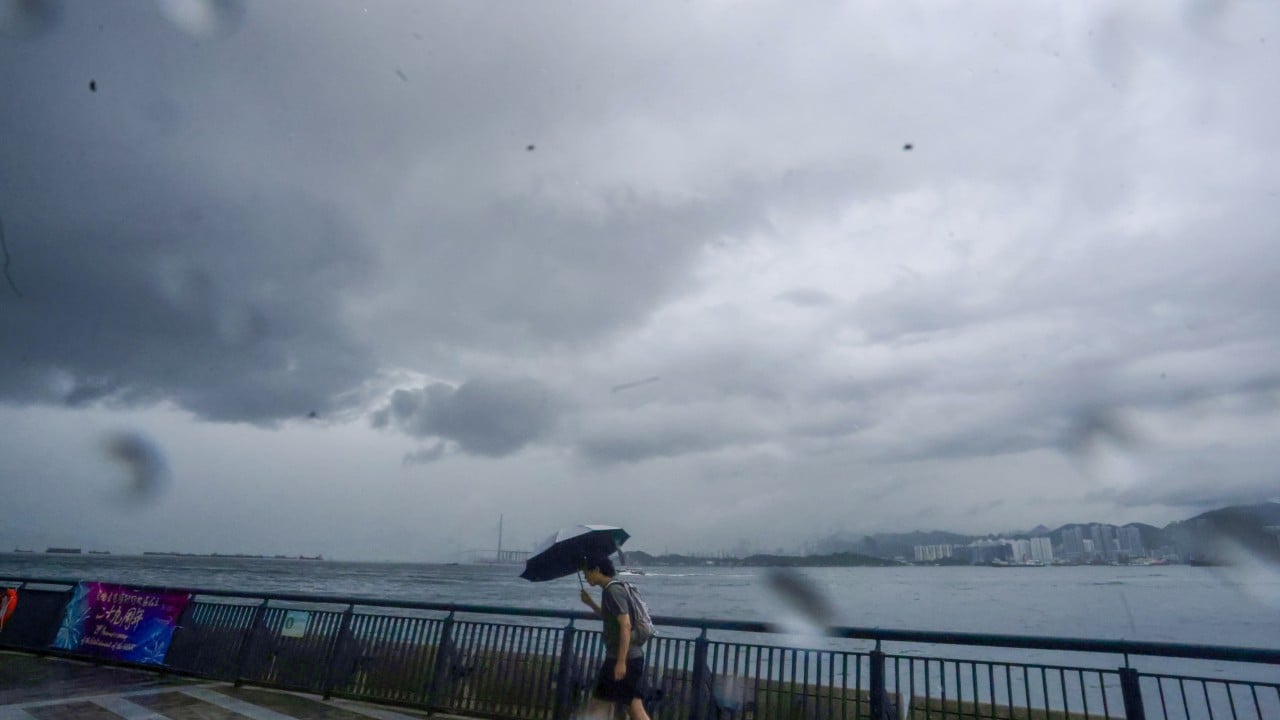
The Hong Kong Observatory announces a Standby Signal No. 1 because a weak tropical depression is drifting within 800 kilometers of the city, and suddenly the entire financial hub hitches its breath. Media outlets run live tickers. HR departments dust off their standard operating procedures. Citizens flock to grocery stores to fight over the last head of bok choy.
This entire spectacle is a farce.
The city is addicted to an archaic warning system designed for a 1950s maritime economy, and it is actively rotting our collective ability to assess real risk. What the public views as a protective shield is actually a bureaucratic hedging mechanism that prioritizes government liability coverage over economic reality and genuine public safety.
By treating every minor atmospheric burp as an impending apocalypse, the system breeds a dangerous mix of economic paralysis and psychological complacency. We do not need better forecasting. We need to stop letting a checklist of numbered flags dictate how a global metropolis functions.
The Modern Bureaucratic Shield
The Hong Kong Observatory (HKO) is globally respected for its technical capabilities, but its signaling framework has devolved from a tool of public utility into a shield against institutional blame.
When the HKO hoists a T1 signal for a tropical depression that has barely cleared the Philippine Sea, it is not protecting you. It is protecting itself. If the storm unexpectedly intensifies or shifts tracks, the bureaucrats can point to the data and say, "We warned you." If the storm fizzles out into a damp squall—which happens most of the time—the public forgets, and life moves on.
This asymmetry creates a powerful incentive to over-warn. In risk management, this is known as a type I error maximization strategy. The institutional cost of a false alarm is near zero; the institutional cost of an unannounced storm is a legislative inquiry. Therefore, the city is subjected to endless days of low-level alerts that mean absolutely nothing to the average structural integrity of a modern Hong Kong skyscraper.
Consider the physical reality of modern Hong Kong. This is not a city of wooden shanties clinging to the hillsides of Victoria Peak anymore. The building codes here are among the most stringent in the world. High-rises are engineered to withstand wind loads far exceeding anything a typical tropical depression or even a mid-grade Typhoon Signal No. 8 can deliver.
Yet, the moment a signal drops, the city reacts as if the infrastructure is made of papier-mâché.
The Economic Atrophy of Precautionary Panic
Every time the city flirts with a transition from a Signal No. 3 to a Signal No. 8, the economic machinery grinds to a halt. The stock market shuts down. Schools close. Public transport scales back.
I have watched multinational firms lose millions in cross-border transactions because a localized wind gust at a remote monitoring station in Waglan Island triggered a mandatory office evacuation in Central. The financial loss of these arbitrary shutdowns is staggering, yet it is rarely factored into the HKO's decision-making matrix. They operate in a vacuum, entirely insulated from the economic fallout of their alerts.
Imagine a scenario where a major logistics provider halts all container terminal operations at the Kwai Tsing port based on a preemptive T3 warning. Ships are diverted, supply chains fracture, and contract penalties accumulate. When the storm passes 200 kilometers to the south, yielding nothing more than a brisk autumn breeze in the harbor, who pays for that lost productivity? Not the Observatory.
This institutional risk aversion creates a massive hidden tax on doing business in Hong Kong. By binding economic activity directly to a rigid, numbered scale, the city surrenders its competitive edge to jurisdictions that treat weather as a factor to be managed rather than an automatic kill-switch for commerce.
The Dangerous Psychology of the Cry Wolf Syndrome
The worst consequence of this over-signaling is not financial—it is psychological. The human brain is poorly wired for continuous, low-level anxiety. When you tell citizens fifty times a year that a storm is "approaching," and forty-nine times nothing happens, you build a culture of profound complacency.
This is the classic "Cry Wolf" phenomenon, verified across decades of behavioral science research. When a genuinely catastrophic Super Typhoon looms on the horizon, the public treats it with the same casual indifference they developed during the three dozen meaningless T1 and T3 alerts they endured earlier in the season.
- Phase 1: Institutional Alertism – Small tropical depressions are treated with official gravity.
- Phase 2: Public Desensitization – Citizens realize the actual impact on their daily lives is negligible.
- Phase 3: The Safety Mirage – People assume that as long as the signal is below a T8, they are completely safe, ignoring localized hazards like flash flooding or landslips.
- Phase 4: Catastrophic Failure – A high-impact, rapid-onset weather event catches a numb populace completely off guard.
We see this manifested in the absurd behavior that accompanies every major storm. People go surfing at Big Wave Bay during a T8. They crowd the shoreline in Tsim Sha Tsui to take selfies against the spray. They do this because the signaling system has taught them that government warnings are hyperbolic. The system has systematically stripped individuals of their personal risk assessment capabilities, replacing them with a paternalistic numbers game.
Dismantling the Fallacies of Storm Prep
Let us address the flawed assumptions that dominate the public discourse every time a tropical depression enters the South China Sea.
Flawed Assumption: "The HKO needs to issue signals early so people can prepare their homes."
This is nonsense. Taping windows in a modern, double-glazed residential tower does next to nothing for structural integrity; it merely prevents glass from shattering inward if hit by a heavy projectile, an event that a T1 or T3 wind speed cannot cause. The frantic taping of windows during a low-level signal is a superstitious ritual, a visual manifestation of control over an uncontrollable environment. The system encourages this theater instead of educating the public on real vulnerabilities, such as clear drainage channels on private balconies.
Flawed Assumption: "If the Observatory says the wind speeds justify a signal, we must obey the economic shutdown rules."
The wind speed criteria used by the HKO are based on a generalized average across a handful of reference anemometers scattered across the territory. These stations include exposed, unpopulated offshore islands like Waglan and Ching Pak U. To shut down a financial center because an uninhabited rock in the ocean is experiencing gale-force winds is organizational madness. The wind profile in the dense urban canyons of Kowloon or Central is radically different from the open water, yet the system applies a single, blunt instrument to the entire territory.
A Blueprint for Sovereign Risk Management
If you run a business, a corporate department, or even a household in Hong Kong, waiting around for the HKO to change a colored digital icon on a screen is a losing strategy. You are outsourcing your operational intelligence to a risk-averse government department. You must build your own internal framework for weather resilience.
Step 1: Decentralize Your Operational Triggers
Stop tying your corporate work-from-home or office closure policies strictly to the HKO's T3 or T8 designations. Evaluate your specific geographic and logistical reality. If your staff can operate entirely via remote cloud infrastructure, a T8 signal should not mean a day off; it should mean a seamless transition to remote operations without a drop in output. Conversely, if your staff relies on treacherous hillside roads prone to landslides, you should suspend operations long before an official T8 is raised.
Step 2: Ignore the Signal, Track the Barometric Pressure and Real-Time Wind Fields
The numbered signals are an interpretation of data, filtered through a bureaucratic lens. Look at the raw data instead. The HKO provides excellent real-time regional weather feeds. Track the actual wind speeds in your specific district and monitor the mean barometric pressure drop. A storm with a central pressure of 1000 hectopascals is a minor nuisance, regardless of how much noise the media makes about its proximity. A storm dropping rapidly toward 950 hectopascals requires immediate, serious defense.
Step 3: Harden the Asset, Not the Protocol
Instead of spending hours in committees debating your corporate typhoon policy every June, spend the money to physically harden your infrastructure. Invest in automated flood barriers for basements, redundant power supplies for critical servers, and high-impact structural glass. Once your physical assets are resilient, the weather ceases to be an existential operational threat and becomes a mere logistical variable.
The city pridefully brands itself as a resilient, world-class financial center, yet it allows its daily life to be dictated by an outdated paternalistic warning system. The next time the HKO hoists a Standby Signal No. 1, turn off the news tickers. Ignore the performative panic. Look out the window, look at the raw atmospheric pressure data, and realize that the only real danger is the collective paralysis we choose to inflict on ourselves.