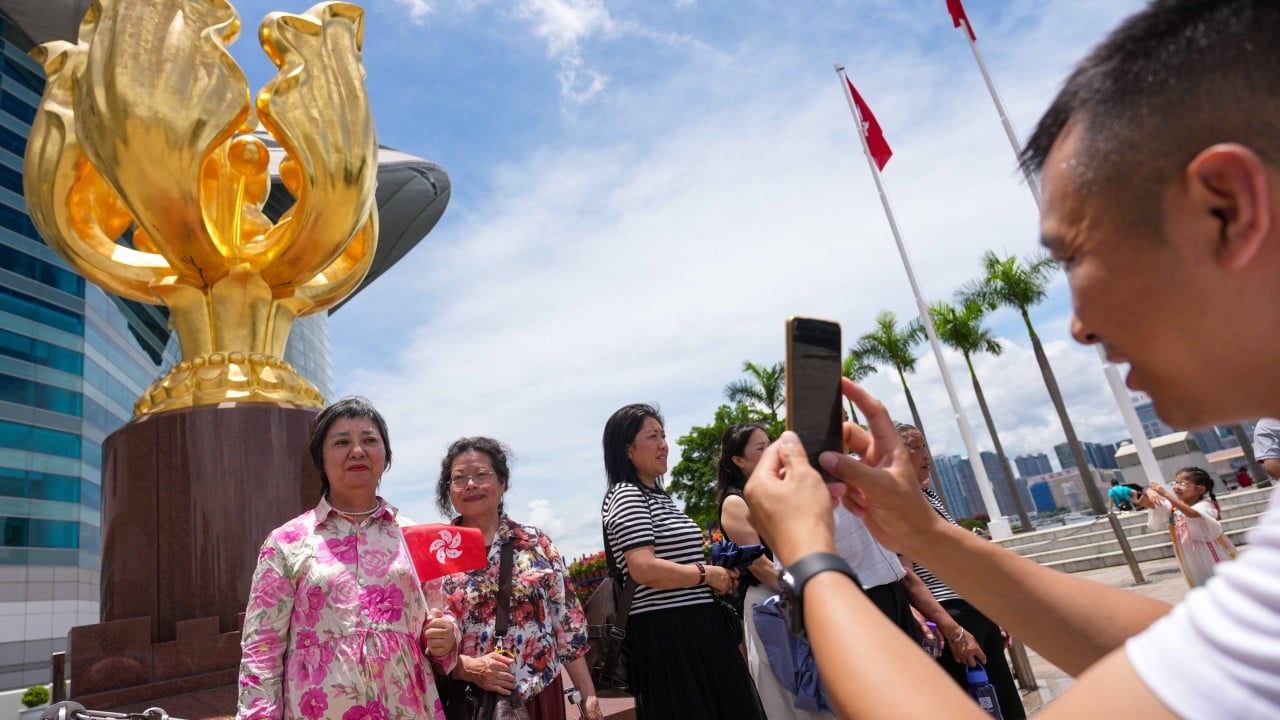
The mainstream media loves a crowded photo op. Every time a major anniversary rolls around in Hong Kong, the financial press rushes out the same predictable narrative: crowds are back, lines are long, and mainland Chinese tourists are filling the streets. The implicit conclusion is always the same—foot traffic equals economic vitality.
It is a comforting lie. It is also a fundamental misunderstanding of modern retail economics.
Headlines celebrating packed landmarks are tracking a ghost metric. They confuse raw volume with high-value velocity. If you actually look at the ledger sheets of retailers in Tsim Sha Tsui or Causeway Bay, the reality is starkly different from the optimistic snapshots. The crowds have returned, but the capital has not.
To understand why the old playbook is dead, you have to stop looking at how many people cross the border and start looking at what they are buying.
The Zero-Dollar Tourist Myth
For two decades, the economic relationship between mainland visitors and Hong Kong retail was straightforward. Visitors arrived with empty suitcases and left with luxury watches, designer bags, and premium cosmetics. Hong Kong’s tax-free status made it a shopping haven.
That version of Hong Kong is gone.
Today, the city is experiencing the rise of the "low-cost, experiential" traveler. Visitors are not queueing outside Chanel; they are queueing outside a specific bakery to buy a twenty-dollar egg tart because it went viral on Xiaohongshu. They are taking photos next to a retro street sign in Central, posting it to social media, and taking the MTR straight back across the border before dinner.
- The Content Economy: Tourism has shifted from asset acquisition to content creation. A selfie in front of the Monster Building costs nothing but generates social capital online.
- The Shenzen Arbitrage: The price differential that once made Hong Kong an automatic discount hub has evaporated. Domestic duty-free zones in Hainan and the rapid maturation of e-commerce channels mean mainland consumers no longer need to travel to buy luxury goods.
- The Currency Squeeze: The Hong Kong Dollar’s peg to the US Dollar makes the city brutally expensive for regional visitors, disincentivizing casual spending on everything except absolute essentials.
When you measure success by headcount, you incentivize the wrong behavior. You get crowded sidewalks, overwhelmed public transport, and plunging retail revenues. It is a optimization failure of the highest order.
Dismantling the Headcount Obsession
Let's look at the standard question asked by analysts: "How can Hong Kong attract more visitors to boost the economy?"
The premise itself is flawed. The question assumes a linear relationship between visitor volume and economic health. In a supply-constrained, high-rent environment like Hong Kong, excess volume without high margins creates negative externalities. It drives up operational costs, alienates local residents, and degrades the premium brand image that the city spent a century building.
Imagine a scenario where a luxury hotel slashes its room rates by 70% to achieve a 100% occupancy rate. The lobby is packed, the staff is exhausted, and the infrastructure is strained. Meanwhile, total revenue plummets, and the brand's core clientele flees to a quieter competitor. That is exactly what celebrating "packed landmarks" looks like on a macro scale.
I have watched retail executives pour millions into localized marketing campaigns designed to draw sheer numbers, only to wonder why their net margins are compressing quarter after quarter. They are optimizing for footfall while ignoring ticket size.
The data from recent golden weeks and anniversaries bears this out. While cross-border passenger traffic frequently hits 80% to 90% of pre-2019 levels, retail sales value routinely lags far behind, often stuck at 60% to 70% of historical peaks. The gap between those two numbers is the reality of the new market.
The Counter-Intuitive Playbook For Retail Survival
If you run a business in this environment, stop waiting for the big-spending tour groups to save you. They are not coming back. Instead, radical adaptation is required.
1. Monetize the Aesthetic, Not Just the Inventory
If tourists are visiting your location purely for the visual aesthetic, stop fighting it and stop giving it away for free. If they want the photo, create premium, high-margin, hyper-localized products that serve as physical trophies of that moment. Standard mass-market merchandise is dead. If a visitor can buy the exact same item on Taobao for less, you have already lost.
2. Pivot to High-Yield Micro-Experiences
Instead of trying to capture a tiny fraction of a massive, low-spending crowd, target the ultra-high-net-worth segment that still views Hong Kong as a financial and cultural safe haven. Shift floor space away from rows of product shelves and toward private, appointment-only salons, exclusive product launches, and bespoke services that cannot be replicated online.
3. Accept the Structural Shift
Hong Kong is no longer the exclusive gateway to Western luxury for mainland China. Accepting this allows businesses to stop overpaying for premium ground-floor retail space. The future belongs to upper-floor operations, niche subcultures, and brands that survive on fierce loyalty rather than random walk-in traffic from a tour bus.
The Cost of Denying Reality
The danger of the current media consensus is that it breeds complacency. When officials and property owners look at crowded streets and declare victory, they delay the necessary structural reforms. Landlords maintain artificially high rents based on the illusion of demand, forcing innovative local businesses out of the market and replacing them with a monoculture of cheap souvenir shops and pharmacy chains that cater to low-margin tourism.
This creates a downward spiral. The city loses its unique cultural edge, making it even less attractive to high-spending global travelers, leaving it entirely dependent on the very low-yield volume that is currently clogging the sidewalks.
Stop counting the bodies at the border. Start counting the value left behind in the cash registers. Until those two metrics align, a crowded street isn't a sign of recovery—it is a diagnostic warning of structural decline.
Shift your strategy or get trampled by the crowd. There is no middle ground.