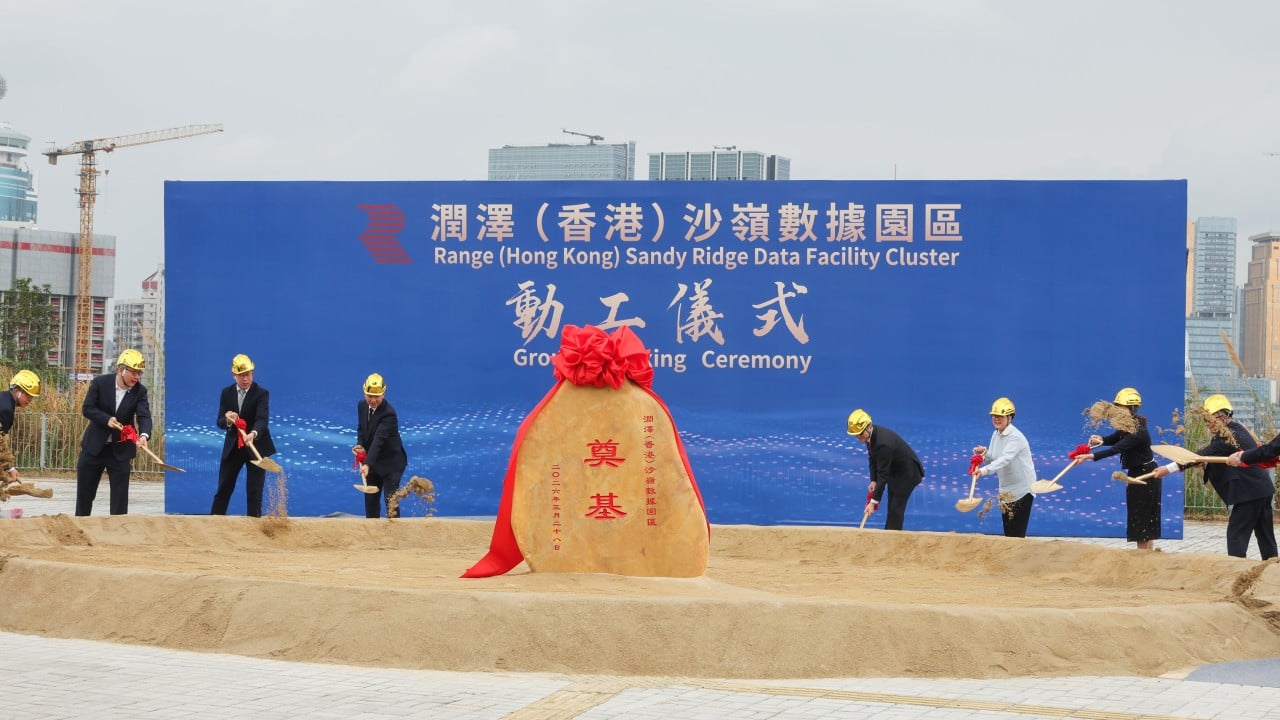
Hong Kong has officially broken ground on the first phase of its Northern Metropolis data center hub, a move designed to secure the city’s position as a regional AI powerhouse. The project, centered in San Tin Technopole, represents more than just a real estate development. It is an aggressive attempt to solve the city's crippling shortage of high-spec industrial land and power capacity. By dedicating thousands of hectares to the "Silicon Valley of the East," the government is betting that physical infrastructure can reverse years of talent flight and bridge the widening gap between local innovation and mainland China’s massive supply chains.
The Physical Constraints of a Virtual Ambition
For years, Hong Kong’s technology aspirations have hit a literal wall of granite and green belts. Data centers require three things that the city lacks: flat land, massive power grids, and cheap cooling. The Northern Metropolis is the first credible answer to this scarcity.
Existing data hubs in Tseung Kwan O are reaching their limits. The power grid there is strained, and the land is almost entirely spoken for. San Tin Technopole changes the math. By integrating data centers into a 30,000-hectare urban plan, the government is trying to build an ecosystem where the servers aren't just isolated silos but are physically adjacent to the laboratories and startups that use them. This proximity reduces latency, sure, but more importantly, it creates a concentrated zone of investment that is hard for international capital to ignore.
The challenge is the timeline. Building a data center is fast; building a city is slow. If the infrastructure lags behind the global AI race by even eighteen months, the hardware being installed today will be legacy equipment before the first tenant moves in.
Bridging the Border with Silicon and Fiber
The Northern Metropolis isn't just about Hong Kong. It is an umbilical cord to Shenzhen.
For decades, the border between Hong Kong and the mainland was a barrier. Now, it is being treated as a feature. The data centers in the Northern Metropolis are positioned to act as a "data port," a controlled environment where information can flow more freely than in the rest of the country, while still remaining within a framework that international firms find predictable.
The Power Problem Nobody Mentions
You cannot run H100 clusters on a standard municipal grid. The sheer electrical demand of modern AI training would brown out a typical residential neighborhood in minutes.
Hong Kong’s power companies, CLP and HK Electric, are having to re-engineer their long-term forecasts. The Northern Metropolis requires a dedicated high-voltage infrastructure that doesn't yet fully exist. While the ground has been broken on the buildings, the substations and cooling pipelines are the real benchmarks of success. Without a massive increase in renewable energy or a stable link to the mainland’s nuclear power plants, these data centers will be the most expensive empty shells in Asia.
The Geopolitical Tightrope
Investors are watching more than just the construction cranes. They are watching the regulatory environment.
The success of this tech hub depends on Hong Kong maintaining its unique status. If the data stored in San Tin is subject to the same restrictive cross-border data transfer laws as the mainland, Western firms will stay in Singapore or Tokyo. If the city can prove it is a "sandbox" where data can be processed with international levels of privacy but utilized with mainland levels of scale, it wins.
This is a delicate balance. Washington’s export controls on high-end chips already complicate the hardware side of the equation. To get the best GPUs, Hong Kong firms must navigate a thicket of compliance that their competitors in the US or Europe do not face. The Northern Metropolis is, in many ways, an $100 billion bet that the city can stay neutral enough to buy the chips and close enough to the mainland to use them effectively.
Beyond the Hardware Hype
Building the "hardware" of a tech hub is the easy part. The "software"—the people—is where the risk lies.
A data center doesn't employ thousands of people. It employs a few dozen highly skilled technicians and security guards. The economic engine of the Northern Metropolis must come from the companies that use those servers. The government is offering incentives to lure global firms, but those firms need a workforce.
Hong Kong has seen a significant shift in its demographics over the last five years. To make San Tin work, the city must not only stop the brain drain but start a "brain gain." This means the Northern Metropolis cannot just be a place to work; it has to be a place to live. The plan includes housing for 2.5 million people, but the cultural friction of building a brand-new city from scratch in a swampy border zone is immense.
Competition from the South
Singapore is not sitting still. While Hong Kong was dealing with domestic shifts and pandemic restrictions, Singapore cleared its own path for data center expansion, albeit with strict environmental caps.
The Northern Metropolis has one advantage Singapore doesn't: the hinterland. Hong Kong can source components, cooling technology, and specialized labor from the Pearl River Delta in a matter of hours. This supply chain integration is the secret weapon. If a server rack fails in San Tin, the replacement is coming from a factory in Dongguan, not an airport in another country.
Environmental Realities and the Cost of Cooling
Data centers are heat engines. In the humid, subtropical climate of Hong Kong, keeping thousands of servers at an operational temperature is a constant battle against physics.
The Northern Metropolis plan includes district cooling systems—centralized plants that pump chilled water to multiple buildings. This is more efficient than individual air conditioning units, but it requires a massive upfront investment in subterranean piping.
Green energy targets add another layer of complexity. Modern investors, particularly those from the EU and US, have strict ESG (Environmental, Social, and Governance) mandates. They cannot put their data in a center powered entirely by coal. Hong Kong’s transition to natural gas and increased imports of zero-carbon energy from the mainland is no longer a "nice to have" goal; it is a fundamental requirement for the viability of the tech hub.
The Land Premium Paradox
In any other city, a data center is built on the cheapest land available. In Hong Kong, no land is cheap.
The government is essentially subsidizing the land cost by designating it for tech use. However, the opportunity cost is staggering. Every square meter used for a server farm is a square meter not used for high-density housing or traditional commercial space. To justify this, the data centers must generate an outsized return in the form of tax revenue, job creation in the tertiary sectors, and general economic "weight."
If these centers end up being used merely for "dumb" storage or crypto mining rather than high-value AI training and R&D, the Northern Metropolis will be viewed as a historic misallocation of resources.
Small Players and Large Monopolies
The barrier to entry in San Tin is high. This is a playground for giants.
Public-private partnerships will define who gets to lead. We are likely to see a few massive players—think the likes of China Mobile, GDS, or local titans with deep pockets—dominating the landscape. Small to medium-sized tech firms may find themselves priced out of the very ecosystem designed to support them.
To prevent this, the government must ensure that "compute" is treated like a utility. Just as a startup doesn't build its own power plant, it shouldn't have to build its own data center. Providing affordable, high-speed access to the Northern Metropolis’s processing power for local startups is the only way to ensure the project benefits the broader economy.
The Reality of the "Groundbreaking"
Ceremonial shovels in the dirt are good for headlines, but they don't process a single byte of data.
The true test of the Northern Metropolis will come three years from now when the first racks are powered on. Success won't be measured by the height of the buildings, but by the density of the fiber connections and the reliability of the power draw.
Hong Kong is trying to build its way out of a corner. It is a bold, expensive, and necessary gamble. The city is no longer competing with its own past; it is competing with the most advanced tech ecosystems on the planet.
Identify the specific power-to-space ratio requirements for your next-generation hardware before committing to long-term leases in the San Tin district, as the current grid projections suggest a phased rollout that may not meet peak demand until the early 2030s.