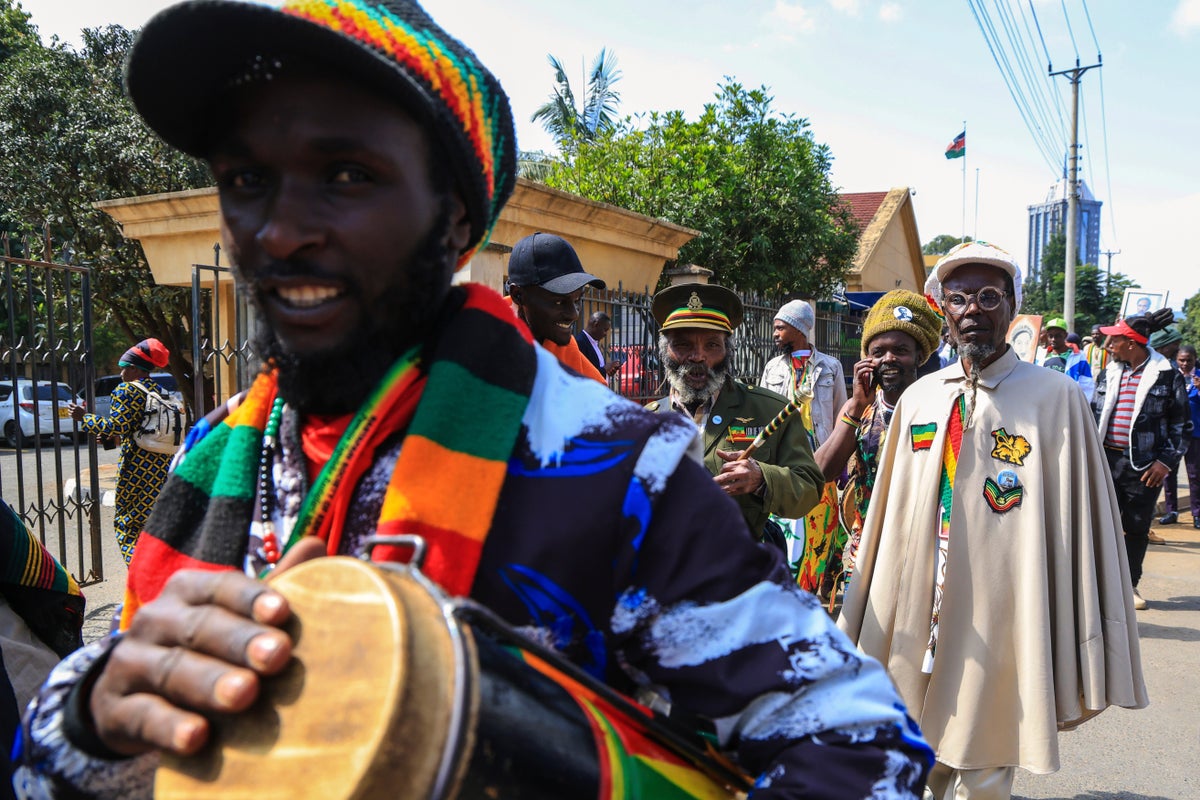
The rhythm of the Nyabinghi drum does not ask for permission. It beats from the chest outward, heavy and slow, echoing off the cold concrete of Nairobi’s Milimani Law Courts.
On the afternoon of July 15, 2026, that steady, hypnotic thrum collided head-on with the rigid language of constitutional law. Outside the courthouse, the air smelled faintly of sweet, burning herb and wood ash. Inside, the atmosphere was sterile, defined by the rustle of legal briefs and the quiet, definitive click of a judge’s gavel.
For five years, Kenya’s Rastafarian community had pinned their hopes on a single legal petition. They wanted the right to do what they have done for decades: burn cannabis as a holy sacrament, a physical conduit to the divine, protected under the constitutional right to freedom of worship.
Instead, they walked out into the Nairobi sun to face the familiar weight of a door slammed shut.
Justice Bahati Mwamuye dismissed the petition in its entirety. But in doing so, he laid bare a profound, agonizing paradox that stretches far beyond the courtroom walls.
The Weight of the Crown and the Comb
To understand why a plant causes such a tremor in the Kenyan legal system, you have to look past the modern courtroom and peer into the damp forests of the Aberdare Range.
Consider Moses Mudachi Isavwa, known to his community as Ras Masinde. At fifty years old, his dreadlocks hang like heavy ropes, a physical manifesto draped over his shoulders. To a passing police officer on the streets of Nairobi, those locks are often treated as a calling card for trouble. To Ras Masinde, they are an ancestral inheritance.
During the 1950s, the Mau Mau freedom fighters grew their hair into thick, matted locks while hiding in the forests, fighting British colonial rule. Dreadlocks were a symbol of defiance, a refusal to trim oneself down to fit the colonial mold. When the Rastafarian movement took root in Kenya, it didn't feel like an import from Jamaica; it felt like a homecoming.
Yet, the laws used to police these very bodies are the direct descendants of British colonial codes. The 1994 Narcotic Drugs and Psychotropic Substances Act dictates that possessing even a single, hand-rolled joint can carry a ten-year prison sentence and a crushing fine.
For Ras Masinde, the daily walk to the communal tabernacle is a gauntlet.
"Every time I walk on the street, someone will come and want to intimidate me," he says, his voice carrying the weariness of a man who has spent a lifetime being watched. "They look at the hair, they assume the herb, and the cuffs come out."
The Legal Trap: Essential vs. Preferred
The courtroom battle turned on a devastatingly dry semantic distinction.
The Rastafari Society of Kenya argued that cannabis—known locally as bhang—is not a recreational escape. It is the sacrament. It is the incense that carries their prayers upward to Jah.
But the law demands a level of rigid, uniform proof that spirituality rarely provides.
During the hearings, the court listened to various testimonies. While everyone agreed that the herb was used during meditation and worship, the witnesses stumbled when pressed on a cold, legal detail: Was the smoking of cannabis absolutely essential to the faith, or was it merely a preferred practice?
It is a classic trap of secular governance trying to measure the boundaries of the soul. How do you prove to a judge that your connection to the Almighty evaporates without a burning leaf?
Justice Mwamuye seized on this division. In his ruling, he pointed out that the petitioners had failed to establish a solid constitutional foundation showing that the drug laws directly infringed upon the core, non-negotiable tenets of their religion. Because the community could not present a single, unified theological consensus on whether they needed the herb or simply wanted it, the court ruled that the state’s drug laws must stand supreme.
To the devotees waiting on the steps, the ruling felt less like a legal failure and more like a cultural erasure.
Wanjiru Gakiu, a sixty-year-old grandmother who has walked the Rastafari path for thirty-four years, stood outside the court, her face etched with quiet fury.
"Disappointed," she said simply, watching the police vans idle nearby. She shook her head, calling the persistent ban on their sacred herb a continuation of "satanic," colonial-era control over African spirituality.
The Judge’s Playlist
But then came the twist.
Just as the ruling threatened to paint Justice Mwamuye as a rigid bureaucrat, he did something entirely unexpected. He looked out at the courtroom and spoke a truth that everyone in Kenya knows, but few in authority care to admit.
He acknowledged that the current law is too harsh. He noted that the use of cannabis in Kenya is "ubiquitous" and has been for decades.
To drive the point home, the judge did not quote ancient British common law or dry East African precedents. Instead, he channeled the late, great reggae pioneer Peter Tosh. He quoted the seminal anthem "Legalize It":
"Judges smoke it, even lawyers do."
The courtroom fell quiet. Here was a High Court judge admitting that the very laws he was sworn to uphold were practically ignored by the very people who wrote and enforced them.
The status quo, the judge conceded, is completely untenable. He called for a "full and frank conversation" across Kenyan society to decide where the country’s drug policies should actually go.
But a call for conversation does not unlock a prison cell.
For the young Rastafarian youth living in Kibera—one of Nairobi’s largest informal settlements—the theoretical debate over national drug reform offers cold comfort. While politicians and judges debate the nuances of policy over tea, young men with dreadlocks continue to be pulled into alleyways by police officers looking for an easy bribe or an arrest to fill a quota.
The Undying Fire at Freedom Corner
Shortly after the gavel fell, the crowd of disappointed petitioners did not disperse quietly into the Nairobi traffic. They marched.
They gathered at Freedom Corner, a historic site of protest and resistance in the city’s Uhuru Park. They beat the drums harder. They chanted.
And then, in a quiet, collective act of civil disobedience, they lit the herb.
Thick, fragrant smoke rose into the afternoon air, drifting over the manicured lawns and toward the distant, towering glass offices of the city's financial district. It was an act of defiance, but also one of profound exhaustion.
Their lawyer, Shadrack Wambui, has already promised to take the fight to the Court of Appeal. The legal battle is far from over. But the legal system moves with the agonizing slowness of a glacier, while the daily reality of criminalization remains an immediate, burning fire.
As the sun began to dip below the Nairobi skyline, the drums at Freedom Corner continued to beat. The law had dismissed their prayers, but it had not silenced them. In the rising smoke, the Rastas of Nairobi made one thing abundantly clear: they do not need a piece of paper from a judge to tell them where the holy resides.
This video documents the immediate aftermath of the High Court's ruling, capturing the raw reactions of the Rastafarian community and their legal representation as they process the decision.