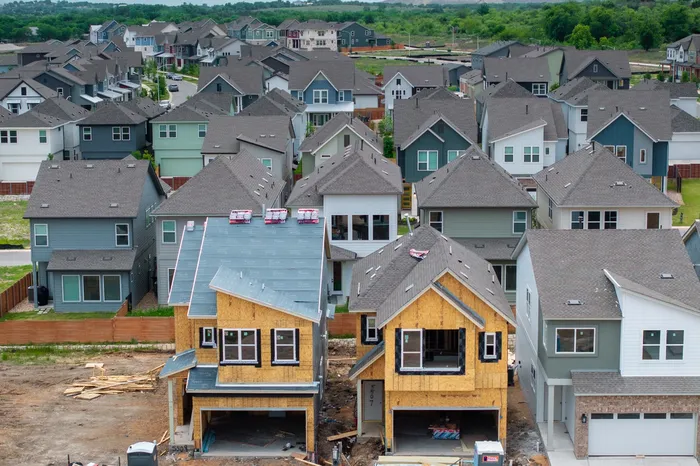
American homebuilders are currently engaged in a massive, high-stakes shell game. To keep sales moving in an era of seven-percent mortgage rates, the industry has turned away from traditional price cuts. Instead, they are pouring billions into mortgage rate buy-downs and closing cost credits. This strategy keeps "sticker prices" artificially high while making monthly payments manageable for the average buyer. It is a brilliant short-term fix for volume, but it masks a deep instability in the housing market that could haunt valuations for years.
While the surface-level story is about builders helping buyers, the underlying mechanics reveal a calculated defense of corporate balance sheets. If a builder drops a home price by $50,000, they instantly devalue every other unsold home in that development. Appraisals drop, and existing homeowners—often still under warranty or in the middle of a multi-phase build—get angry. By using incentives, builders maintain the "comparable sales" data that keeps banks happy, even if the net profit on the house is significantly lower than the public price suggests.
The Mortgage Buy Down Trap
The most effective tool in the current builder kit is the permanent mortgage rate buy-down. When the market rate is 7.2%, a builder like D.R. Horton or Lennar might offer a long-term rate of 5.5%. They do this by paying a massive upfront fee to their in-house mortgage subsidiary.
This is not a discount. It is a pre-payment of interest.
For a buyer, the math is seductive. On a $400,000 mortgage, the difference between 7% and 5.5% is roughly $400 a month. That is the difference between qualifying for a loan and being rejected by an automated underwriting system. However, this creates a two-tier market. You have the "incentivized" buyers who can afford their homes only because of the builder’s subsidy, and the "organic" buyers who are facing the full brunt of the Federal Reserve’s tightening cycle.
If these buyers need to sell in three years, they will face a harsh reality. They won't have a builder behind them to subsidize the next person's interest rate. Unless rates have naturally fallen to 5%, their home will be effectively more expensive to the next buyer than it was to them, even if the price stays exactly the same.
Why Builders Fear Price Integrity
Publicly traded homebuilders are under intense pressure to maintain "starts" and "closings." Their stock prices depend on the velocity of money. If a house sits empty, it eats through capital in the form of property taxes, insurance, and maintenance.
Price cuts are a last resort because they are "sticky." Once you lower the price of a specific model in a neighborhood, that becomes the new ceiling for every future appraisal in that ZIP code. Incentives, conversely, are "invisible" to many basic data aggregators. When a county recorder logs a sale, they log the gross price. They rarely log the fact that the builder handed back $25,000 at the closing table to cover the buyer’s points and fees.
This creates a dangerous gap between recorded values and actual market value. We are building a bubble of "phantom equity" where the paper value of new construction is propped up by corporate marketing budgets.
The Burden of In-House Lending
The rise of the "builder-banker" model has accelerated this trend. Most major builders now operate their own mortgage companies. This vertical integration allows them to move money from one pocket to the other. They can accept a lower profit margin on the mortgage side to ensure a high-margin sale on the construction side.
- Risk Concentration: The builder now holds the risk of the construction, the land, and often the initial financing.
- Artificial Demand: Incentives pull forward demand from the future, meaning builders are "borrowing" buyers from 2026 to fill their 2024 and 2025 quotas.
- Appraisal Lag: Because incentives aren't always transparent in public records, appraisers may inadvertently use subsidized sales as benchmarks for non-subsidized homes, inflating the entire neighborhood.
The Casualty of the Incentive War
Small, local builders are the primary victims of this environment. A firm building five homes a year cannot afford to buy down a mortgage rate to 5% for thirty years. They don't have the capital reserves or the captive mortgage arms of the national giants. As a result, we are seeing a massive consolidation of market share. The "Big Builders" are effectively using their balance sheets to price out smaller competitors, not by building better homes, but by offering better financial engineering.
This consolidation reduces architectural variety and local economic resilience. When a single national firm controls 40% of the new permits in a county, they dictate the local economy. If they decide to pull back, the local labor market for trades—plumbers, electricians, framers—collapses overnight.
The Appraisal Distortion
The most technical, and perhaps most overlooked, aspect of this shift is the impact on the "Comparable Sale" (Comp) system. In a healthy market, an appraiser looks at three similar homes sold recently to determine what a new one is worth.
Today, that system is broken.
Imagine two identical houses. House A is a resale from a private individual, listed at $450,000 with a market interest rate of 7%. House B is a new build across the street, listed at $475,000 but with a builder-funded 5% interest rate. House B is actually the "cheaper" house in terms of monthly carry, but on the public record, it looks like it sold for $25,000 more.
Future buyers and banks will look at House B as the benchmark. They will see a rising price trend where there is actually a stagnation or a hidden decline. This is how a market loses its ability to price risk correctly. When the "real" price is hidden behind a curtain of credits and buy-downs, nobody actually knows what the dirt is worth.
Looking Beyond the Monthly Payment
Buyers often focus entirely on the monthly "nut." They ask, "Can I afford the check I write on the first of the month?" The builders know this and exploit it. By shifting the focus from the total debt to the monthly service, they encourage buyers to take on larger principal balances than they might otherwise.
If interest rates stay high for a decade, these buyers are fine—as long as they never move. But the American economy thrives on labor mobility. If a buyer needs to relocate for work, they must sell that $475,000 home into a market that may only support a $425,000 valuation without the builder's help. That $50,000 gap is the cost of the incentive, and it is a debt that eventually comes due.
The Inventory Illusion
We are told there is a massive housing shortage. While true in a general sense, the "shortage" is exacerbated by the "lock-in effect" of existing homeowners with 3% rates who refuse to sell. This gives builders a temporary monopoly on "available" inventory.
They are using this monopoly power to maintain high prices through financial gimmicks. However, the supply of new homes is actually rising in many Sun Belt markets. In cities like Austin or Phoenix, the "days on market" for new builds is creeping up despite the incentives.
When the incentives stop working, the only tool left is the one builders fear most: the actual price cut. We are already seeing the first cracks in this facade. Some builders have started offering "flex cash" that can be used for anything from upgrades to rate buy-downs. When "flex cash" increases from $10,000 to $40,000, it is a price cut in everything but name.
The Institutional Exit
It is also worth noting who is not buying right now. Institutional investors, who flooded the market in 2021, have largely moved to the sidelines for new construction. They see the math. They know that the cap rates don't make sense when you strip away the temporary financing perks.
If the "smart money" is waiting for a correction, the retail buyer should be asking why they are being lured in with "free" money at the closing table. There is no such thing as a free lunch in real estate. Every dollar the builder gives you for your mortgage is a dollar they have already added to the sales price of the home.
The industry is currently holding its breath, praying for the Federal Reserve to pivot. If rates drop to 5% naturally, the builders can phase out the incentives and the "phantom equity" becomes real equity. If rates stay at 7%, the gap between the subsidized price and the actual market value will eventually become too wide to bridge.
At that point, the builders won't just be leaning on incentives; they will be falling over them. The shift from "incentive-heavy" to "price-discovery" will be painful, swift, and entirely necessary for a functional market.
Watch the "Net Orders" and "Cancellation Rates" in the next quarterly earnings reports. Those are the only numbers that tell the truth. Everything else is just a marketing budget masquerading as a mortgage. Buyers should stop looking at the shiny new kitchen and start calculating the exit price without a corporate subsidy attached.
The era of the "free" mortgage rate is a debt being pushed onto the future. When that future arrives, the bill will be paid by the homeowner, not the builder.
Check the local tax assessment vs. your purchase price in twelve months. That is where the reality hits the ledger.