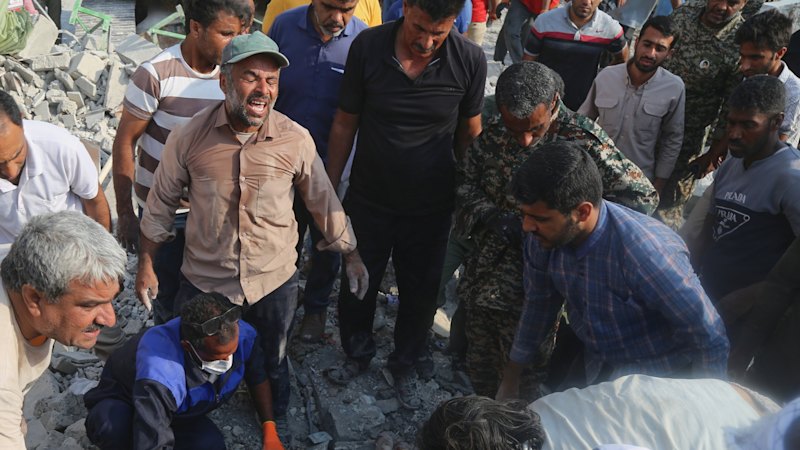
Australia’s foreign policy is currently performing a high-wire act over a Middle Eastern furnace. In the wake of the joint U.S.-Israeli strikes on Iran that claimed the life of Supreme Leader Ali Khamenei on February 28, 2026, the Albanese government has offered a predictable chorus of "strategic support." Prime Minister Anthony Albanese and Foreign Minister Penny Wong have framed the escalation as a necessary evil to prevent a nuclear-armed Tehran. Yet, beneath the veneer of alliance solidarity lies a brutal reality that Canberra is hesitant to voice. Australia is not just a spectator; it is an exposed party facing a triad of risks: the potential collapse of the AUKUS timeline, a domestic cost-of-living spike fueled by $2.50-per-litre petrol, and a diplomatic vacuum that leaves 2,000 Australians stranded in a war zone.
The "why" behind the U.S. move is a radical departure from the containment strategies of the last decade. President Donald Trump has pivoted from pressuring a deal to actively pursuing regime change, explicitly calling for the Iranian people to "take over" their government. For Australia, this shift is more than a change in rhetoric. It is a fundamental disruption of the regional "warning time" upon which our recent Defence Strategic Review was built. If the Middle East descends into a multi-year vacuum, the American "strategic bandwidth"—the very thing Australia relies on for Indo-Pacific deterrence—will be sucked back into the sands of the Persian Gulf.
The AUKUS Collision Course
The most overlooked casualty of a prolonged Iran conflict is the AUKUS submarine program. Australia’s path to nuclear-powered capability is paved with American industrial capacity. Currently, the United States struggles to produce even two Virginia-class submarines per year for its own fleet. An active war in the Middle East, requiring sustained naval presence and potential replenishment of vertical launch systems, places immediate operational demands on a brittle U.S. defense industrial base.
When Washington has to choose between fulfilling a 2030s delivery to an ally in the Pacific or replacing assets lost or strained in a 2026 Middle Eastern war, the choice is historically clear. Australia faces a real risk of its submarine arrival dates slipping into the 2040s. This isn't just a delay; it is a decade-long "capability gap" during which Chinese maritime pressure in the South China Sea will likely go unanswered. We are essentially mortgaging our future security in the Pacific to support a regime-change gamble in the Middle East.
The Economic Aftershock at the Bowser
While the strategic thinkers in Canberra focus on "rules-based order," the average Australian is looking at the price of 91-unleaded. The Strait of Hormuz, which handles 20% of global oil supply, is now a frontline. Even without a total blockade, the "war risk" premium is already driving Brent crude toward $100 per barrel.
Immediate Market Impacts
| Commodity | Pre-Strike Price | Current Trajectory | Australian Impact |
|---|---|---|---|
| Brent Crude | $73 | $100+ | $2.50/L petrol prices |
| Gold | $2,400/oz | Rising (Safe Haven) | AUD strength buffer |
| Shipping Insurance | Standard | 300% Spike | Increased cost of imports |
The Treasurer’s office has hinted at "monitoring" the situation, but monitoring doesn't stop inflation. Higher fuel costs are a regressive tax on the Australian suburbs. Every cent added to the price of diesel trickles into the price of groceries and freight. In an economy already bruised by 3% persistent inflation and the "Liberation Day" tariff shocks of 2025, a Middle Eastern energy spike could be the catalyst for a domestic recession that the government is desperate to avoid.
The Consular Crisis and the Pine Gap Question
There is a cold irony in Australia’s diplomatic stance. We are supporting strikes by a nation whose leader didn't bother to inform us they were happening. Foreign Minister Penny Wong confirmed Australia was not told in advance of the February 28 attacks. This lack of communication highlights a deepening asymmetry in the alliance.
Wong has also been pointedly evasive regarding the role of the Joint Defence Facility Pine Gap. When asked if the facility was used to provide targeting data or signals intelligence for the strikes, the response was a rehearsed silence. This "no comment" approach is becoming harder to maintain as the conflict scales. If Australian soil is being used to facilitate an unprovoked strike aimed at regime change—a move many international law experts are already calling a violation of the UN Charter—then Australia is a co-belligerent in all but name.
Meanwhile, 2,000 Australians in Iran and another 1,200 in Israel are trapped by closed airspaces and cancelled flights. The government’s advice to "shelter in place" or "travel to the Azerbaijani border" (an eight-hour land journey through a collapsing security environment) is a grim admission of limited reach. After withdrawing our ambassador from Tehran in 2025, Canberra has no direct levers to pull. We are effectively outsourcing our citizens' safety to Omani mediators and the hope of commercial flight resumptions.
The Social Fabric Under Strain
The conflict is already bleeding into Australian streets. The 80,000-strong Iranian-Australian community is fractured between those celebrating the fall of a "vicious group of hard people" and those terrified for family members caught in the inevitable "reprisal attacks" promised by the IRGC.
Past conflicts, like the Syrian civil war, saw a proliferation of community-based fundraising and mobilization that eventually triggered intense ASIO scrutiny. Iran, with its larger diaspora and deeper geopolitical roots in Australia, presents a much larger risk to domestic cohesion. The government is currently trying to balance support for the "struggle against oppression" with the need to prevent sectarian spillover at home. It is a balance that rarely holds once the civilian casualty counts start to climb.
The Strategic Silence
What is missing from the official Australian narrative is an honest assessment of the "endgame." If the clerical regime in Tehran falls, who fills the void? The assumption that a pro-Western democracy will blossom overnight is a ghost of 2003-era neoconservatism that has failed every time it was tested in the region.
A fractured Iran is arguably more dangerous to Australian interests than a sanctioned one. A civil war or a collapsed state would trigger a humanitarian crisis of 20 million displaced persons, dwarf the Syrian refugee crisis, and permanently divert American naval assets to the region. Canberra’s vocal support for the strikes suggests we have accepted these risks, yet there has been no public discussion about our readiness to handle the fallout.
Australia is currently walking toward a decade of heightened Chinese pressure with a distracted ally, a delayed submarine program, and an economy tethered to the most volatile waterway on earth. Supporting the "Board of Peace" era of U.S. foreign policy may be the price of the alliance, but the bill is coming due much sooner than anyone anticipated.
Would you like me to look into the specific legal arguments being raised by international law experts regarding Australia’s potential liability in these strikes?


