The current diplomatic friction regarding a Lebanese ceasefire is not a dispute over wording, but a structural conflict between two incompatible security architectures. On one side, the United States and Israel seek a "monitoring and enforcement" mechanism that grants external actors the right to intervene if violations occur. On the other, Hezbollah views any oversight body that bypasses the Lebanese State or includes Israeli oversight as a terminal breach of national sovereignty. The core of this impasse lies in the Sovereignty-Security Paradox: Israel cannot accept a deal that relies solely on a Lebanese Army it deems incapable or unwilling to disarm Hezbollah, while Hezbollah cannot accept a deal that formalizes Israeli military freedom of action within Lebanese borders.
The Triad of Non-Negotiable Constraints
To understand the current deadlock, one must categorize the demands into three distinct operational pillars. Each pillar represents a "red line" where the tactical requirements of one party create an existential threat to the strategic posture of the other.
- The Enforcement Mandate: The US proposal reportedly includes a shift in the composition of the Tripartite Committee—currently consisting of UNIFIL, Lebanon, and Israel—to include a more active Western oversight role. Hezbollah’s leadership characterizes this as "dictating text" because it shifts the burden of proof from Lebanese judicial processes to international monitors.
- Freedom of Action (Article 3 Overreach): Israel’s primary demand is the "right to respond" to any re-armament or infrastructure building by Hezbollah south of the Litani River. In the logic of strategic depth, this turns a ceasefire into a "conditional pause" where the criteria for resuming hostilities are defined unilaterally by the Israeli Air Force (IAF).
- The Territorial Buffer (UNSCR 1701+): While the 2006 Resolution 1701 mandated a zone free of any armed personnel except the Lebanese Army and UNIFIL, its failure to prevent the buildup of Hezbollah’s Radwan Force has led to the current demand for physical verification mechanisms that Hezbollah views as intelligence-gathering for the Mossad.
The Cost Function of "Dignity" in Asymmetric Warfare
Hezbollah’s rhetoric regarding "insults" and "dictation" is often dismissed as political theater, but in an asymmetric warfare framework, it serves a specific utility: Maintaining the Legitimacy of the Resistance. If Hezbollah accepts a deal that looks like a surrender or a loss of Lebanese autonomy, they lose their domestic political mandate as the "protector" of the state.
The group’s strategy follows a War of Attrition Model. Their goal is to prove that the cost of continued Israeli ground operations and the displacement of northern Israeli residents is higher than the cost of Israel conceding on the "freedom of action" clause. The logic dictates that as long as Hezbollah can launch rocket fire into northern Israel, they maintain a "veto" over the diplomatic process.
The Failure of Current Monitoring Frameworks
The existing UNIFIL (United Nations Interim Force in Lebanon) framework is functionally paralyzed by a lack of an enforcement mandate. Under current rules, UNIFIL cannot search private property for weapons without the presence of the Lebanese Armed Forces (LAF). This creates a Verification Gap:
- The Proximity Problem: Hezbollah operates within civilian infrastructure, making high-confidence verification impossible without intrusive searches.
- The Institutional Constraint: The LAF is a multi-confessional institution that risks internal fragmentation if ordered to directly confront Hezbollah on behalf of an international mandate.
- The Information Asymmetry: Israel utilizes high-altitude surveillance (ELINT and IMINT) to identify violations, but international law requires physical evidence to trigger a formal UN response, creating a time-lag that Hezbollah exploits to move assets.
The "Direct Intervention" Bottleneck
The most contentious element of the US-brokered draft is the reported inclusion of a clause allowing Israel to strike Lebanon if the international monitors fail to act. This creates a Sovereign Decay for Lebanon. No state can formally sign a treaty that grants a neighbor the legal right to bomb its territory.
From a strategic consulting perspective, this is a "poison pill" designed to force a choice. If Lebanon signs, it cedes sovereignty; if it refuses, it remains a combat zone. Hezbollah’s leadership is betting that the international community will eventually pressure Israel to drop this clause to prevent a total regional collapse.
Quantification of the Escalation Ladder
We can map the current military-diplomatic trajectory using an Escalation Dominance Matrix.
- Level 1: Symbolic Strikes. (Current State) Exchange of fire limited to military targets and border towns. Diplomatic channels remain open.
- Level 2: Infrastructure Degradation. Targeting of state assets (ports, airports, power grids) to pressure the Lebanese government to force Hezbollah's hand.
- Level 3: Ground Buffer Expansion. Israel attempts to push the "Blue Line" physically to the Litani River, creating a de facto security zone managed by the IDF.
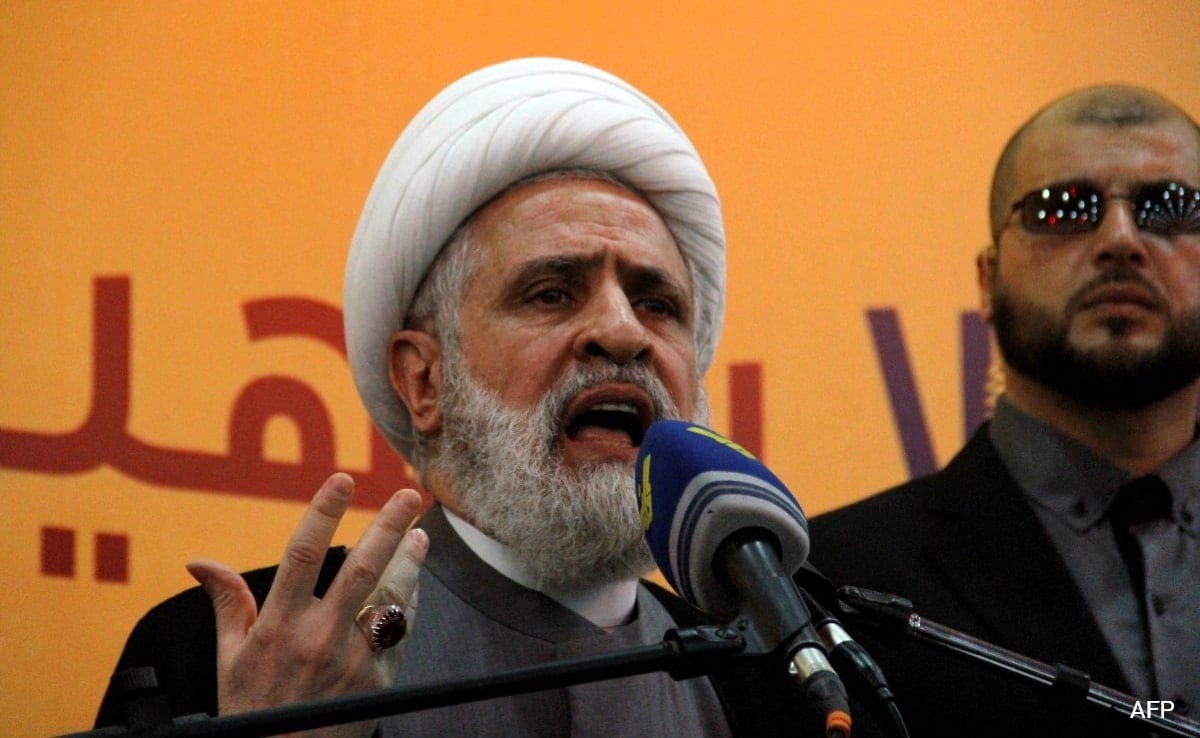
Hezbollah’s response to Level 2 and 3 is the expansion of the "Circle of Fire" into Tel Aviv and central Israel. The "insult" Naim Qassem refers to is the US expectation that Hezbollah will accept Level 1 constraints without Israel making any concessions on its own reconnaissance overflights or territorial violations.
Structural Flaws in the US Mediation Model
The United States is attempting to solve a Zero-Sum Security Problem with a Positive-Sum Diplomatic Solution. This approach is structurally flawed because it assumes that both parties value "stability" more than their respective "security guarantees."
The US relies on the "carrot" of Lebanese economic reconstruction. However, Hezbollah’s survival is not tied to the Lebanese GDP. It is tied to its military capability. Therefore, economic incentives are an ineffective lever against an ideological and military non-state actor.
The Geopolitical Anchor: The Iran Factor
Hezbollah does not operate in a vacuum. Its decision-making is inextricably linked to the "Unity of Fronts" strategy orchestrated by Tehran. The refusal to accept "dictated text" is also a message to the incoming US administration that the "Maximum Pressure" campaign will not translate into easy diplomatic wins in the Levant.
The Lebanese government, led by Speaker Nabih Berri (acting as the conduit for Hezbollah), is seeking to revert to the "pure" version of UNSCR 1701. Their logic is that the 2006 resolution is already a legal framework, and adding new "monitoring layers" is a redundant attempt to undermine the LAF.
Strategic Forecast: The Shift to De Facto Arrangements
If a formal agreement remains unreachable due to the "Sovereignty Clause," the conflict will likely transition into a Stabilized Attrition State. This is characterized by:
- A gradual reduction in fire intensity without a signed treaty.
- The LAF deploying more troops to the south as a "face-saving" measure for the West.
- Israel maintaining an undeclared policy of "Active Defense," striking any identified long-range missile transfers while avoiding large-scale ground maneuvers.
This scenario avoids the "insult" of a dictated text but fails to provide the long-term security guarantees required for the return of displaced populations on either side of the border.
The final strategic play for the Lebanese state is to decouple the "technical" requirements of border security from the "political" requirements of Hezbollah’s disarmament. By focusing strictly on the physical deployment of the LAF and the expansion of UNIFIL’s logistical footprint, Lebanon can potentially bypass the "Sovereignty-Security Paradox." However, this requires Israel to accept a "probationary" period where its right to strike is suspended in favor of international monitoring—a concession the current Israeli cabinet is structurally predisposed to reject. The result is a diplomatic "deadlock of attrition" where the document's text is less important than the kinetic reality on the ground.