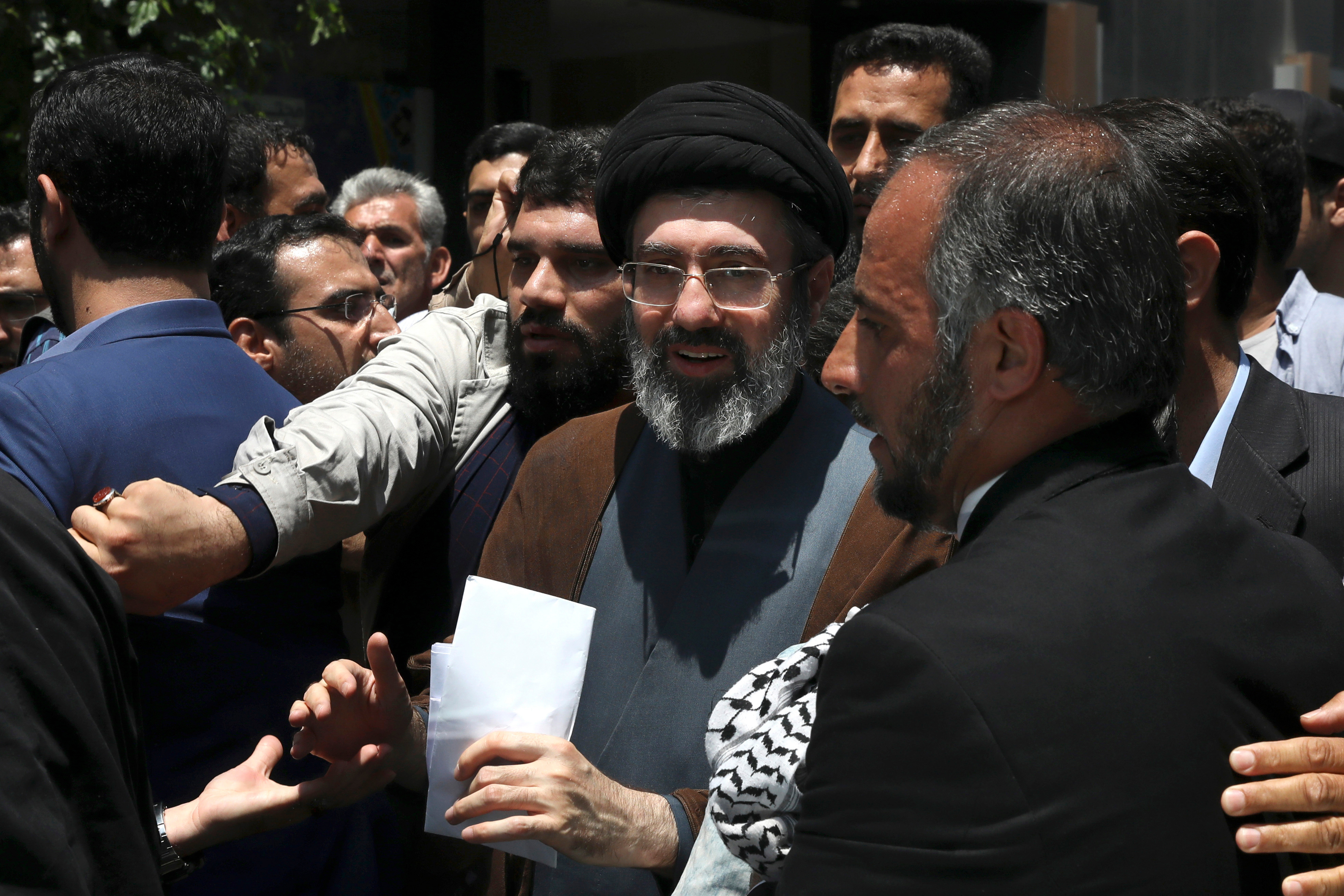
The obsession with Mojtaba Khamenei is a symptom of lazy geopolitical analysis.
Western intelligence circles and headline-hungry editors love a dynastic succession story. It is clean. It is Shakespearean. It fits into a pre-packaged narrative of "The Son Also Rises." But if you are betting on a seamless father-to-son handoff in Tehran, you are ignoring forty years of institutional friction and the brutal reality of how the Islamic Republic actually breathes.
The reports suggesting Mojtaba has been "picked" or "anointed" miss the structural design of the Iranian state. This is not a monarchy. It is a convoluted, hyper-competitive clerical oligarchy protected by a paramilitary corporate giant.
In Tehran, bloodlines are often liabilities, not assets.
The Assembly of Experts is Not a Rubber Stamp
The common refrain is that the Assembly of Experts—the 88-member body of clerics responsible for choosing the Supreme Leader—is merely a group of elderly men waiting for a signal from the top. That is a dangerous simplification.
While the Supreme Leader holds immense sway, the Assembly is a shark tank of competing clerical interests. To ascend to the position of Vali-e Faqih (Guardian Jurist), a candidate needs more than a famous last name; they need a level of religious seniority (ijtihad) that Mojtaba has struggled to project.
In 1989, when Ali Khamenei himself took power after the death of Ayatollah Khomeini, the constitution had to be amended because he lacked the necessary religious credentials. The system survived that pivot once. It is highly unlikely the conservative core of the Qom seminary will allow a second "downgrading" of the office for a man who hasn't spent decades building a theological base independent of his father's office.
The IRGC Does Not Want a Strong King
The Islamic Revolutionary Guard Corps (IRGC) is the most powerful economic and military entity in the country. They control everything from telecommunications and construction to maritime trade and missile silos.
Ask yourself: Why would a multi-billion dollar military-industrial complex want a young, ambitious, and potentially autonomous Supreme Leader with a thirty-year shelf life?
The IRGC thrives under a leader who provides legitimacy while allowing them operational autonomy. A dynastic succession creates a "royal" aura that could eventually consolidate power back into the hands of a single family, threatening the IRGC’s "state-within-a-state" model. The Guard wants a partner, not a boss. If Mojtaba takes the seat, he becomes a target for every faction that feels sidelined by the Khamenei inner circle.
I have watched analysts make this mistake in corporate boardrooms for years. They assume the CEO’s handpicked successor is a shoe-in, forgetting that the VPs and the board members have been sharpening their knives for a decade. In Tehran, those knives are literal.
The Ghost of the Pahlavis
The Islamic Republic was founded on the explicit rejection of hereditary rule. The 1979 Revolution was a violent, seismic "No" to the concept of a Peacock Throne.
For Ali Khamenei to install his son is to admit that the revolutionary experiment has failed and reverted to a standard Middle Eastern autocracy. This is a PR nightmare that the regime’s ideologues cannot afford. They rely on the veneer of a "religious democracy" to maintain domestic mobilization.
If the leadership becomes a family business, the regime loses its last shred of ideological distinction from the Shah they deposed. The street knows this. The mid-ranking clerics know this.
The Economic Reality of the Succession
Whoever takes the seat isn't just inheriting a prayer rug; they are inheriting a bankrupt economy, a devalued Rial, and a population that is increasingly indifferent to revolutionary slogans.
- The Sanctions Trap: A Mojtaba presidency or leadership would be met with immediate, intensified Western sanctions. He is already under U.S. sanctions. His elevation would signal a hardline "fortress Iran" mentality, killing any hope of foreign investment or nuclear de-escalation.
- The Legitimacy Deficit: Iran is currently seeing its lowest voter turnouts in history. A dynastic handoff is a recipe for a national strike or a renewed "Woman, Life, Freedom" style uprising that the security apparatus might not be able to contain if the rank-and-file soldiers feel they are dying for a prince rather than a principle.
A More Likely Scenario
Stop looking at the son and start looking at the gray men in the background.
The most probable outcome isn't a single "Supreme Leader 2.0." It is a leadership council or a weak, compromise candidate—a placeholder cleric who allows the IRGC and the bureaucratic elite to run the country by committee.
In business terms, this is a transition from a Founder-led company to a Private Equity-managed firm. The "brand" stays the same, but the power is distributed among stakeholders who care more about the bottom line (regime survival and asset protection) than the charismatic authority of the person in the big chair.
The "People Also Ask" Fallacy
People ask: "Will Iran become more moderate after Khamenei?"
The honest answer: No. It will likely become more militarized.
People ask: "Is Mojtaba the most powerful man in Iran?"
The honest answer: He is the most visible proxy. Power in Iran is opaque, shifting, and currently resides in the intersection of the IRGC’s Intelligence Organization and the Bonyads (charitable foundations that function as slush funds).
The Risk of the Counter-Intuitive Bet
The downside of this take is simple: Ali Khamenei has spent thirty years purging every viable rival. He may have cleared the forest so thoroughly that Mojtaba is the only tree left standing. But being the only one left doesn't mean you can withstand the storm.
If Mojtaba is the "pick," it is a move of desperation, not strength. It signals a regime that has run out of ideas and is retreating into the most primitive form of power preservation.
Don't buy the narrative of a smooth coronation. Iran’s history is a graveyard of "anointed" successors who never made it to the throne.
Stop watching the son. Watch the generals. Watch the bazaaris. Watch the water shortages. That is where the next Supreme Leader will be broken or made.
Betting on a Khamenei dynasty is betting on a 19th-century solution to a 21st-century collapse.