Silence.
That is what usually precedes the headline, a thick, suffocating quiet that settles over a hospital room the exact second the doctor closes the door and leaves you alone with the new vocabulary of your life.
You sit on the edge of the crinkly paper covering the examination table, staring at a pamphlet with a stock photo of a smiling woman walking on a beach, and your brain tries to translate medical Latin into the actual, terrifying logistics of Tuesday morning. Who will pick up the kids? How long does the nausea last? When will the hair start coming out in clumps in the shower drain?
Then, if you happen to be Catherine, Princess of Wales, the door opens not to a quiet hallway, but to the roaring, insatiable machinery of the global press.
In March 2024, when Kate sat on a wooden bench framed by spring daffodils and told the world she was undergoing preventative chemotherapy, the collective reaction was swift, emotional, and deeply predictable. Within hours, the tabloid front pages had already drafted her script. She was the "Brave Princess." Her journey was neatly packaged into a linear, uplifting arc called the "road to recovery."
It sounds kind. It sounds supportive. It sounds like the exact sort of rallying cry a beloved public figure deserves when facing down a brutal diagnosis.
Except anyone who has actually sat in an infusion chair knows the truth. Calling a cancer patient "brave" is often a polite way of asking them to perform strength so the rest of us don't have to feel uncomfortable about their vulnerability.
The Architecture of a Fairy Tale
To understand why the "Brave Princess" narrative is so seductive—and so subtly damaging—we have to look at the ancient machinery of royal storytelling. For centuries, the British monarchy has survived on a simple, unspoken contract: we give you palaces, tiaras, and unimaginable privilege, and in return, you give us stability. You do not bleed. You do not falter. And if you must suffer, you do so with impeccable posture and a serene, reassuring smile.
Queen Elizabeth II perfected this art over seventy years, turning emotional stoicism into a constitutional virtue. When she famously declared that she had to be seen to be believed, she set a standard that left very little room for the messy, unpredictable reality of human biology.
Enter Kate Middleton.
For over a decade, she played her role with breathtaking precision. She stepped onto the steps of the Lindo Wing hours after giving birth, hair glossy, heels high, waving to the cameras as if childbirth were merely a brisk morning walk. She absorbed the scrutiny, the relentless commentary on her hemline, her weight, her facial expressions, and turned herself into a mirror onto which the public could project whatever version of modern royalty they wanted to see.
So when she vanished from public view following abdominal surgery in January 2024, the vacuum created a kind of collective panic. The internet did what the internet always does when denied access to a woman's body: it invented conspiracies. Where was she? Why hadn't she waved? Why wasn't she performing?
By the time she released her video message in March, the public was desperate for a story they could understand. They didn't want the terrifying ambiguity of cellular biology. They wanted a hero's journey.
And the media happily obliged. Headlines immediately flattened a complex, grueling medical reality into a familiar fairy tale. She was fighting a battle. She was being brave. She was on the road to recovery.
The Myth of the "Road"
Let's dismantle that metaphor for a moment, because words matter, especially when they dictate how we treat the sick.
A road implies a clear direction. It has a starting point, a middle, and a destination. If you walk down a road, you expect to make steady, measurable progress. Tuesday is better than Monday. Next month is closer to the end than this month.
Cancer treatment—and specifically preventative, or adjuvant, chemotherapy—is not a road. It is a labyrinth built on shifting sand.
Consider a hypothetical scenario. Imagine a woman named Sarah, a thirty-eight-year-old graphic designer and mother of two, living in a quiet suburb outside Manchester. Like Kate, Sarah undergoes what is supposed to be a routine abdominal surgery. Like Kate, she wakes up to learn that post-operative tests have revealed the presence of cancer. The tumor is gone, the surgeons say, "clean margins," a phrase that sounds wonderfully tidy.
"Now," the oncologist tells her, "we do preventative chemotherapy. Just to mop up any microscopic cells that might have escaped."
To the outside world, Sarah is lucky. She caught it early. She is on the road to recovery. Her friends send cards with cheerful slogans about her warrior spirit. Her coworkers tell her she is so strong, so inspiring.
Inside Sarah's house, the reality looks entirely different.
Preventative chemotherapy is a paradox that breaks the brain: you are taking poison to cure a disease you technically no longer have visible evidence of. You walk into the clinic feeling relatively fine, perhaps a little sore from surgery, and you willingly allow a nurse to drip cytotoxic drugs into your veins that make you feel like you are dying.
On week one, Sarah sleeps for fourteen hours a day, her bones aching with a deep, metallic cold that no blanket can touch. On week two, she feels almost normal, goes to the grocery store, laughs with her kids, and convinces herself the worst is over. On week three, a minor infection lands her in the emergency room at two in the morning because her white blood cell count has bottomed out, turning a common cold into a life-threatening crisis.
Where is the "road" in that? There is no linear progression. There is only endurance.
When the public and the press fixate on a linear "road to recovery," they unintentionally create a timeline of expectations. When Kate appeared at Trooping the Colour in June 2024, standing on the Buckingham Palace balcony in a crisp white dress, the collective sigh of relief was audible across the Atlantic. Look, the headlines cheered, she's back! She's winning!
Yet even in her carefully worded statement ahead of that appearance, Kate had to gently push back against the narrative being written for her. She explicitly noted that she was "not out of the woods yet," and that she had "good days and bad days."
It was a rare, candid admission from a woman trained never to complain. She was telling us, in the most polite royal English possible, that the fairy tale was premature.
The Tyranny of Bravery
I remember sitting in a sterile waiting room three years ago, watching my own mother stare at her hands before her fourth round of chemo. A well-meaning volunteer walked by, patted my mother's shoulder, and beamed, "You're so brave! You're a real fighter."
After the volunteer walked away, my mother looked at me, her eyes exhausted, and whispered, "I'm not brave. I'm terrified. I'm just sitting here because the alternative is dying."
That moment changed how I hear the language we use around illness.
When we label someone like Kate Middleton the "Brave Princess," we aren't actually honoring her humanity. We are placing an invisible crown of thorns on her head. Bravery implies a choice. It suggests that the person has looked fear in the eye and conquered it through sheer force of will.
And what happens on the days when you don't feel brave? What happens when you are crying on the bathroom floor because you can't keep water down, or because you are terrified you won't live to see your youngest child graduate from high school?
If the world has decided you are a "brave warrior," then fear feels like a moral failing. Weakness feels like letting the team down.
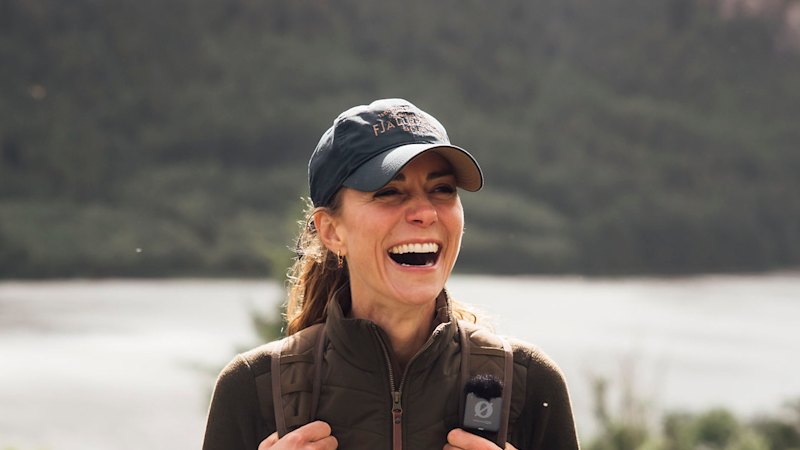
For a royal figure, this trap is doubly lethal. Kate's entire public value is tied to her ability to project warmth, composure, and reassurance. When she released her video in September 2024 announcing that she had completed her chemotherapy treatment, the production itself was a masterclass in visual storytelling. Shot in the sunlit woods of Norfolk, featuring soft-focus footage of William, George, Charlotte, and Louis laughing, holding hands, and leaning against trees, it looked less like a medical update and more like a perfume commercial for eternal familial bliss.
It was gorgeous. It was deeply moving. And it was meticulously engineered to restore the comforting illusion of the fairy tale.
People needed to see her glowing in the sunlight because the alternative—seeing the grey, hollowed-out exhaustion that actually accompanies the final weeks of chemotherapy—would have shattered the magic. Even in her recovery, the "Brave Princess" had to do the emotional heavy lifting for millions of strangers, reassuring us that everything was going to be okay.
The Invisible Stakes for the Rest of Us
You might wonder why any of this matters. Kate Middleton is a millionaire living in a palace with access to the finest medical care on earth, private chefs, nannies, and sprawling country estates in which to convalesce. Why should we care if the tabloids call her brave?
Because royal narratives don't stay inside palace walls. They trickle down into our living rooms, our workplaces, and our hospital rooms, shaping the cultural script we use for every ordinary person facing a diagnosis.
When the most famous woman in the world is praised primarily for her stoicism and her rapid return to public duty, it subtly raises the bar for everyone else.
Think about the everyday realities of cancer recovery that never make it into a royal press release:
- The cognitive fog: Known colloquially as "chemo brain," it can leave a sharp, articulate professional struggling to remember the word for "refrigerator" or unable to read a single page of a book without losing the thread.
- The physical fallout: Peripheral neuropathy that leaves fingers and toes permanently numb; sudden, medically induced menopause that triggers crushing waves of anxiety and hot flashes; chronic fatigue that doesn't lift after a good night's sleep.
- The psychological whiplash: The terrifying silence that happens after treatment ends. During chemo, you are actively doing something to fight the disease. Once the infusions stop, you are simply sent home and told to wait for your next scan, living in three-month increments of dread.
In her September 2024 statement, Kate touched on this exact transition, noting that her focus was now on doing what she could to "stay cancer free." It was a telling choice of words. Not "cured." Not "over." Just staying free of it, day by day, scan by scan.
Yet the media coverage largely glossed over the nuance, rushing straight to speculation about when she would resume foreign tours, which state banquets she would attend, and what tiara she might wear next. The cultural impatience was palpable. You've had your nine months of illness, the collective consciousness seemed to say; now put the crown back on and get back to work.
For an ordinary worker—a teacher, a nurse, a delivery driver—that same cultural impatience translates into lost jobs, strained marriages, and crushing isolation. When friends and employers subconsciously measure your recovery against the glossy, sunlit resilience of a princess, your messy, lingering disability starts to look like a lack of grit.
The Power of Letting the Mask Slip
The irony is that Kate Middleton's greatest service to the public over the past two years had nothing to do with her bravery, her fashion, or her royal duties. It was her vulnerability.
When she sat alone on that bench in March 2024, wearing a simple striped sweater, her voice trembling slightly as she explained that it had taken time to explain everything to George, Charlotte, and Louis in a way that was appropriate for them, she broke the centuries-old royal taboo. She wasn't a symbol. She wasn't a distant, untouchable icon. She was just a mother trying to figure out how to tell her kids that mommy was sick, without breaking their hearts.
In the weeks following that announcement, cancer charities across the United Kingdom reported a massive surge in traffic. Macmillan Cancer Support saw its highest weekend of online visits since the height of the pandemic. Cancer Research UK recorded tens of thousands of additional searches for signs and symptoms.
People didn't book screenings because they were inspired by a "Brave Princess." They booked screenings because seeing a young, athletic, seemingly invincible woman admit she had cancer shattered their own illusion of immunity. Her humanity, not her heroism, saved lives.
It is a lesson we seem determined to forget every time a public figure falls ill. We want our heroes to be superhuman so we don't have to confront how fragile we all are. We wrap them in shiny words like warrior, fighter, and brave because those words create a safe distance between their tragedy and our own mortality.
Beyond the Fairy Tale
True recovery—the real, unvarnished kind that happens after the cameras are turned off and the get-well flowers have wilted—rarely looks like a triumph.
It looks like learning to live in a body you no longer entirely trust. It looks like grieving the person you were before the diagnosis, while slowly making peace with the person you have become. It is quiet, unglamorous, and deeply uncertain.
Kate Middleton will eventually return to the full rhythm of royal life. She will walk down red carpets, shake hands with dignitaries, and smile for the lenses that have followed her since she was twenty-two years old. And when she does, the headlines will celebrate the triumphant completion of her "road to recovery."
Let's hope we are wise enough not to believe the hype.
Because if you look closely—past the tailored coats, past the sunlit video montages, past the comfortable clichés of the morning papers—you can still see the truth she tried to tell us on that wooden bench in March. There is no magic tiara that protects against human frailty. There is no royal decree that speeds up the healing of scarred tissue.
There is only a woman, standing in the long, unpredictable shadow of a serious illness, trying to find her footing on ground that will never feel quite as solid as it used to. And in the end, simply standing there—without pretending it doesn't hurt—is more than enough.