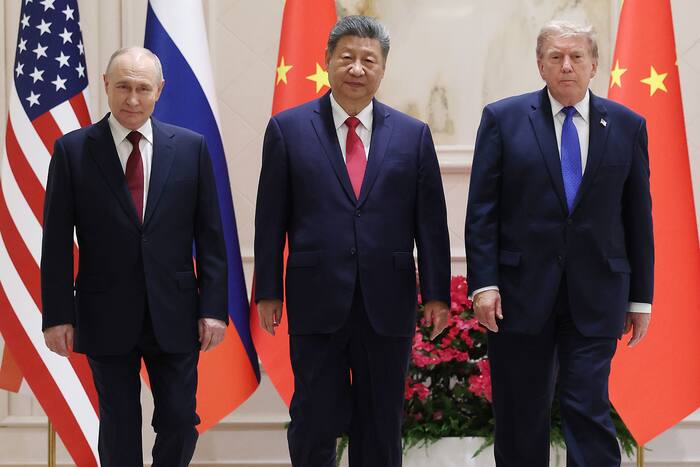
When Xi Jinping, Donald Trump, and Vladimir Putin jointly describe a trilateral summit as groundbreaking, the immediate diplomatic reality is rarely as unified as the press release suggests. A three-way meeting between the leaders of China, the United States, and Russia represents a rare convergence of the world's most consequential nuclear and economic powers, yet history shows that public declarations of historic breakthroughs often mask deep, unresolved structural friction. Behind the carefully choreographed photo opportunities, each leader enters the room with starkly competing survival imperatives, distinct economic vulnerabilities, and a shared desire to project strength to domestic audiences while conceding as little tangible ground as possible.
The surface narrative of a groundbreaking diplomatic triumph serves an immediate political function for all three capitals. For Washington, direct leader-to-leader engagement bypasses entrenched bureaucratic channels and signals an ability to dictate terms on global security and trade without relying on traditional multilateral coalitions. For Moscow, sitting at the same table as an equal partner breaks years of Western diplomatic isolation and validates its insistence on a multipolar order where great powers negotiate spheres of influence directly. For Beijing, hosting or facilitating a high-level dialogue reinforces its image as an indispensable global broker capable of managing superpower friction while keeping international trade corridors open for its export-driven economy.
Yet diplomatic history offers a sobering corrective to summit euphoria. From the Spirit of Geneva in 1955 to the 2018 Singapore summit between the United States and North Korea, initial claims of historic progress frequently dissolve once mid-level negotiators attempt to translate broad verbal understandings into binding verification mechanisms. In a trilateral setting involving Beijing, Washington, and Moscow, the mathematical complexity of compromise multiplies exponentially. Any concession made by one party to appease a second immediately alters the strategic balance for the third.
The Architecture of Great Power Triangles
Understanding why a summit between Xi, Trump, and Putin generates both intense optimism and deep skepticism requires looking at the mechanics of strategic triangles. International relations theorists have long observed that in any three-way power dynamic, each actor's primary nightmare is a two-against-one alignment. The fundamental objective of each leader is not necessarily to achieve permanent peace, which remains structurally elusive, but to ensure they occupy the pivot position—maintaining better relations with each of the other two than those two maintain with each other.
During the Cold War, the Nixon administration executed a classic pivot by opening diplomatic relations with Mao Zedong's China in 1972, effectively exploiting the Sino-Soviet split to gain leverage over Moscow. Today, the geometry has inverted. Over the past decade, shared opposition to American alliance networks and Western financial sanctions pushed Beijing and Moscow into an increasingly tight embrace, characterized by record bilateral trade volumes and joint military exercises. From Washington's perspective, engaging both leaders simultaneously is an effort to test the durability of that partnership and introduce friction between Moscow and Beijing by offering bilateral incentives that neither can easily ignore.
Conversely, Beijing views trilateral diplomacy through the lens of risk management. China's economic model depends heavily on access to American consumer markets, advanced Western technology, and global maritime shipping lanes policed by the United States Navy. At the same time, Beijing relies on Russia as a secure overland supplier of discounted energy, raw materials, and diplomatic backing in international forums. A total breakdown in US-China relations threatens China's economic stability, while a weakened or alienated Russia leaves China isolated against Western pressure. Therefore, Xi Jinping's interest in a groundbreaking summit lies in stabilizing the external environment without abandoning Moscow.
Moscow's calculus is arguably the most transactional of the three. Constrained by extensive Western sanctions, export controls, and the immense economic toll of prolonged military conflict in Eastern Europe, the Kremlin seeks relief from economic isolation and recognition of its security demands. By participating in a high-profile trilateral forum, Putin gains a platform to argue that global security architecture cannot be reconstructed without Russia's direct participation, while simultaneously signaling to Beijing that Moscow retains independent diplomatic options with Washington.
Economic Friction Beneath the Diplomatic Surface
While leaders speak in broad strokes about historic cooperation, the underlying economic realities connecting and dividing these three nations remain stubbornly adversarial. Trade balances, industrial subsidies, currency dominance, and technological decoupling cannot be resolved through a single weekend of negotiations.
| Core Economic Domain | United States Position | China Position | Russia Position |
|---|---|---|---|
| Trade and Tariffs | Demands steep tariff barriers to protect domestic manufacturing and reduce bilateral trade deficits. | Seeks tariff rollbacks and uninterrupted access to Western consumer markets to absorb industrial overcapacity. | Focuses on bypassing Western trade embargoes and securing alternative markets for commodities. |
| Technology Controls | Restricts exports of advanced semiconductors, AI hardware, and dual-use manufacturing tools. | Aims to end technology blockades while accelerating domestic self-sufficiency in critical supply chains. | Relies heavily on third-party intermediaries and Chinese components to sustain industrial and defense output. |
| Energy and Commodities | Maximizes domestic oil and gas exports to capture European and Asian market share. | Demands stable, discounted energy imports from multiple suppliers to insulate its economy from maritime chokepoints. | Depends on hydrocarbon and mineral export revenues to fund state budgets and stabilize the ruble. |
| Financial Architecture | Defends the primacy of the US dollar and the SWIFT messaging system as instruments of statecraft. | Promotes gradual internationalization of the renminbi in bilateral trade without fully opening its capital account. | Actively builds alternative payment rails and barter mechanisms to operate outside Western banking networks. |
The structural clash over industrial policy illustrates why verbal agreements struggle to survive contact with reality. China's domestic economy faces persistent deflationary pressures, a prolonged real estate downturn, and sluggish household consumption. To sustain growth targets, Beijing has channeled massive state investment into high-tech manufacturing, including electric vehicles, solar panels, lithium batteries, and legacy semiconductors. American policymakers view this surge in state-backed exports as an existential threat to domestic reindustrialization efforts, prompting tariffs and regulatory barriers that enjoy broad bipartisan backing in Washington.
A summit communiqué may promise enhanced trade dialogue or joint working groups, yet neither Washington nor Beijing can easily abandon its core industrial strategy. If Washington lowers tariffs without verifiable reductions in Chinese state subsidies, domestic manufacturing sectors face immediate price undercutting. If Beijing curtails state support for strategic industries, it risks triggering domestic unemployment and slowing technological modernization.
Energy markets present another layer of hidden tension. While Moscow and Beijing celebrate pipeline agreements and discounted crude shipments, their interests diverge sharply on pricing and infrastructure financing. Beijing consistently negotiates from a position of monopsony leverage, demanding steep discounts and refusing to fully underwrite massive capital projects like the Power of Siberia 2 pipeline unless Moscow absorbs the bulk of the construction risk. Meanwhile, Washington's push to expand American liquefied natural gas exports directly competes with Russian energy ambitions in global markets, creating a zero-sum dynamic over long-term supply contracts.
Security Dilemmas and Nuclear Stability
Beyond commerce, the security agenda between the United States, China, and Russia carries existential weight. Arms control architecture has steadily eroded over the past decade, leaving the world's three largest nuclear powers operating with fewer transparency mechanisms, inspection regimes, and crisis communication protocols than at any point since the early 1970s.
For decades, nuclear arms control was strictly a bilateral affair between Washington and Moscow. Treaties such as the Intermediate-Range Nuclear Forces Treaty and New START established verifiable limits on warheads and delivery systems. That bilateral framework collapsed under the weight of mutual accusations of non-compliance, geopolitical confrontation, and a fundamental shift in the global balance of power: the rapid expansion of China's nuclear arsenal.
"Any durable framework for strategic stability in the twenty-first century cannot ignore the rapid modernization of third-party nuclear arsenals, yet bringing three asymmetric forces under a single verifiable ceiling remains one of the hardest problems in diplomacy."
Washington has consistently argued that future arms control agreements must include Beijing, pointing to estimates that China is rapidly expanding its stockpile of intercontinental ballistic missiles and nuclear warheads. Beijing has just as consistently rejected trilateral arms control talks, arguing that its arsenal remains a fraction of the size of American and Russian stockpiles and that the two nuclear superpowers must make deep reductions before China joins any formal limitation regime. Moscow, meanwhile, insists that any new nuclear negotiations must account for the nuclear arsenals of American allies, specifically the United Kingdom and France, while addressing American missile defense deployments and space-based capabilities.
Even if a trilateral summit produces a joint statement affirming that a nuclear war cannot be won and must never be fought—a formulation used in past diplomatic declarations—translating that principle into concrete verification measures requires years of technical negotiations. Satellite monitoring, on-site inspections, data exchanges on missile launches, and rules governing artificial intelligence in nuclear command-and-control systems are notoriously difficult to negotiate even between two nations. Across three nations with fundamentally asymmetric force structures, reaching binding verification protocols is a monumental task.
Regional flashpoints further complicate the security equation. In Eastern Europe, Moscow seeks formal guarantees regarding NATO expansion and recognition of territorial realities on the ground, demands that clash directly with European security principles and international law. In the Indo-Pacific, Beijing asserts sweeping territorial claims in the South China Sea and maintains pressure on Taiwan, while Washington reinforces defense treaties with regional allies such as Japan, South Korea, and the Philippines. Neither Russia nor China is likely to trade away its core regional ambitions in exchange for vague diplomatic assurances, nor can an American administration easily abandon long-standing treaty allies without triggering a collapse in deterrence credibility worldwide.
The Domestic Theater of Summitry
To evaluate whether a meeting is genuinely groundbreaking, experienced observers pay less attention to the banquet toasts and more attention to how each leader frames the event for domestic consumption. Foreign policy summits are often extensions of domestic politics, designed to shore up internal legitimacy, distract from economic headwinds, or outmaneuver domestic critics.
In the United States, the executive branch possesses wide latitude to conduct personal diplomacy, yet any formal treaty requires the advice and consent of two-thirds of the Senate, and major tariff or sanction adjustments frequently trigger legislative pushback. A president can announce sweeping frameworks or pause executive actions during a summit, creating immediate headlines and market rallies. However, without durable statutory backing or bipartisan consensus, such executive understandings remain vulnerable to reversal by future administrations or legal challenges in federal courts.
In China, state media utilizes high-profile diplomatic gatherings to reinforce the narrative of national rejuvenation and global leadership. Images of foreign leaders engaging respectfully with Xi Jinping validate the Chinese Communist Party's governance model at a time when domestic audiences are navigating youth unemployment, local government debt, and declining property values. The diplomatic messaging emphasizes stability, mutual respect, and China's role as a responsible major power, carefully omitting any concessions Beijing may have discussed behind closed doors.
In Russia, the Kremlin's information apparatus frames trilateral engagement as definitive proof that Western efforts to isolate Moscow have failed. For a domestic population living under wartime economic mobilization, inflation pressures, and restricted international travel, seeing Vladimir Putin stand alongside the leaders of the world's two largest economies projects permanence and inevitability. It reinforces the state narrative that Russia remains an indispensable pillar of global governance whose interests must be accommodated.
The Verification Gap and What Actually Matters
History demonstrates that the true measure of a summit is never found in the adjectives used to describe it on the final day. Words like historic, productive, and groundbreaking are standard diplomatic currency, deployed routinely to justify the immense political capital invested in arranging a leader-level meeting. The real test unfolds over the subsequent six to eighteen months in the quiet, unglamorous work of bureaucratic implementation.
When assessing whether a three-way agreement between Washington, Beijing, and Moscow carries genuine substance, four concrete indicators separate meaningful détente from diplomatic theater:
- Measurable Regulatory and Tariff Rollbacks: Broad promises to improve trade relations mean little until customs agencies formally revise tariff schedules, remove specific entities from export control blacklists, or lift agricultural import bans. If tariffs remain intact while leaders praise their personal rapport, the economic conflict remains frozen rather than resolved.
- Restored Military-to-Military Communication Channels: Genuine de-escalation requires operational hotlines between theater commanders, maritime incident prevention protocols, and advance notifications of major military exercises. Without functional guardrails at the operational level, a single accidental collision in contested waters or airspace can instantly erase high-level goodwill.
- Verifiable Inspection and Data Exchange Regimes: In security and arms control, trust is irrelevant without verification. A substantive breakthrough requires mutually agreed mechanisms allowing technical experts to inspect facilities, monitor compliance, and resolve disputes through established commissions rather than public accusations.
- Third-Party Alignment and Diplomatic Follow-Through: In a trilateral dynamic, actions taken immediately after the summit reveal each party's true priorities. If Moscow and Beijing announce new joint defense initiatives within weeks of a summit with Washington, or if Washington finalizes new security pacts with Indo-Pacific allies immediately after praising cooperation with Beijing, the underlying strategic competition remains completely unaltered.
Diplomacy between rival superpowers is rarely a linear march toward harmony. More often, it is a cyclical process of managed friction, where periods of acute confrontation give way to tactical pauses designed to buy time, recalibrate leverage, and test the resolve of adversaries. Handshakes at the summit table can temporarily lower the diplomatic temperature and reopen stalled lines of communication, which carries undeniable value in an era of heightened global instability. Yet until those handshakes produce binding, verifiable changes in tariffs, troop deployments, and nuclear stockpiles, the underlying collision course of twenty-first-century great power politics remains firmly intact.