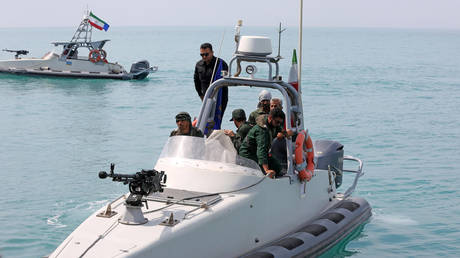
The Persian Gulf remains the world’s most volatile maritime choke point, a stretch of water where a single miscalculation can trigger a global energy crisis. Recently, a familiar pattern of accusation and denial emerged following reports of a confrontation between United States naval assets and Iranian fast-attack craft. While Washington often asserts that it has neutralized immediate threats—sometimes claiming to have sunk or disabled vessels—Tehran routinely dismisses these accounts as pure fiction or psychological warfare. This perpetual cycle of "he-said, she-said" isn't just about optics. It is a sophisticated game of theater designed to test the limits of international law and the physical reflexes of sailors on the front lines.
At the heart of the latest friction is the discrepancy over a reported engagement involving the Islamic Revolutionary Guard Corps Navy (IRGCN). The U.S. narrative typically describes "unprofessional and unsafe" maneuvers by Iranian boats, leading to defensive fire. Tehran’s response is a flat rejection. They claim no such losses occurred, suggesting instead that their presence is merely a sovereign right to patrol their "own backyard." For an analyst watching this for thirty years, the truth usually lies in the murky middle, buried under layers of electronic warfare logs and classified drone footage.
The Strategy of Fast Attack Craft and Swarm Tactics
Iran does not attempt to match the U.S. Navy hull-for-hull in terms of destroyers or carriers. That would be a fool’s errand. Instead, they have perfected the art of the swarm. They utilize hundreds of small, fast, and heavily armed boats that can disappear into the jagged coastline of the Persian Gulf. These vessels are difficult to track with traditional long-range radar and can overwhelm the sophisticated sensors of a billion-dollar warship through sheer numbers.
When the U.S. claims to have sunk one of these boats, it serves a dual purpose. It validates the "Rules of Engagement" (ROE) and sends a message to regional allies that the American umbrella remains functional. Conversely, when Iran denies the claim, they are protecting the domestic image of the IRGCN. If the Iranian public believes their "martyrdom-ready" fleet is being picked off without consequence, the deterrent value of the swarm evaporates.
The Technology of the Denial
Modern naval warfare is as much about the "kill chain" as it is about the "narrative chain." In an era of ubiquitous satellite surveillance and high-resolution drone feeds, one might think a sunken boat would be easy to verify. However, the Persian Gulf is shallow and cluttered. Small fiberglass hulls don't always leave a significant wreckage trail on the surface.
Iran leverages this ambiguity. By denying a loss, they force the U.S. to either release classified intelligence—revealing their surveillance capabilities—or stay quiet and let the world wonder who is telling the truth. Most of the time, the Pentagon chooses to keep its sensors secret. This creates a vacuum of information that Tehran is more than happy to fill with its own version of events.
The Economic Shadow Over the Strait of Hormuz
Every time a shot is fired or a denial is issued, the markets flinch. Approximately 20% of the world’s petroleum liquids pass through the Strait of Hormuz. For the global economy, this isn't just a military dispute; it’s a logistics nightmare.
Insurance premiums for tankers rise the moment a "kinetic event" is reported. If the U.S. is seen as trigger-happy, or if Iran is seen as being able to harass shipping with impunity, the cost of moving oil climbs. This economic pressure is a weapon in itself. Iran knows that by maintaining a state of "controlled instability," they can exert leverage over European and Asian nations that are more sensitive to energy prices than the United States.
Proving a Negative in International Waters
The burden of proof in these skirmishes is notoriously difficult. Under international maritime law, a state has the right to defend its vessels from "imminent danger." The definition of "imminent" is where the lawyers and the admirals clash.
A boat speeding toward a destroyer at 40 knots might be a suicide bomber, or it might be a bored patrolman seeing how close he can get before the "big ship" flinches. If the U.S. fires and the boat sinks, the U.S. calls it defense. Iran calls it an unprovoked act of aggression against a vessel that was merely "exercising its right of transit." Because the wreckage is often at the bottom of the sea in disputed or congested waters, independent verification is nearly impossible.
The Role of Psychological Operations
We have entered an era where the video of the fight matters more than the fight itself. Both the U.S. Navy and the IRGCN now routinely carry high-definition cameras to document every encounter. These videos are edited, watermarked, and released to social media within hours.
The Iranian denial is a core component of their "Soft War" strategy. By casting doubt on American military claims, they aim to paint the U.S. as an unreliable narrator to the global community. They want to project a sense of "strategic patience," suggesting that the Americans are the ones who are nervous and prone to seeing ghosts on their radar screens.
Historical Precedents of Maritime Gaslighting
This isn't the first time we've seen this play out. During the "Tanker War" of the 1980s, both sides frequently disputed the outcomes of naval engagements. The 1988 Operation Praying Mantis saw the U.S. Navy destroy a significant portion of Iran's surface fleet. Even then, the official accounts from Tehran attempted to downplay the scale of the defeat to maintain morale.
The difference today is the speed of communication. In 1988, it took days for news to filter out. Today, a denial can be issued on Telegram before the smoke has cleared from the water. This rapid-fire cycle prevents the U.S. from ever truly "winning" the argument in the eyes of the Middle Eastern public.
The Evolution of the Iranian Fleet
The boats the U.S. claims to be hitting today are not the same boats they faced ten years ago. Tehran has moved toward domestic production of high-speed catamarans and semi-submersibles. Some of these are remotely operated.
If the U.S. sinks an unmanned vessel, is it still "sinking an Iranian boat" in the traditional sense? This is a gray zone. Iran can deny the loss because there was no crew to "martyr," or they can claim the vessel wasn't theirs to begin with. This shift toward "attritable" assets—cheap, replaceable machines—means that the U.S. can win every tactical exchange but still lose the broader strategic battle of persistence.
Assessing the Risks of Escalation
The danger of the "denial" strategy is that it encourages more aggressive behavior. If Iran feels they can get away with denying a loss, they may push the envelope further next time. If the U.S. feels their claims aren't being taken seriously, they may feel the need to use more "decisive" force to prove a point.
This creates a ladder of escalation where neither side has a clear off-ramp. Each encounter becomes a data point for the next. The crews on these ships are operating under immense pressure, knowing that a three-second window is all that separates a routine patrol from an international incident.
Tactical Reality vs Political Posturing
On the deck of a Cyclone-class patrol ship or a Burke-class destroyer, the geopolitical denials of Tehran feel very far away. For a commander, the only thing that matters is the "distance to contact." If a swarm of boats is closing in, the decision to fire is based on physics and safety, not on how the news will play in the Iranian press the next morning.
The disconnect between the tactical reality on the water and the political posturing in the capitals is widening. This gap is where the most significant danger lies. When the military reality is denied or obscured for political gain, the chance of a "hot war" started by accident becomes a statistical probability rather than a remote fear.
The Deadlock of the Deep
The current situation is a stalemate that suits both sides’ domestic agendas but threatens global stability. The U.S. continues its "Freedom of Navigation" operations to assert its role as the guarantor of the seas. Iran continues its harassment and subsequent denials to assert its role as the regional powerhouse that refuses to be bullied.
Until there is a transparent, third-party mechanism for monitoring these encounters—which is unlikely given the sensitive nature of the Gulf—the world will remain in the dark about what actually happens during these high-speed chases. The "denial" is not just a statement; it is a weapon used to maintain a fog of war that allows both sides to claim victory without ever having to prove it.
The next time a headline surfaces regarding a sunken boat or a disputed skirmish in the Strait, look past the official statements. The real story isn't whether a small fiberglass hull is sitting on the seabed. The real story is the ongoing struggle to define the rules of the road in a corridor that the world cannot afford to see closed.
Navies are built for combat, but in the Persian Gulf, they are increasingly being used as props in a long-running play about sovereignty, pride, and the control of the global energy pump. The boats may sink or they may sail on, but the tension remains as constant as the tide.