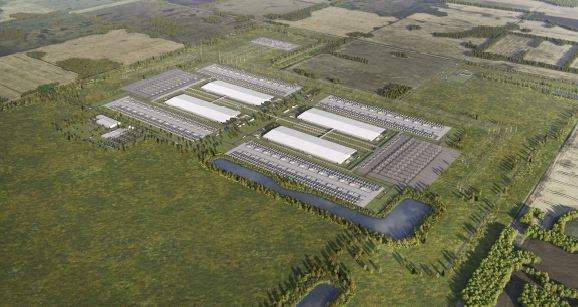
Consider a patch of flat, wind-swept dirt in Sturgeon County, Alberta. For generations, the rhythm of this place was dictated by the seasons. Farms grew canola, the horizon was vast, and the loudest noise was the low hum of a tractor or the whistle of a northern gale.
Now, look closer at the blueprint descending on this dirt. It is a structure spanning 270,000 square metres, a footprint equivalent to thirty-three football fields. This is Meta’s newest, most colossal artificial intelligence data centre—the largest the company has ever attempted outside the United States. It is a $13-billion temple of silicon and fiber optics, designed to process the billions of likes, videos, and algorithmic predictions that dictate modern human interaction.
But there is a glaring hitch in this digital gold rush. Computers need electricity. Incredible, staggering amounts of it.
To solve this, a consortium of industrial heavyweights planned the Greenlight Electricity Centre, a $4.6-billion natural gas-fired power plant meant to sit right next door, breathing life directly into the servers. It was a neat, self-contained ecosystem on paper. The problem is time. The data centre will be ready in two to three years. The power plant will not be ready for four.
What happens when the world’s most demanding digital brain turns on before its heart is built?
The Invisible Strain
To understand the scale of what is happening north of Edmonton, you have to look past the corporate press releases. Think of a data centre not as a collection of hard drives, but as a giant, hyper-efficient radiator. These servers work so hard that they generate enough thermal energy to cook themselves within seconds if left unchecked. Historically, keeping them cool meant sucking up rivers of local water, evaporating it into the atmosphere, and demanding more.
In Alberta, a province intensely protective of its agricultural roots and watershed, that approach would have sparked a localized rebellion. Meta’s engineers had to pivot, adopting a closed-loop liquid-cooling system. Imagine it like the radiator in your car. A mixture of water and glycol circulates over the blistering hot processor chips, absorbs the heat, carries it to the roof, and vents it into the frigid Canadian air via giant fans. No water is lost. The company boasts the facility will use less water annually than a single local golf course.
But while the water problem was engineered away, the power problem remains stubbornly real.
The Sturgeon County facility is a one-gigawatt project. One gigawatt is roughly enough electricity to power 750,000 homes. It is an amount of energy that can bend a regional power grid if plugged in carelessly.
Sarah, a hypothetical small-business owner running a bakery in downtown Edmonton, knows nothing about server architecture. But she knows what happens when her utility bill spikes or when a winter brownout threatens her ovens. When a multi-billion-dollar tech giant moves into the neighborhood, the immediate instinct for people like Sarah is anxiety. Will the machine eat my power?
The Waiting Game
The original plan was a synchronized dance. Meta builds the servers; Pembina Pipeline, Morgan Stanley Infrastructure Partners, and Kineticor Asset Management build the 932-megawatt Greenlight natural gas plant. They open together.
But the physical world moves slower than the digital one. Supply chains for massive industrial turbines are choked. Permitting for heavy infrastructure takes time. The Greenlight plant will not fire up its turbines until the second half of 2030.
Meta, facing a global arms race against Google, Microsoft, and OpenAI, cannot afford to let $13 billion worth of cutting-edge silicon sit dark for two years waiting for a dedicated power plant. They need speed to market.
So, they are tapping the line.
Alberta’s grid operator previously set aside 1,200 megawatts of capacity specifically for large-load projects, creating a temporary buffer until 2028. Meta secured the rights to hook into this system early. To bridge the gap before their bespoke power plant arrives, they have cut a long-term deal with Capital Power Corp for 250 megawatts of juice starting in 2028, supplemented by other wholesale providers.
It is a high-wire act of industrial logistics. The province is essentially betting its temporary power reserves on a single tenant, hoping the system can bear the load before the dedicated gas turbines finally roar to life.
The Cost of the Future
There is an inherent vulnerability in talking about the future of energy. The truth is, nobody knows exactly how hard the AI boom will press against the limits of our physical reality. Right now, Alberta is the epicenter of this friction in Canada. The province holds nearly 92 per cent of all planned new data centre capacity in the country.
Why? Because Alberta possesses an abundance of natural gas and a regulatory system that allows private companies to build their own power generation.
The provincial government is framing this as a massive win, claiming that adding such a massive payer to the system will actually drive down transmission costs for everyday consumers by up to six per cent. They want us to believe the machine will pay for its own sandbox.
But for the people living near the construction site, watching three thousand workers descend on Sturgeon County, the transformation feels profound, breathless, and slightly terrifying. We are tying our physical energy infrastructure directly to the ethereal needs of artificial intelligence.
When the switch is flipped in a few years, the energy flowing through the Alberta grid won't just be heating homes or lighting schools. It will be keeping millions of microscopic transistors cool enough to think. The ghost in the machine is hungry, and Alberta has agreed to feed it.