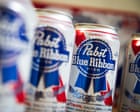
There is a specific kind of quiet that settles over a distribution yard at three in the morning. It is a heavy, industrial silence, punctuated only by the distant hum of a freeway or the occasional metallic ping of a cooling semi-truck engine. In that vacuum of night, thousands of aluminum cylinders stacked neatly on wooden pallets do not look like commerce. They look like monuments. Silver bricks. A liquid economy waiting for the sun.
Then comes the diesel.
Picture a twenty-six-foot box truck idling near the perimeter fence, its headlights killed, swallowing the darkness. Imagine the crisp click of a padlock giving way under the stubborn bite of heavy-duty bolt cutters. In moments, the sanctuary of the warehouse yard is violated not by master thieves seeking cryptographic codes or priceless diamonds, but by modern-day rustlers with a very specific, blue-collar ambition. They are not here for gold. They are here for Pabst Blue Ribbon.
Two separate heists, miles apart and weeks apart, stripped California warehouses of thousands of cans of cheap, historic American lager. To read the police blotter is to see dry statistics: loss values, trailer numbers, insurance claim codes. But numbers flatten the absurdity. They erase the human footprint of a crime so brazen, so strangely specific, it feels less like a calculated enterprise and more like the plot of a forgotten folk song written by men who drank too much working the loading docks.
Let us trace the logistics of longing. Stealing a car is frantic. Stealing electronics requires a buyer, a fence, a circuit board graveyard in some anonymous port city. But stealing an entire semi-trailer loaded with budget beer? That requires a strange alchemy of audacity, heavy machinery, and an operational crew that knows how to drive a manual transmission double-axle through tight industrial park turns without spilling a drop.
Consider what happens next. A truckload of PBR vanishes into the sprawling maze of the Central Valley or the tangled arteries of Southern California highways. Where do you hide twenty tons of liquid nostalgia? You cannot list it on eBay without raising the collective eyebrows of every beverage distributor west of the Rockies. You cannot melt it down. You have to move it fast, selling it out of the back of unmarked vans to shady mom-and-pop bodegas, underground weekend swap meets, or desperate party promoters looking to cut corners on a wholesale tab.
It sounds comical until you talk to the people whose livelihoods depend on those pallets staying put.
Logistics is a fragile dance of trust and inventory. Every single can of that iconic blue-ribbon brew represents a link in a long chain stretching from the brewery floor to the sticky laminate tables of dimly lit dive bars where the jukebox only plays outlaw country and heartbreak ballads. When a heist hits, the ripples hit the floor manager staring at a gaping hole in row four. It hits the independent trucker whose insurance rates just spiked into the stratosphere because someone hooked up to his rig while he was inside buying a lukewarm ham sandwich. It hits the regular patron who walks into their corner watering hole, asks for a pitcher, and gets a polite shrug from a bartender who has to explain that the supply chain has hit yet another surreal, alcoholic snag.
We live in an age of frictionless theft. Money moves across fiber-optic cables in fractions of a second, invisible and untraceable. Hackers in distant server farms drain accounts without ever touching a crisp hundred-dollar bill. There is something almost quaint, almost jarringly analog, about a cargo theft that requires a pair of work gloves, a flatbed, and the sheer, unadulterated gall to steal enough beer to float a modest naval destroyer.
It forces us to confront the weird underbelly of American commerce. Why Pabst? Why not artisanal IPAs with names that sound like meteorological anomalies? Why not rows of imported champagne or high-end bourbon?
Because the blue ribbon is democratic. It is the currency of the front porch, the bowling alley, the post-shift garage hangout, and the indie rock concert. It sits comfortably in the hand without demanding pretension. It is cheap, reliable, and ubiquitous. And because it is everywhere, it is strangely invisible—right up until twenty thousand cans of it disappear into the California fog.
The detectives working these cases are seasoned veterans of high-stakes cargo rings. They have chased stolen pharmaceuticals, smuggled electronics, and hijacked shipments of designer sneakers. Yet, even hardened investigators admit there is a surreal quality to interviewing a warehouse foreman whose entire vocabulary for the morning consists of staring at an empty concrete square and asking how someone manages to drive off with a rolling monument to working-class thirst.
Security cameras caught fuzzy, monochrome footage of the culprits. Hoods pulled low. Movements practiced and efficient. No wasted motion. These were not drunken teenagers looking for a prank; they were professionals who understood the black market value of liquid comfort. They knew that in a state as vast and economically stratified as California, there is always an open market for a discount buzz, no questions asked.
As the investigations grind forward, the stolen cans are slowly being consumed. They are cracking open in garages, disappearing down throats at desert bonfires, fueling late-night porch debates about baseball and rent. The evidence is literally vanishing, one recycled aluminum cylinder at a time.
The truck doors slam shut in the dark. The engine roars to life, chewing up the asphalt, leaving behind only skid marks and the faint, sweet smell of spilled malt.