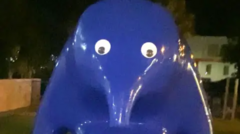
Art is dead, and the Australian legal system just helped bury it under a pile of adhesive-backed plastic.
If you read the mainstream reports about the woman in Adelaide convicted of "graffiti" for placing googly eyes on a public sculpture, you likely saw a story about property damage and the rule of law. You saw a narrative where a "vandal" was caught and a community asset was "restored."
That narrative is a lie. It is the lazy consensus of a bureaucratic class that values sterile compliance over the very heartbeat of urban culture.
The conviction isn't a victory for public order. It is a symptom of a deep, systemic failure to understand the difference between destruction and dialogue. We have reached a point where a temporary, non-destructive gag is treated with the same legal weight as a spray-painted slur. If we can't tell the difference, we’ve lost the plot.
The Myth of Property Damage
Let’s dismantle the legal premise immediately. Graffiti, by definition, usually involves "marking" or "defacing" property in a way that requires significant resources to rectify. We’re talking chemical strippers, sandblasting, and permanent scarring of the substrate.
Googly eyes are held on by a mild adhesive. They are designed to peel off.
Calling this "graffiti" is like calling a Post-it note "arson." It is a category error of the highest order. By pursuing a criminal conviction, the state isn't protecting a sculpture; it is enforcing a monopoly on visual expression.
I have seen city councils spend hundreds of thousands of dollars on "public art" that the public hates—massive, cold, abstract steel husks that provide zero utility and zero engagement. When a citizen interacts with that husk in a way that humanizes it, the state reacts with the fury of a slighted god.
The High Cost of Sterile Cities
Why are we so terrified of whimsy?
The argument from the prosecution is always the same: "If we allow this, where does it end?" This is the "broken windows" theory applied to a googly eye, and it is intellectually bankrupt. Placing eyes on a bronze statue doesn't invite gang violence or urban decay. It invites a smile. It creates a "moment" in a day otherwise defined by the grey monotony of commuting and consumption.
When you criminalize the harmless, you don't create a safer city. You create a sterile one. You tell your citizens that they are merely observers in their own environment, not participants.
The Economics of the Eye
Let’s talk about "restoration costs." The media loves to cite the bill for cleaning up these "vandalized" sites.
- Council Claim: "It cost $500 in specialized labor to remove the unauthorized additions."
- The Reality: It took a maintenance worker thirty seconds and a fingernail.
The "cost" is a bureaucratic fiction. It includes the hourly rate of the manager who wrote the report, the legal fees for the prosecutor, and the overhead of the department that oversees the "sanctity" of the park. We are lighting taxpayer money on fire to punish a woman for making a statue look like a confused frog.
The Institutional Ego
The real crime here isn't property damage. The real crime is bruised egos.
Public art commissions are high-stakes games for artists and politicians. They want their "vision" to remain pristine and unchallenged. When a prankster adds a pair of googly eyes, they are pointing out that the emperor has no clothes—or at least, that the emperor’s statue is a bit too serious for its own good.
It is a form of "culture jamming." It is a reminder that the public square belongs to the public.
I’ve worked in urban planning circles where we discussed "tactical urbanism." Usually, this involves sanctioned, boring things like "pop-up parks" with expensive permit requirements. The moment the public tries tactical urbanism for free, it becomes a crime.
People Also Ask (And They’re Asking the Wrong Things)
"Isn't it still illegal to touch property that isn't yours?"
Technically, yes. But we exercise "prosecutorial discretion" every single day. We don't arrest people for leaning against a public building. We don't fine people for putting a lost dog flyer on a pole. The decision to prosecute this specific act is a deliberate choice to prioritize the "purity" of a bronze casting over the common sense of the community.
"What if the adhesive damages the patina?"
If your multi-thousand-dollar outdoor sculpture can be destroyed by a child’s craft supply, you bought a bad sculpture. These works are designed to withstand bird droppings, acid rain, and UV radiation. A dab of glue is not a structural threat.
The Contrarian Path Forward
Stop trying to "protect" art from the people it was built for.
If a piece of public art is so fragile—either physically or conceptually—that a pair of googly eyes ruins it, then the art has failed. Truly great art absorbs the environment. It evolves.
Imagine a scenario where the Adelaide council, instead of calling the police, simply took a photo, posted it on social media, and said, "Glad to see the community is keeping an eye on things."
They would have gained more goodwill, more tourism interest, and more cultural capital than a thousand "sanctioned" gallery openings. Instead, they chose the path of the litigious killjoy.
The Danger of the Precedent
This conviction sets a chilling precedent. It validates the idea that any unauthorized interaction with the urban environment is a criminal act.
- You move a public bench two feet to be in the shade? Graffiti.
- You knit a "sweater" for a cold-looking bollard? Vandalism.
- You leave a painted rock in a park for a kid to find? Property damage.
We are legislating the soul out of our streets. We are turning our cities into museums where you can look, but you better not touch, and you certainly better not laugh.
The woman with the googly eyes isn't the villain of this story. She’s the only one who actually treated the sculpture like it mattered. She gave it her attention. She gave it a personality. She treated it as a living part of the city rather than a dead hunk of metal.
If that’s a crime, then our cities deserve to be boring.
Stop defending the "sanctity" of the sidewalk. Start demanding a world where we aren't arrested for being human in public.
Put the eyes on the statue. Peel them off if you must. But never pretend that the person with the glue stick is the one hurting society. The real vandals are the ones in suits, clutching their clipboards and charging you for the privilege of living in a cage.
Go out and buy a pack of 100.