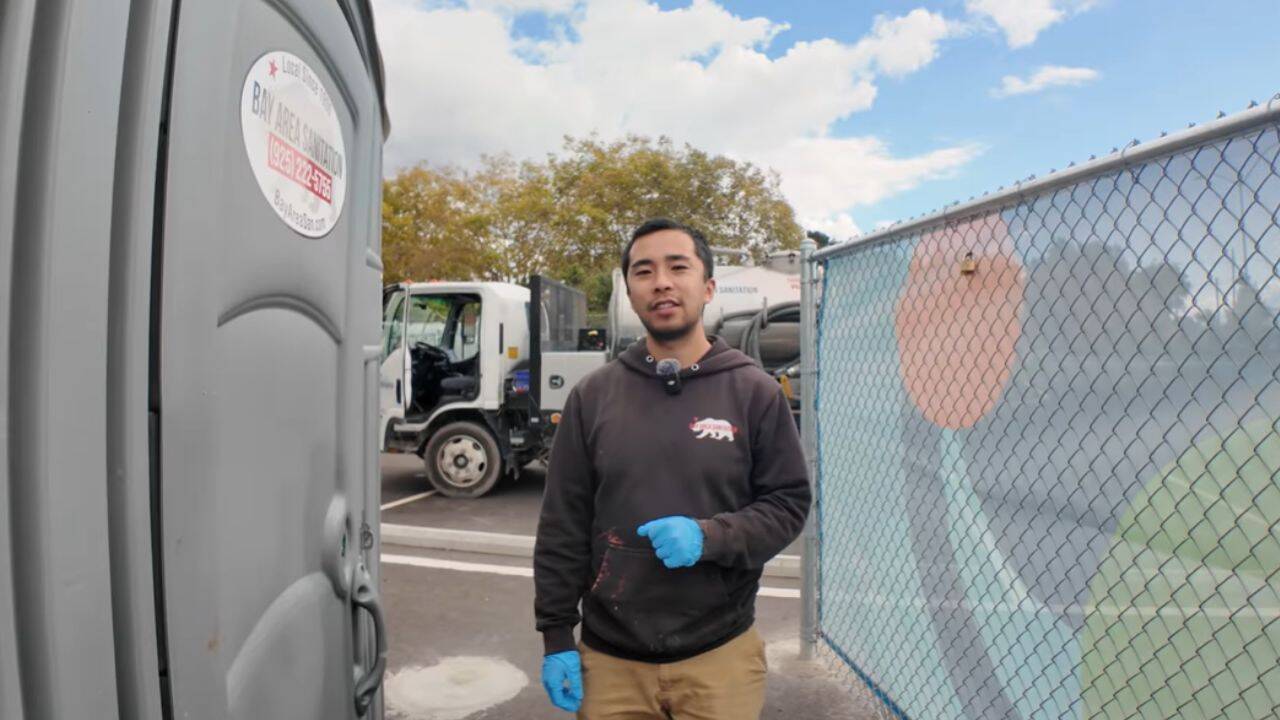
Nobody stands around at a cocktail party talking about porta-potties.
When people ask what you do for a living, you mention software, real estate, digital marketing, or something with a shiny veneer. You do not tell them you make your living off festival-goers, construction workers, and emergency responders needing a clean, plastic box to squat in. It lacks glamour. It lacks the Silicon Valley tech-bro aura.
Yet at thirty-one years old, a California entrepreneur named Colin Campbell built a multi-million-dollar empire on those exact blue plastic boxes.
Four point three million dollars.
That is the kind of number that makes people stop drinking their artisanal coffee and look twice. We are conditioned to believe that wealth only flows from the upper echelons of the digital economy—from code written in glass-walled offices or algorithms trading fractions of a penny. We forget about the physical world. We forget that civilization, for all its high-minded ambitions, rests entirely on infrastructure. And sometimes, infrastructure smells like bleach and summer heat.
To understand how a thirty-one-year-old managed to pull off a multi-million-dollar enterprise in the portable sanitation sector, you have to look past the humor of the product. You have to look at the math of human necessity.
The Problem with Cleanliness
Imagine a Saturday afternoon in July.
A music festival sprawls across a dusty valley floor. Ten thousand people are drinking lukewarm beer under an unrelenting sun. Within two hours, every single physical law of biology catches up with the crowd. Lines form. Tempers fray. The air turns thick with the sharp scent of industrial disinfectant mixed with desperation.
Most people see a line. Colin Campbell saw a recurring revenue stream.
The portable sanitation industry is ancient in its concept, dating back to the mid-twentieth century when shipbuilders realized workers needed facilities closer to their stations than the dock restrooms. But for decades, it remained a fragmented, mom-and-pop domain. It was run by local operators with a couple of beat-up flatbed trucks, a hose, and a phone number on the Yellow Pages.
It was ripe for disruption not because it needed an app, but because it needed discipline.
When you look at a traditional sanitation business, you see inefficiency. Trucks idling too long on routes. Poorly mapped servicing schedules. Equipment sitting idle in a yard during the winter months, generating zero income while eating depreciation costs. A modern business mind stepping into this space does not just buy more toilets. They optimize the logistics.
Campbell recognized a fundamental truth: dignity is expensive, but people will always pay for it.
Building the Fleet
Building a business from scratch is an exercise in controlled panic.
At the start, there are no safety nets. There is only cash flow, or the terrifying lack of it. When Campbell launched his venture, he wasn't dealing with venture capital seed rounds or angel investors writing checks over brunch. He was dealing with heavy plastic, steel frames, deodorizing chemicals, and the brute-force labor of hauling waste across California terrain.
Consider what a single day looks like for a sanitation entrepreneur.
It starts before dawn. The diesel engine of a vacuum truck coughs to life in the cool morning air. The driver checks the gauges. The hoses are coiled. The chemical tanks are filled with blue concentrate—a proprietary blend designed to mask odors and break down waste under brutal desert heat.
The truck rolls out. Destination: a sprawling residential construction site where fifty framers and drywallers have been drinking coffee since six in the morning.
This is where the romantic notion of entrepreneurship collides with reality. There are no beanbag chairs. There are no midday meditation breaks. There is the low rumble of a diesel engine, the weight of a heavy suction hose, and the meticulous tracking of every unit deployed across a county.
Scale in this industry is achieved through relentless execution. If you miss a pickup on a Tuesday, your client cancels their contract on Wednesday. There is no grace period for a backed-up toilet. Reliability is your entire brand.
The Economics of Waste
Let us talk about the numbers, because they tell the real story.
A standard portable restroom unit costs a modest sum to purchase upfront. But that plastic box is a tiny factory. Rented out for construction sites, it generates a steady monthly fee. Rented out for weekend events, it commands a premium daily rate plus service fees.
Multiply that by hundreds of units. Then thousands.
Suddenly, you are no longer just cleaning toilets; you are managing a logistics network. You are negotiating bulk rates for biodegradable chemicals. You are scheduling preventative maintenance on vacuum pumps. You are handling insurance policies that cover liability on active construction sites where heavy machinery and deep excavations are standard operating procedure.
People love to ask about the "yuck factor." Does it bother you? Does it gross you out?
The answer from anyone who has built wealth in unglamorous industries is always the same: money doesn't smell.
In fact, the greater the yuck factor, the lower the competition. Every entrepreneur wants to launch the next social media platform or direct-to-consumer sock brand. They crowd into digital spaces like tourists at a popular monument, driving up customer acquisition costs until nobody is making a profit. Meanwhile, the unsexy physical world sits wide open, begging for someone willing to get their hands dirty—metaphorically or literally.
Campbell bypassed the noise. He looked at a dusty, overlooked corner of the service economy and applied modern operational rigor to it.
The Human Element
At its core, this business is not about plastic or pumps. It is about human comfort in uncomfortable places.
Think about disaster relief zones. Think about wildfire containment camps where hundreds of firefighters spend weeks sleeping in tents, cut off from basic municipal services. When a mobile sanitation truck rolls into that camp, it brings a semblance of civil order to chaos.
Think about large public gatherings, marathons, parades, and farmers' markets. Without these mobile systems, modern public life simply grinds to a halt. Cities cannot function without temporary sanitation. By providing it reliably, cleanly, and efficiently, an entrepreneur is essentially oiling the hinges of society.
This is where the narrative shifts from a simple business profile to a lesson in modern enterprise.
We spend so much time teaching young people how to pitch software decks that we forget how much value lies in keeping the physical world clean, operational, and running smoothly. We have created an educational pipeline that spits out thousands of growth hackers while facing severe shortages of people willing to manage the logistical backbones of our towns and cities.
The View from the Cab
Today, Colin Campbell's enterprise stands as a testament to what happens when you strip away ego and look at the market through the lens of pure utility.
Four point three million dollars is not just a valuation. It is a tally of solved problems. It represents thousands of construction projects kept on schedule because the workers had a clean place to break. It represents dozens of public events where families could spend a Saturday without worrying about basic sanitary needs.
The truck pulls back into the yard as the sun dips below the California hills, casting long shadows across rows of bright blue and green cabins waiting for tomorrow's deployment. The engine cuts out. The silence rushes in.
There is no applause. There are no tech blogs writing breathless profiles about the poetry of waste management.
There is only the quiet satisfaction of a system working exactly as intended, built brick by brick, route by route, out of the most unpromising material imaginable.