The air inside the great hall always smells of old paper, filtered air, and the faint, invisible friction of a thousand whispered agendas. Delegates sit behind small, neat placards bearing the names of ancient republics and restless kingdoms. They adjust translation earpieces. They tap screens. They wait.
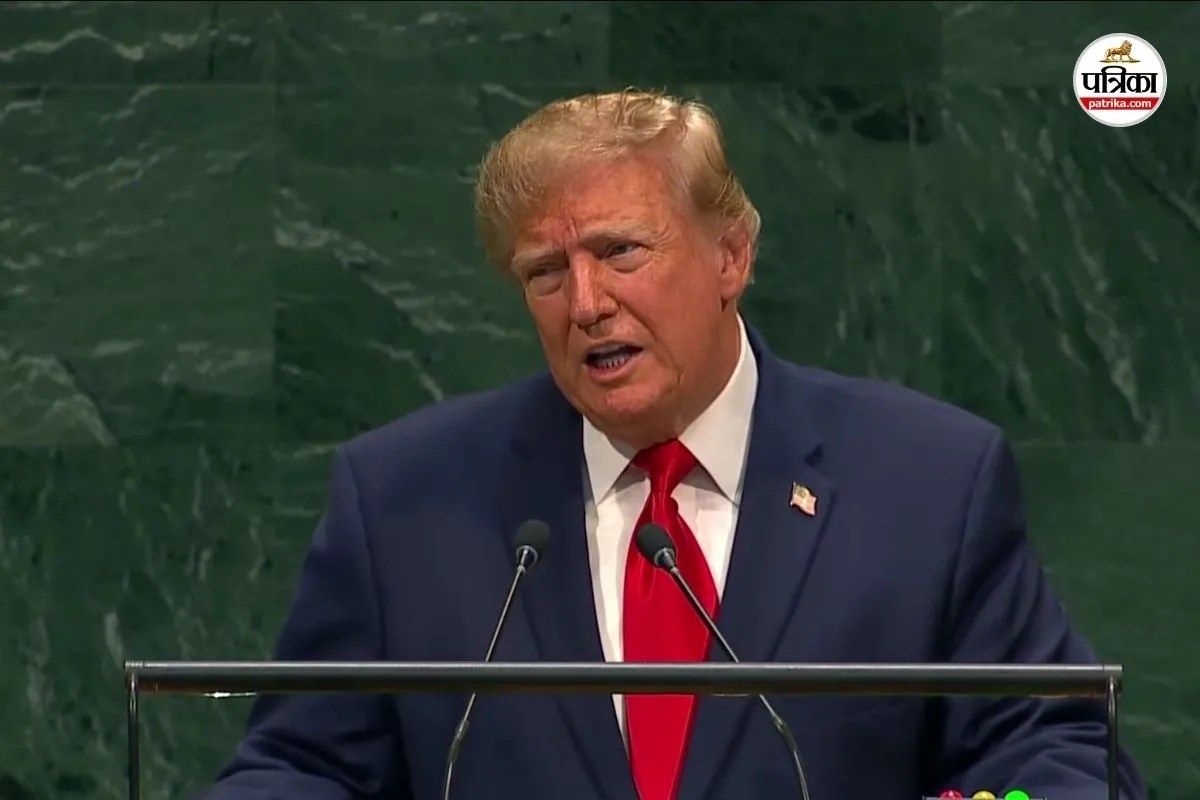
When Donald Trump walked toward the mahogany podium at the United Nations General Assembly, he did not walk with the measured, cautious glide of a career diplomat. He moved with the familiar, heavy-footed confidence of a man who believes every room he enters is merely an extension of his own living room.
He looked out over the assembly. Thousands of eyes stared back. Some were bored. Some were guarded. A few were hostile.
Then he began to speak of the dark ages.
It is a theatrical phrase, heavy with biblical and historical dread. To use it in a room built to prevent global catastrophe is to invite skepticism. But rhetoric in modern politics is rarely about the dictionary definition of words; it is about the emotional temperature they create. By declaring that a dark era of weakness and drift had been decisively sealed away, he was drawing a bright, unyielding line through time. Before him, chaos. Behind him, decline. And right now, in this exact microphone, salvation.
Consider what that feels like if you are an American voter sitting in a quiet kitchen in Ohio or a bustling diner in Florida, watching the blue light of a television screen illuminate the dark room. For years, the narrative has been one of erosion. Bridges rusting. Factories silent. The rest of the world catching up, overtaking, laughing behind closed doors.
When a leader stands on the world stage and tells you that the rust is gone, that the factories are roaring, and that the golden age has finally arrived, something inside you shifts. You want to believe it. You need to believe it.
Power is a strange, intangible currency. In international relations, we like to pretend it is measured entirely in cold, hard metrics. Gross domestic product. Aircraft carrier strike groups. Semiconductor manufacturing output. Barrel counts of crude oil.
Yet, for all our obsession with data, power lives or dies in the theater of perception.
During his address, the statistics rolled out like rhythmic drumbeats. Economic resurgence. Military might restored. Borders locked down and defended. To his supporters, these were self-evident truths long overdue for global acknowledgment. To his critics in the gallery, they were exaggerations, distortions, or outright falsehoods masking a deeper democratic decay at home.
That is the paradox of modern diplomacy. Two people can look at the exact same data point and see two entirely different universes.
Imagine standing on a coastline during a storm. One person sees a violent tempest destroying everything in its path, washing away the dunes and threatening the houses on the cliff. Another person, standing right beside them, smells the ozone, feels the raw energy of the wind, and sees a magnificent cleansing fire that clears the air for something stronger, newer, better.
Trump’s entire political alchemy relies on being that second person.
He does not apologize for the storm. He claims ownership of it. When he speaks of American strength at the UN, he is not merely addressing the ambassadors of foreign nations. He is performing for the domestic audience across the ocean. Every syllable is calibrated to project an image of unyielding dominance.
We have lived through a strange decade. A time where the old rules of engagement—polite handshakes behind closed doors, carefully worded communiqués, the slow, grinding machinery of multinational treaties—have frayed under the weight of populism. People are tired of nuance. Nuance feels like a hedge. Nuance feels like an excuse for failure.
When a leader says the dark ages are over, he is offering a psychological escape hatch. He is cutting through the Gordian knot of global interdependence with a sharp, blunt sword.
Of course, the real world is rarely so binary.
Outside the glass walls of the United Nations headquarters, the East River flows indifferently past concrete promenades. The global challenges do not vanish because a speech ends. Climate pressures mount. Supply chains tangle. Artificial intelligence reshapes labor markets in ways no single administration can fully control. Dictators plot in secret bunkers. Democracies argue over trivia in brightly lit parliaments.
Yet, as the applause faded in the hall—scattered, polite from some corners, silent from others—the core reality of the moment hung suspended in the air.
Words matter because they define what we are willing to attempt. If you truly believe you are living in a golden age, you act differently. You invest. You risk. You stand taller. And if you believe you are trapped in a terminal decline, you withdraw, you hoard, you fear your neighbor.
Donald Trump offered the world his version of the story. A story where America stands alone at the apex, casting a long, protective, and sometimes terrifying shadow across the globe.
The delegates put their earpieces back in their cases. They folded their notes. They walked out into the crisp autumn air of New York City, heading toward black cars and waiting flights, each carrying their own version of the truth back across oceans and borders.
The golden age, it turns out, is in the eye of the beholder. And the night is still very young.