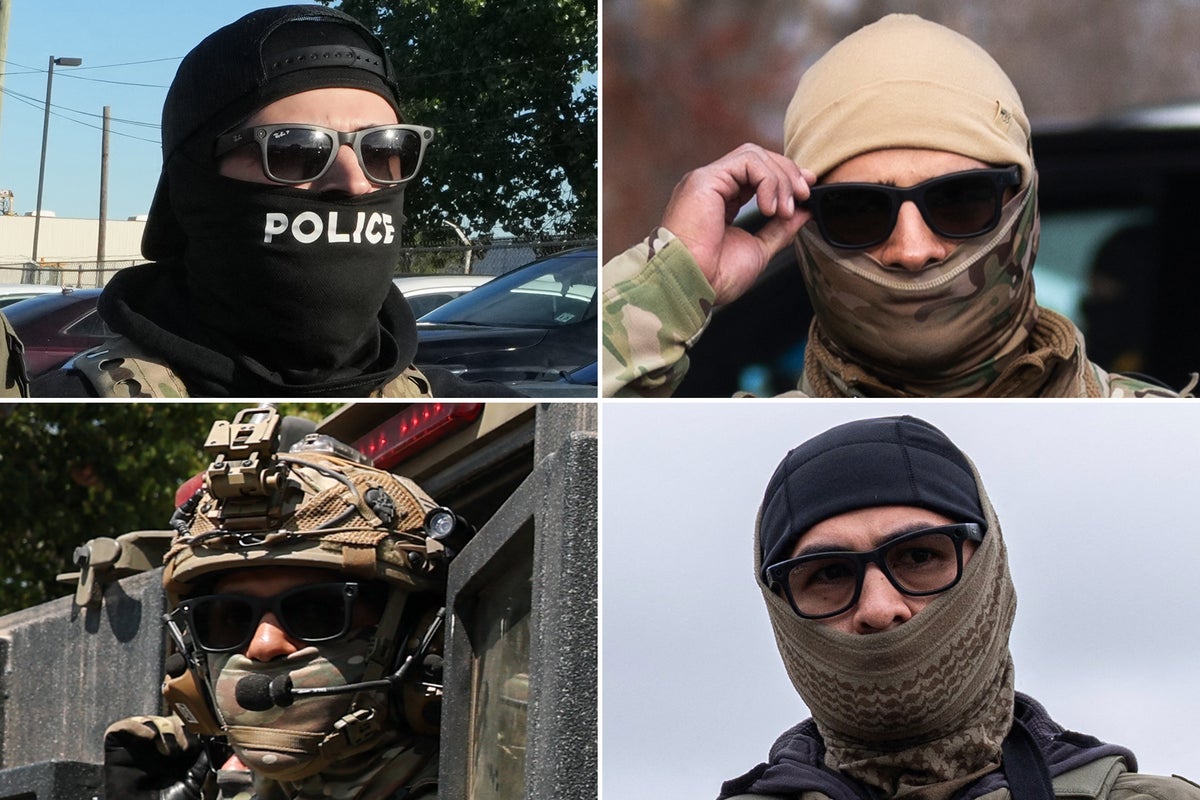
A man stands at a border crossing, or perhaps a busy transit hub in a major American city. He wears a standard-issue uniform, the familiar patches of the Department of Homeland Security stitched into his shoulder. He looks like any other officer you’ve passed a thousand times. But when you catch his eye, you notice something different. He isn't looking at you. Not exactly. He is looking through a pair of matte-black frames that look remarkably like the Ray-Bans sitting in your own glovebox.
These are not standard ballistic eyewear. They are Meta AI glasses.
The officer doesn't need to reach for a radio or look down at a handheld tablet. Behind those lenses, a digital layer is unfolding over the physical world. He is seeing data points, facial recognition hits, and perhaps a live stream of your own digital footprint, all while maintaining a steady, unblinking gaze. For the officer, it is a miracle of efficiency. For the person on the other side of the lens, it is the moment the last shred of public anonymity finally dissolved.
The Silicon Valley Handshake
The integration of Meta’s hardware into the toolkit of federal agents under the Trump administration isn't just a procurement story. It is a marriage of convenience between social media’s data-hungry architecture and the government’s desire for total situational awareness. For years, we viewed these glasses as a toy for influencers—a way to record a hands-free POV of a mountain bike trail or a cooking segment. We joked about the "creep factor" of a tiny LED light indicating a recording in progress.
Now, that same light is a signal of state power.
When a DHS agent puts these on, they aren't just wearing a camera. They are wearing a gateway. These devices are designed to sync with the cloud, to process images through artificial intelligence, and to categorize the world in real-time. The "Why" is simple: speed. In the high-pressure environment of border enforcement or domestic surveillance, a second saved is a tactical advantage. But the "Who" is a much more haunting question.
Is it the traveler with a suspicious passport? The protester at a rally? Or is it simply the person standing in line for a coffee who happens to walk through the officer’s field of vision?
The Ghost in the Machine
Consider a hypothetical agent named Miller. Before the glasses, Miller had to make a conscious choice to investigate someone. He had to pull out a phone, snap a photo, or call in a description. There was a friction to the surveillance—a moment where Miller had to check his own bias or at least acknowledge he was taking an official action.
With the glasses, the friction is gone.
As Miller walks through a terminal, the AI does the heavy lifting. It scans every face. It matches bone structures against databases. It flags "persons of interest" before Miller even processes their presence. The technology turns the human eye into a passive sensor. This shift changes the psychology of policing. When the machine tells you who is a threat, the burden of judgment shifts from the man to the algorithm.
The danger isn't just that the technology exists; it's that the technology is notoriously flawed. We know that facial recognition algorithms struggle with skin tones that aren't white. We know they misidentify women at higher rates than men. In a lab, these are "bugs." At a federal checkpoint, they are life-altering errors. A "false positive" on a pair of smart glasses doesn't result in a polite apology. It results in a detention.
The Vanishing Right to be Forgotten
We used to have a concept called "the right to be anonymous in a crowd." It was the unspoken agreement that unless you did something to draw the attention of the law, you could move through the world as a ghost. You were just one of ten thousand people in a stadium or a subway station.
Meta’s hardware, repurposed for DHS, effectively ends that era.
Because these glasses look like lifestyle accessories, they blend into the environment. They don't have the bulky, aggressive silhouette of a traditional body camera. This "stealth" utility is exactly why they are so valuable to the state. They allow for surveillance that doesn't feel like surveillance—until the handcuffs click.
The legal framework for this is a patchwork of outdated privacy laws that never anticipated a world where a pair of spectacles could outcompute a desktop from five years ago. Current regulations often focus on "intentional recording." But what happens when the glasses are always "on," always buffering, always analyzing the metadata of the humans they encounter? The law is still trying to figure out how to handle a wiretap; it has no idea how to handle a bionic eye.
The Invisible Stakes
Imagine you are a mother traveling with your children. You see an officer. You smile, a reflexive habit of a law-abiding citizen. You don't know that as you passed, the glasses on his face were pinging a server in a different state. You don't know that because of a clerical error or a similarity in your jawline to someone on a list, your location has just been logged into a permanent federal file.
You go home. You live your life. But the data persists.
This is the "invisible stake." It isn't always about the immediate arrest. It’s about the persistent, silent accumulation of our movements into a searchable history. It’s the feeling of being watched by a wall that looks like a person.
The tech companies often hide behind terms of service and "user intent." They claim they can't control how a government agency uses their commercial product. But when you build a tool designed to identify and record everything it sees, you cannot be surprised when it is used to do exactly that. The pivot from "sharing your life with friends" to "tracking lives for the state" is a shorter walk than any of us want to admit.
The Fragility of the LED
There is a small, blinking light on the corner of the Meta frames. It was put there to satisfy privacy advocates—a "digital courtesy" to let people know they are being filmed.
In the hands of a DHS agent, that light is a joke.
In a crowded room, under fluorescent lights, or in the chaos of a protest, who is looking for a pin-sized glow? And even if you see it, what is your recourse? You cannot tell a federal agent to stop recording you in a public space. You cannot opt-out of the algorithm. The light isn't a warning; it’s a receipt. It marks the moment your likeness was harvested and turned into a data point for an administration that has made no secret of its desire to use every technological lever available to enforce its will.
We are entering a phase of human history where the "eyes" of the law are literally everywhere, and they never get tired. They don't forget a face. They don't have bad days. They simply process.
The man in the uniform is still there. He still has a name and a family. But as long as those glasses are on his face, he is something else. He is a node in a network. He is the physical manifestation of a digital dragnet that has finally jumped from our screens and onto our streets.
The next time you walk past an officer, look at their eyes. If you see your own reflection in a pair of smart lenses, know that you aren't just being seen. You are being indexed. You are being sorted. And once the machine knows who you are, it never lets go.
The glass wall is up. We are all on the other side of it now.