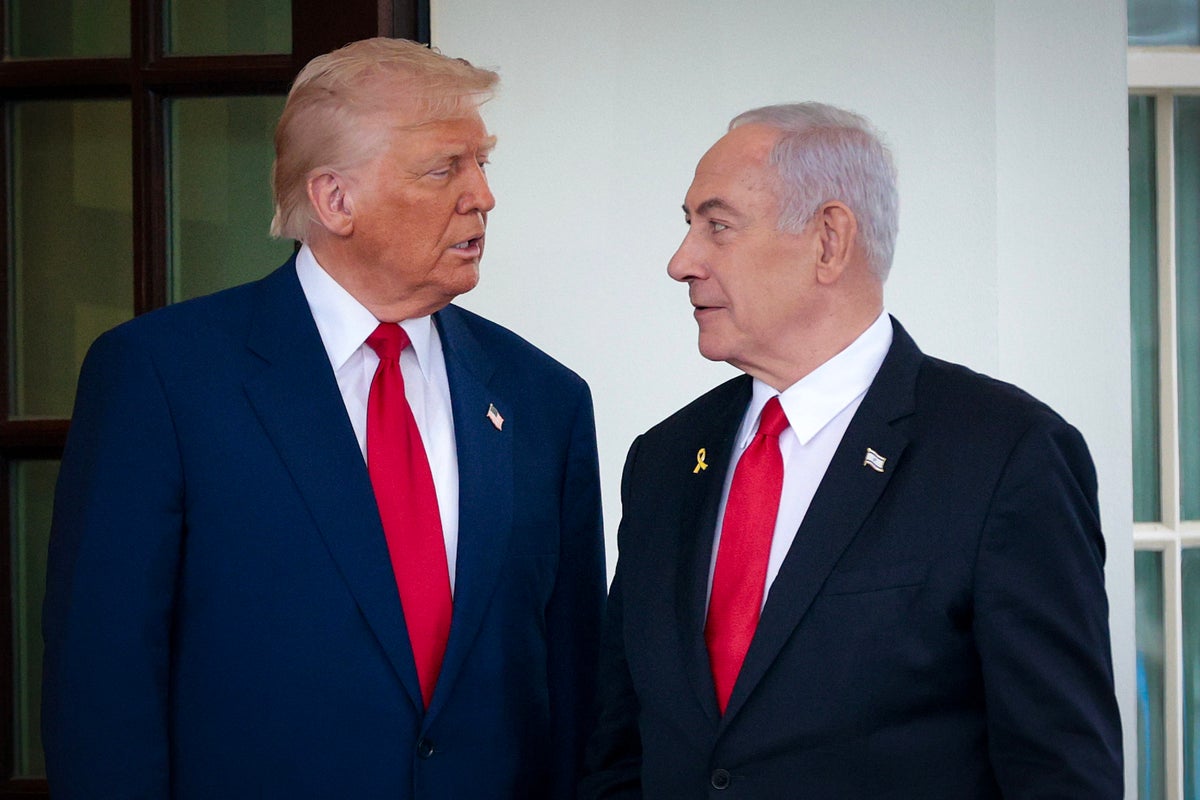
The gold-leafed ceilings of a private club in Florida do not usually feel like a war room. But when Donald Trump and Benjamin Netanyahu sit across from one another, the air changes. It thickens. There is a specific kind of silence that exists between two men who have spent decades perfecting the art of the grand gesture, only to find themselves staring at a map that refuses to obey their commands.
This is not a story about diplomatic white papers or the dry mechanics of a nuclear centrifuge. It is a story about two legacies colliding with a reality that neither can quite bully into submission. They call it "ending the Iran war," but that phrase is a ghost. There is no formal war to end, only a shadow conflict that has bled across four decades, several continents, and thousands of lives.
The problem is that Trump and Netanyahu are looking at two entirely different maps.
The Architect and the Dealmaker
Imagine a high-stakes poker game where one player is betting his house and the other is betting his reputation. Netanyahu is the one with the house on the line. For him, Iran is not a geopolitical puzzle; it is an existential shadow. He sees a future where a nuclear-armed Tehran isn't just a threat—it is the end of the story. His strategy has always been a straight line: pressure, isolation, and, if necessary, the kinetic force of a bunker-buster.
Then there is Trump.
Trump does not view the world through the lens of ancient grievances or eternal struggles. He views it through the lens of the "Great Deal." To Trump, Iran is a failing business that needs to be brought to the table. He wants the victory lap. He wants the photograph of the handshake that "no one else could get." He isn't looking for a thirty-year occupation or a regional transformation. He wants to close the file and move on to the next venture.
This creates a fundamental friction. Netanyahu needs a definitive victory. Trump needs a definitive exit.
The Ghost of 2018
We have been here before. In 2018, the world watched as the United States tore up the JCPOA—the Iran nuclear deal. At the time, it felt like a triumph of shared will. Netanyahu stood before his wall of CDs and files, claiming he had proof of Iran’s nuclear duplicity. Trump provided the muscle. They were in total lockstep.
But look at what happened next.
The "Maximum Pressure" campaign did not result in a new, better deal. It resulted in a more desperate, more aggressive Iran. Today, the Iranian "breakout time"—the period needed to produce enough weapons-grade uranium for a single bomb—has shrunk from months to mere days.
This is where the human element becomes terrifying. Consider a young technician in Natanz or a drone operator in the Revolutionary Guard. These aren't just abstract entities; they are people operating within a system that feels it has nothing left to lose. When you corner a regime, you don't always get a surrender. Sometimes, you get a cornered animal.
Netanyahu looks at those shrinking breakout times and sees a reason to strike. Trump looks at them and sees a reason to bargain before the price goes up. They are walking toward the same door, but they are trying to open it from opposite sides.
The Regional Jigsaw
It isn’t just about Washington and Jerusalem.
In the cafes of Riyadh and the government offices of Abu Dhabi, the mood has shifted. A few years ago, the Gulf states were the loudest cheerleaders for a hard line against Tehran. Now? They are hedging. They have seen what happens when the missiles start flying—their oil refineries burn, their tourist hubs go quiet, and their economies shudder.
The Abraham Accords were supposed to be the foundation of a new, anti-Iran alliance. But the neighbors are tired. They are opening diplomatic channels with Tehran because they’ve realized that while the U.S. might fly its carrier groups home, they have to live next to Iran forever.
If Trump tries to "end" the conflict by making a grand bargain, Netanyahu risks being left out in the cold. If Netanyahu tries to end it by dragging the U.S. into a regional war, Trump risks breaking his core promise to his base: No more "forever wars."
The Invisible Stakes
Think about a family in Haifa or a student in Tehran. For them, the "Iran war" isn't a headline; it's a persistent, low-grade fever. It's the sound of an air-raid siren. It's the skyrocketing price of bread under sanctions.
Netanyahu’s political survival is tethered to his image as "Mr. Security." If he allows Iran to become a nuclear power on his watch, his entire historical narrative collapses. He is incentivized to push for the most extreme outcome because anything less looks like failure.
Trump, conversely, is haunted by the ghosts of Iraq and Afghanistan. He remembers the trillions of dollars spent and the caskets returning to Dover Air Force Base. He has a visceral, almost physical allergy to the idea of a massive military entanglement.
This is the central paradox.
To "end" the threat, you might have to start a war. But to avoid a war, you might have to live with the threat. Netanyahu is willing to gamble on the former. Trump is desperate for a version of the latter that he can sell as a win.
The Red Line Problem
The most dangerous moment in any negotiation is when you realize your partner’s "red line" is actually your "green light."
Netanyahu has drawn a red line at Iranian enrichment. He has signaled, time and again, that Israel will act alone if it must. But an Israeli strike on Iran is not a surgical procedure. It is an earthquake. It would likely involve the mobilization of Hezbollah in Lebanon, thousands of rockets raining down on Tel Aviv, and a global energy crisis.
Trump knows this. He also knows that if Israel strikes, the U.S. is effectively in the war, whether he signed off on it or not. There is no "ending" a conflict that has just entered its most violent phase.
The two men are trapped in a room together. One wants to burn the building down to kill the termites; the other wants to renovate and flip the property.
The Weight of the Crown
There is a psychological exhaustion that sets in after decades of confrontation. You can see it in the eyes of the veterans on both sides. You can hear it in the voices of the diplomats who have spent their careers trying to bridge a gap that seems to widen every year.
The difficulty of ending this together isn't just about policy. It's about the fact that both men are performers who require a specific kind of audience. Netanyahu needs to be the defender of Zion. Trump needs to be the Master of the Universe.
But Iran isn't a stage. It is a country of 88 million people, an ancient culture, and a deeply entrenched, paranoid leadership that has survived decades of isolation. It doesn't follow the script.
Suppose a hypothetical scenario: Trump reaches out to Tehran for a "Grand Bargain 2.0." He offers to lift sanctions in exchange for a permanent freeze on enrichment. It sounds great on a teleprompter. But for Netanyahu, a "freeze" is just a pause button. He knows that knowledge cannot be un-learned. You can’t bomb a scientist’s brain.
The Final Calculation
We often talk about these leaders as if they are playing a game of 3D chess. The truth is much messier. It's more like a game of Jenga played during a hurricane. Every piece they pull out makes the whole structure more precarious.
The "Iran war" will not end with a signed treaty or a decisive explosion. It will end, if it ends at all, through a series of messy, unsatisfying compromises that leave everyone a little bit unhappy and a little bit safer.
But compromise is not in the vocabulary of Mar-a-Lago or the Prime Minister's Office in Jerusalem. They are built for the spectacular. They are built for the definitive.
As they sit in that gold-leafed room, discussing the "end" of a forty-year struggle, the maps on the table continue to shift. The centrifuges continue to spin. The drones continue to fly. And the two men realize that while they can agree on the enemy, they cannot agree on what a world without that enemy actually looks like.
They are holding the matches, but they are arguing over whether to start a fire or light a candle.
One wants a legacy of peace; the other wants a legacy of protection. In the Middle East, you rarely get both. You are lucky if you get either. The real tragedy is that while they debate the "end," the people on the ground—from the Galilee to the suburbs of Isfahan—are just trying to survive the middle.
The sun sets over the Florida coast, casting long, distorted shadows across the patio. The two leaders shake hands for the cameras, a flash of white teeth and expensive suits. But as the cameras turn off, the map remains. It is cold, it is complex, and it is utterly indifferent to the desires of the men who think they own it.
The most difficult part of ending a war is realizing that you might not be the one who gets to write the final chapter.
Would you like me to research the current status of the Iranian nuclear breakout timeline or the latest diplomatic shifts in the Abraham Accords?