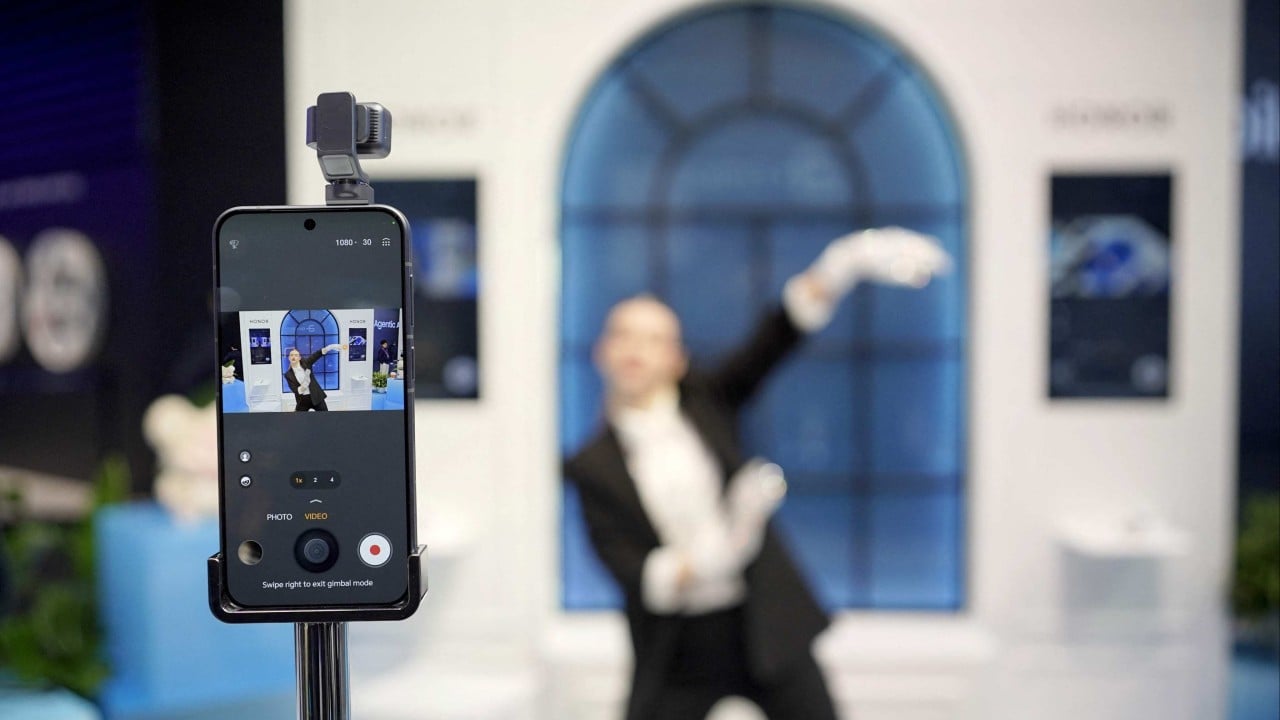
The air inside the Fira Gran Via usually smells of expensive espresso and the ozone of ten thousand recharging lithium batteries. But this year, at Mobile World Congress 2026, the atmosphere is different. It is quieter. There is a specific kind of tension that exists when the future promised by marketing departments slams into the brick wall of global reality.
I stood at a booth where a sleek, titanium-rimmed prototype sat under a spotlight. This was supposed to be the "Year of the Sovereign Agent"—a phone that doesn't just run apps but anticipates your life. It was designed to translate languages in real-time without a cloud connection, to edit video with a whispered command, and to manage your digital privacy with the iron-clad security of local processing.
The demonstrator, a weary-looking engineer named Elias, tapped the screen. The device stuttered. A small spinning wheel appeared. Elias didn't offer the usual polished pitch. He just looked at me and sighed.
"We have the brains," he said, tapping the chassis. "We just don't have the room for them to think."
That sentence captures the invisible crisis of 2026. For three years, the tech industry has told us that Artificial Intelligence would turn our phones into digital extensions of our consciousness. We were promised "On-Device AI" that wouldn't need the internet to be smart. But as the doors opened in Barcelona this week, the buzz felt dimmed, dampened by two harsh truths: the world is literally running out of the memory required to make these phones work, and the geopolitical veins that supply the industry are bleeding.
The Math of a Digital Mind
To understand why your next phone might be a disappointment, you have to look at the silicon.
Think of a standard smartphone like a small desk. You can have a very fast worker (the Processor) sitting at that desk, but if the desk itself is only the size of a postcard, the worker can only handle one piece of paper at a time. That desk is the Random Access Memory, or RAM.
For a phone to run a truly sophisticated Large Language Model (LLM) locally—meaning your data never leaves the device—it needs a massive "desk." We are talking about $16GB$ or $24GB$ of RAM just to keep the AI awake. Most phones currently in your pocket have $8GB$ or $12GB$.
During the height of 2025, manufacturers assumed they could simply scale up. They thought the supply chains would accommodate the hunger for LPDDR5X memory chips. They were wrong. The demand for server-side AI—the massive data centers run by giants like Google and Microsoft—has sucked the oxygen out of the room. The factories that bake these chips are prioritizing the high-margin "brains" for data centers, leaving the mobile industry to scrap for the leftovers.
This is the "Memory Crunch." It is a physical limit on imagination. Because memory costs have spiked by nearly $30%$ in the last fiscal quarter, the dream of an affordable AI phone is dying. Manufacturers are faced with a brutal choice: sell a phone for $$1,500$ that actually works, or sell a $$800$ phone that offers a "lite" version of AI that is, frankly, not very intelligent at all.
The Shadow of the Levant
While the memory shortage is a technical hurdle, the second ghost haunting the halls of MWC 2026 is human.
The Middle East has long been more than just a market for smartphones; it is a critical hub for logistics, investment, and specialized talent. The escalating crisis in the region has sent shockwaves through the maritime corridors of the Red Sea. Shipping a container of components from Shenzhen to Rotterdam now takes longer and costs more than it has in a decade.
But the cost isn't just measured in freight fees.
In one of the quieter keynote lounges, I spoke with a venture capitalist who had spent years funding software startups in Tel Aviv and Dubai. He pointed to his tablet, which showed a heat map of venture capital flow. The red zones were expanding.
"AI development is a collaborative sport," he told me. "When borders close and regional stability collapses, you don't just lose customers. You lose the engineers who were writing the code for the next generation of voice recognition. You lose the data scientists who were refining the ethics of these models."
The "AI Smartphone" was marketed as a tool for global connection. There is a bitter irony in watching its launch be hobbled by global fragmentation. The supply chains are brittle. A single disruption in a shipping lane or a redirected flight path for a cargo jet can delay a product launch by months. At MWC, several major "Hero" devices—the phones meant to define the year—were conspicuously absent, replaced by placeholder "Coming Soon" placards.
The Hidden Architecture of Expectation
We are living through a correction.
For the last eighteen months, the narrative has been one of exponential growth. We were told that $Moore's Law$ would somehow bridge the gap between a laptop's power and a pocket-sized device's heat dissipation.
$$P = C \cdot V^2 \cdot f$$
The physics of power consumption ($P$) in a chip, where $C$ is capacitance, $V$ is voltage, and $f$ is frequency, doesn't care about marketing hype. To run the math required for a trillion-parameter model, a phone generates heat. To manage that heat, you need space. To have space, you need a bigger phone. To power that phone, you need a bigger battery.
We are hitting a plateau where the hardware can no longer keep up with the software's ambition. This is the first time in the smartphone era where our dreams have outpaced our ability to manufacture them.
Consider a hypothetical user, Sarah. Sarah is a freelance journalist who bought into the promise of the AI phone. She wants a device that can record an interview in a crowded cafe, strip out the background noise, transcribe the text, and summarize the key points—all while she’s on the subway with no signal.
In 2024, this was a demo. In 2026, it should be reality.
But because of the memory crunch, Sarah’s phone has to "swap" data. It moves information from the fast RAM to the slower storage. The result? The transcription lags. The summary is riddled with hallucinations because the model had to be "quantized" or compressed so much that it lost its nuance. Sarah doesn't care about global memory markets or Red Sea shipping lanes. She only knows that her expensive new tool feels broken.
The Pivot to Subscriptions
Walking through the stalls of the smaller vendors, a new strategy is emerging. It is a pivot born of desperation.
Since they cannot afford to put $24GB$ of RAM in every phone, companies are moving back to the cloud. They are rebranding it, of course. They call it "Hybrid Intelligence."
In reality, it is a admission of defeat.
By moving the "thinking" back to a server, companies can sell you a cheaper phone with less memory. But there is a catch. The cloud isn't free. To offset the massive electricity and hardware costs of running these AI servers, manufacturers are introducing "AI Tiers."
- The "Basic" tier gives you simple spellcheck.
- The "Pro" tier gives you the creative tools you actually want.
- The "Enterprise" tier gives you the privacy you were originally promised.
The smartphone is no longer a product you own; it is a portal to a service you rent. This shift was the unspoken theme of MWC 2026. The hardware has become a vessel for a monthly bill.
The Fragility of the Shiny
On the final day of the congress, the sun hit the glass facade of the Fira, making the whole complex look like a shimmering mirage. Inside, people were still clutching their badges, still networking, still trying to find the "Next Big Thing."
But the "Next Big Thing" isn't a foldable screen or a camera with a $200x$ zoom. The real story of 2026 is the realization that the digital world is inextricably tied to the physical one.
We forgot that "The Cloud" is actually made of silicon, copper, and cooling fans. We forgot that the "Global Village" depends on peaceful waters and open ports.
The AI smartphone buzz didn't just dim because of a lack of innovation. It dimmed because the infrastructure of our modern world is showing its age. We have built a penthouse of software on a foundation of crumbling hardware and volatile politics.
I went back to Elias's booth before leaving. He was packing up his prototype. He handled it with a strange mix of reverence and frustration. It was a beautiful object, a masterpiece of engineering, yet it was functionally a paperweight without the chips that the world had decided to send elsewhere.
"It's like building a Ferrari," he said, "but the only road available is a dirt path through a storm."
The miracle of the smartphone was never just the screen or the chip. It was the fluke of a stable world that allowed us to mass-produce miracles. As that stability wavers, the devices in our pockets feel less like windows to the future and more like mirrors reflecting our current limitations.
The silence at MWC 2026 wasn't the sound of an industry dying. It was the sound of an industry holding its breath, waiting for the physical world to catch up with the digital one. Until then, the "AI Revolution" remains a high-resolution dream deferred by the stubborn reality of a shortage in memory and a surplus of conflict.
The phone in your hand is only as smart as the world that allows it to be built.


