Every time a paleontology team unearths a handful of fragmented vertebrae in a remote corner of the world, the media apparatus runs the exact same playbook. They dust off the "largest ever" template, find a quirky local metric for comparison—like a cricket pitch, a double-decker bus, or a Boeing 747—and declare a monumental breakthrough.
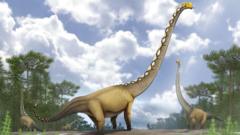
The recent discovery of a long-necked sauropod in Thailand, heralded as a massive leap forward in our understanding of prehistoric life because its neck stretched the length of a cricket pitch, is a masterclass in this kind of lazy science communication. Learn more on a related topic: this related article.
We are obsessed with scale. We treat paleontology like the Guinness Book of World Records, valuing fossils solely by how much dirt they displaced or how many headlines they can generate.
But if you look at the actual taphonomic and biomechanical data, this obsession with crown-jewel giants isn't just exhausting. It is actively distorting our understanding of evolutionary biology. Additional analysis by The Washington Post explores related perspectives on this issue.
The Fragmentary Fallacy of the Megasauropod
Let us start with the uncomfortable truth that museums and university PR departments hate to admit: we almost never find whole giants.
When a paper claims a newly discovered dinosaur had a neck measuring 20 meters, they are rarely measuring 20 meters of fossilized bone. Instead, they are looking at two and a half highly distorted cervical vertebrae, a partial femur, and perhaps a rib fragment. They run these meager findings through scaling equations based on entirely different species found thousands of miles away, and then they export a highly speculative digital model to the press.
In paleontology, this is known as the fragmentary taxon trap.
[Three Vertebrae Found] ---> [Scaled Against Distant Species] ---> [20-Meter Speculative Press Release]
This is not a robust scientific methodology; it is educated guesswork wrapped in statistical optimism. When we estimate the total mass and length of a creature from less than 10% of its skeleton, the margin of error is massive. A 5% variance in the vertebral scaling formula can alter the estimated length of an animal by several meters and its estimated weight by tens of tons.
By treating these maximum-end estimates as established facts, the public receives a cartoonish caricature of the Mesozoic era. We are led to believe the ancient world was populated exclusively by impossibly massive giants walking on pristine, gravity-defying frames, rather than biological organisms bound by the harsh realities of physics and resource limits.
The Biomechanical Lie of the "Cricket Pitch" Neck
The "cricket pitch" neck comparison makes for a great headline. It makes for terrible biology.
In the real world, biological structures are constrained by the laws of thermodynamics, material science, and fluid dynamics. To support a neck of that length, a sauropod requires specialized adaptations that the standard "giant lizard" narrative completely glosses over:
- Pneumatization: The bones must be more air than calcium. Sauropod cervical vertebrae were highly hollowed out, resembling fragile honeycomb structures rather than solid rock.
- The Siphon Problem: Pumping blood up a vertical column of that height requires a cardiovascular system operating at pressure levels that would rupture human arteries.
- The Lever Arm Paradox: The muscular and ligamentous support required to prevent a horizontal neck of that length from collapsing under its own weight requires immense anchoring points over the dorsal vertebrae.
P = \rho \cdot g \cdot h
The hydrostatic pressure ($P$) required to pump blood to the brain of a sauropod with its head held high is directly proportional to the fluid density ($\rho$), gravitational acceleration ($g$), and the vertical height ($h$) of the column. If these animals actually held their heads as high as the popular renderings suggest, their systemic blood pressure would need to be upward of $400 \text{ mmHg}$.
When we obsess over the sheer length of these necks, we ignore the much more fascinating evolutionary trade-offs. These creatures were not majestic statues. They were highly specialized, biological vacuum cleaners. Their long necks allowed them to sweep vast swathes of vegetation without moving their massive, energy-expensive bodies. It was an exercise in extreme energy conservation, not a circus act.
Why the Obsession with "Biggest" is Killing Real Science
By channeling funding, media attention, and academic prestige almost exclusively toward the largest specimens, we ignore the real story of evolution.
The true engines of evolutionary change are not the outliers. They are the mid-sized generalists, the ecological transitionals, and the micro-fossils.
"I have watched university departments spend hundreds of thousands of dollars excavating and prepping a single, heavily eroded femur of a known sauropod species simply because it looked good in a donor brochure, while crates of exquisite micro-vertebrate fossils from the same site sat in basement storage, unstudied and uncataloged."
If you want to understand how ecosystems collapse and recover, you do not look at the giants. You look at the soil, the pollen, the small lizards, and the early mammals. The giants are the first to die when the environment shifts even a fraction of a degree. They are evolutionary dead-ends—highly specialized, fragile, and utterly dependent on hyper-stable, high-energy ecosystems.
By focusing on the giants, we train the public to view paleontology as a treasure hunt rather than a historical science. We value the gold doubloon (the giant bone) over the ship's logbook (the stratigraphic context).
Redefining the Prehistoric Picture
If we want to rescue paleontology from the grip of PR-driven sensationalism, we must change how we talk about discoveries.
We must stop using lazy, scale-based metrics. We need to replace them with deep ecological context. The value of the new Thai sauropod is not that its neck could stretch across a sports pitch. Its value lies in what its presence tells us about the paleoclimate of Southeast Asia during the Late Jurassic or Early Cretaceous.
It tells us about the distribution of flora, the migration corridors across ancient continents, and the localized evolutionary pressures that allowed such specialized gigantism to emerge in that specific region.
Let the media keep their cricket pitches and their double-decker buses. The real science is happening in the microscopic details of the bone histology, the geochemical signatures locked within the enamel of ancient teeth, and the painstaking, unglamorous work of reconstructing lost worlds from the bottom up.
We do not need bigger dinosaurs. We need better questions.