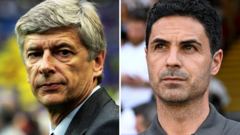
The rain in north London always smells the same. It is a mix of damp concrete, spilled lager, and fried onions wafting from vans parked along the Holloway Road. If you stood outside the Emirates Stadium on a wet Tuesday night in 2026, you could easily close your eyes and convince yourself it was 2006.
But then you open your eyes. You might also find this connected story insightful: The Five-Iron Frustration and the Quiet Tech Revolution on London’s Edge.
The concrete underfoot is smoother now. The stadium is a towering glass bowl, no longer the shiny new spaceship that had just landed to replace the Art Deco red-brick warmth of Highbury. Twenty years have evaporated. Two decades of scar tissue, near-misses, banter-era memes, and tactical revolutions separate two distinct versions of the same football club.
If you forced them to play each other—the romantic, tragic losers of 2006 and the cold, suffocating winners of 2026—who actually walks away with the ball? As extensively documented in latest reports by FOX Sports, the implications are notable.
It is a thought experiment that forces us to choose between two entirely different philosophies of human achievement. One was built on individual genius and a fragile, beautiful arrogance. The other is a marvel of hyper-optimized collective engineering.
The Fragile Gods of Highbury’s Twilight
To understand the 2006 team, you have to understand the specific ache of that year. Arsenal had reached the Champions League final in Paris, only to have their goalkeeper sent off after eighteen minutes, leading the match until the dying embers, and ultimately watching Barcelona lift the trophy. It was the end of an era. The Invincibles were splintering.
That team played football as if they were trying to compose poetry on the fly.
Think of Jens Lehmann in goal. A man who seemed to operate on a permanent axis of pure adrenaline and mild insanity. He was capable of saving a penalty in the semi-final against Villarreal through sheer force of will, yet equally liable to get sent off on the grandest stage of his life.
Ahead of him stood Sol Campbell and Kolo Touré. Campbell was a mountain of a man, carrying the physical weight of a brutal English league, while Touré was all recovery pace and heart. They were protected by Gilberto Silva, the "invisible wall."
But the magic—the reason adults now in their late thirties still get misty-eyed over a specific shade of O2-sponsored maroon jersey—lay in the final third.
Robert Pires was gliding down the left, socks rolled down to his ankles, running with that strange, duck-like gait that somehow baffled the best full-backs in Europe. Cesc Fàbregas, a teenager with a mullet and the vision of a seasoned chess grandmaster, was dictating the tempo of games against men ten years his senior.
And then, there was Thierry Henry.
To watch Henry in 2006 was to watch an athlete at the absolute zenith of his powers. He did not just score goals; he chose how to score them to maximize the psychological damage to the opposition. He would drift to the left flank, pick up the ball, open his body, and stroke it into the far corner with a casual elegance that felt almost insulting to the defender tracking him.
That team was a collection of soloists. When the harmony worked, it was breathtaking. When one instrument went out of tune, the whole composition collapsed. They finished fourth in the Premier League that year, a massive twenty-four points behind Chelsea. They were flawed. They were human.
The Silicon Valley of the Premier League
Now, walk twenty years down the timeline. Flush out the nostalgia. Wipe away the romance.
The Arsenal of 2026 is an entirely different beast. Under Mikel Arteta, the club has been remade in the image of a high-frequency trading firm. Every blade of grass is accounted for. Every movement is calculated. If the 2006 team was jazz, the 2026 team is a flawless techno set, relentless and perfectly timed.
David Raya stands between the posts. He doesn't possess Lehmann’s theatrical madness; instead, he has the cold, calculating precision of a quarterback. His value is measured as much by his passing accuracy into the half-spaces as it is by his shot-stopping.
In front of him is a defensive wall that makes the 2006 backline look porous. William Saliba and Gabriel Magalhães do not just defend; they erase strikers from the game. They play with a terrifying physical serenity. Saliba, in particular, moves with a calm that suggests he already knows what the forward is going to do three seconds before the forward thinks of it.
Where the 2006 team looked to express themselves, the 2026 team looks to control.
Declan Rice provides a physical presence in midfield that Gilberto Silva could only dream of matching in terms of sheer ground covered. Martin Ødegaard, the captain, presses with the intensity of a man possessed, directing his teammates with frantic hand gestures, a conductor who demands absolute synchronization.
And on the right wing, Bukayo Saka carries the emotional weight of the club. He lacks Henry’s arrogant swagger, but he replaces it with an unstoppable, repetitive efficiency. You know he wants to cut inside on his left foot. The defender knows he wants to cut inside on his left foot. The seventy thousand people in the stadium know it. It doesn’t matter. He still finds the corner.
The Ultimate Direct Comparison
Let us look at how these eras collide when we try to assemble a single, definitive eleven. This is where the nostalgia breaks against the hard reef of modern sports science.
                  Lehmann / Raya

   Lauren    Saliba    Campbell    Cole

   Saka      Fàbregas  Rice        Pires

             Bergkamp  Henry
Consider the right-back position. In 2006, you had Lauren, a fierce, uncompromising warrior who converted from a midfielder into a top-tier defender through sheer grit. In 2026, Ben White plays the role with an aloof, deeply modern excellence, overlapping, underlapping, and treating the sport like a highly lucrative nine-to-five job he happens to be world-class at executing. Lauren gives you soul; White gives you structural integrity.
Left-back is a easier conversation. Ashley Cole in 2006 was arguably the best in the world in his position—a relentless engine who could lock down Cristiano Ronaldo and still provide an overlapping threat for Pires. The 2026 iterations, rotating through Jurriën Timber or Riccardo Calafiori, offer tactical flexibility inverted into midfield, but they lack the pure, orthodox dominance that Cole brought to that flank.
The midfield battle is where the philosophical war is won or lost.
A pairing of 2006 Cesc Fàbregas and 2026 Declan Rice is a dream born in football heaven. Fàbregas provides the imagination, the defense-splitting passes that defy geometry. Rice provides the steel, the athletic engine to cover for Cesc’s physical limitations.
But what happens when you have to choose between Dennis Bergkamp at thirty-six, playing his final, sunset season in 2006, and the modern output of Martin Ødegaard? Bergkamp is a statue in the minds of Arsenal fans, a man who controlled the ball as if it were an extension of his own foot. Yet, the sheer volume of high-intensity running and creative output Ødegaard produces in the modern game is something the 2006 squad simply wouldn't recognize.
The Invisible Stakes of the Timeline
We tend to look back at twenty years ago through a golden lens. We forget the nights Arsenal went away to places like Blackburn or Bolton and got bullied off the pitch. We forget the tactical rigidity of a 4-4-2 formation that was slowly being figured out by Jose Mourinho’s three-man midfields at Chelsea.
Modern football is faster. The pitches are carpets. The balls are lighter. The tactical preparation is microscopic. A single mistake in 2026 is parsed by a dozen analysts before the players even reach the dressing room at half-time.
If you dropped the 2006 team into a match against the 2026 team under modern refereeing guidelines, the physical superiority of the current squad would likely overwhelm the past. The sheer intensity of the 2026 press would deny Fàbregas the time to look up. It would starve Henry of space.
Yet, there is an intangible quality that data cannot track.
The 2006 team possessed a collective arrogance born from having recently been undefeated. They knew how to win when the system broke down. When the tactics failed, Henry could simply decide to take the ball from the halfway line at the Santiago Bernabéu, beat four Real Madrid defenders, and slot it home.
The 2026 team is magnificent, but their goals feel like the result of an algorithm working correctly. A corner routine worked on for sixty hours at the training ground. A turnover forced in the opposition half after a coordinated press. It is effective. It wins titles. But does it make your heart leap into your throat in quite the same way?
The Verdict Written in Concrete
Standing outside the stadium as the crowds disperse into the London night, the conversation among fans never truly changes. The older generation talks about what was lost when the club moved from Highbury—the intimacy, the feeling that you could hear the players drawing breath. The younger generation talks about Expected Goals, transition phases, and squad depth.
If a manager were handed a contract today and told he had to win a single match to save his life, he would choose the 2026 team. They are safer. They are a machine designed to minimize variance. They do not allow chaos into their box.
But if you asked that same manager what match he would want to watch the night before he died, he would choose 2006.
He would want to see Henry tilt his head, accelerate past a helpless defender, and curf the ball into the net, just one more time, while the old North Stand roared into the dark.